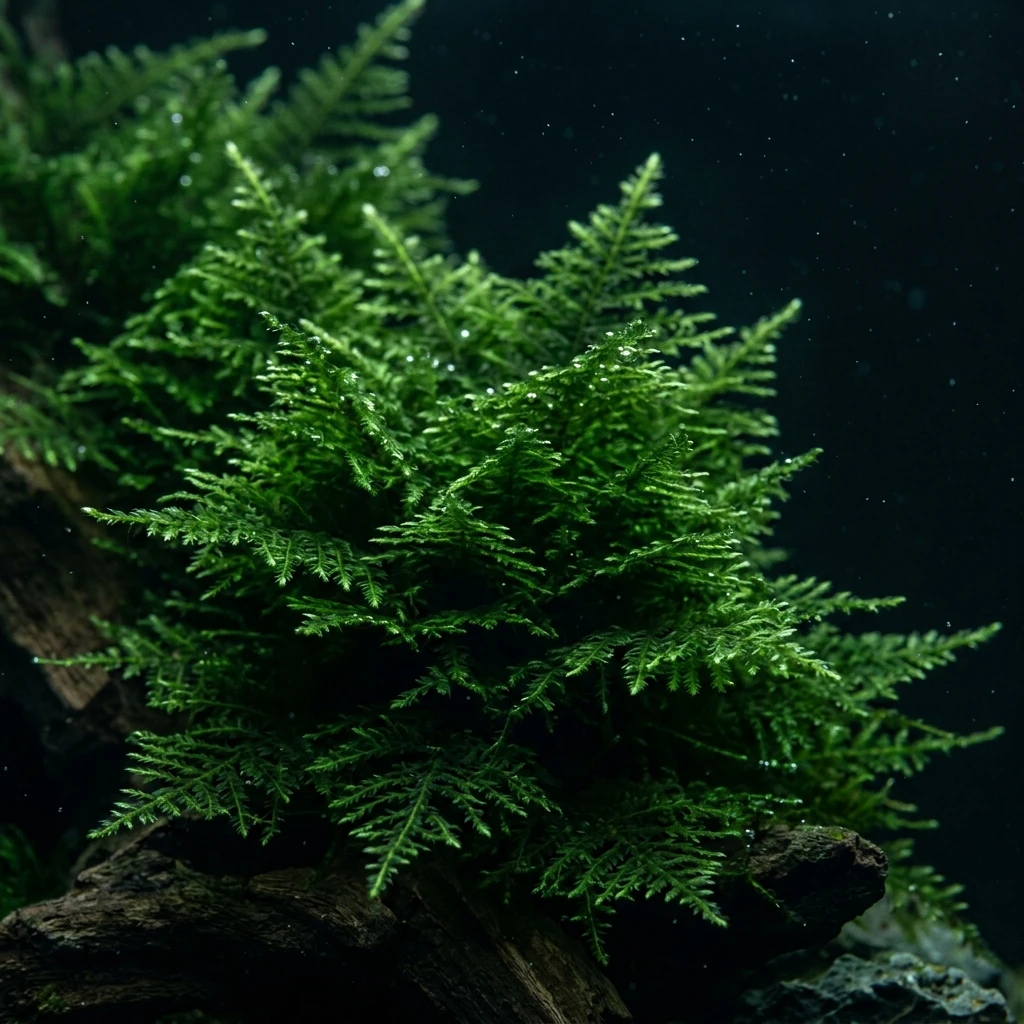
Christmas Moss
Scientific Name: Vesicularia montagnei
Christmas Moss is an exceptionally popular, highly popular vertical aquatic moss native to tropical Southeast Asia. Famed for its gorgeous, dense pinnate fronds that branch symmetrically in the shape of perfect equilateral triangles, it resembles a miniature evergreen forest of Christmas trees. Grown on hardscape, it forms highly textured, weeping green walls.
Lighting Needs
Low to Moderate
Water Parameters
Aquatic (pH 6.0-7.8)
Optimal Substrate
Epiphytic (Driftwood / Rock)
Hardy Temperature
15°C - 26°C
Toxicity Level
Pet Friendly (Non-toxic)
How to Identify Christmas Moss
Use our structural morphological markers to verify the identity of your Christmas Moss in any local nursery or wild wetland:
-
✔
Overall Visual Shape: Highly dense vertical fronds with perfect equilateral triangular pinnate structures resembling Christmas trees.
-
✔
Leaf Morphology: Fine, scale-like round pinnate leaves arranged symmetrically in flat, wide triangle branches.
-
✔
Root & Anchoring Structure: Rootless; develops fine brown anchoring rhizoids that attach tightly to hardscape crevices.
Complete Cultivation & Spawning Guide
Follow our detailed scientific water parameters and care guides to keep your Christmas Moss thriving.
pH: 6.0 - 7.8, GH: 3 - 15 dGH. Extremely resilient, adapting easily to soft or hard water conditions.
Low. Grows perfectly without pressurized CO2, though carbon injection induces faster growth and thicker stems.
Low to Moderate. High intensity light will coat its slow-growing leaves with green spot algae.
Cut off old, yellowing, or damaged leaves at the base of the stem. Clean dead organic debris to prevent siltation.
An water-column feeder. Relies on liquid macro and micro nutrients; substrate fertilizers are ineffective.
Do not bury in soil! Tie or glue the moss onto driftwood or rocks. Submerging rhizoids in soil will rot the plant.
Optimal temperature is 15°C to 26°C (59°F - 78.8°F). Sensitive to heat; starts turning brown and rotting above 28°C.
Requires steady water circulation. Good current prevents organic waste and algae spores from landing on delicate fronds.
Its tough, bitter leaves are completely fish-proof. Provides excellent hiding places for shrimp and breeding fish.
Slow growth makes it susceptible to hair algae. Keep water clean and employ Siamense Algae Eaters or Amano shrimps.
Attach to midground rocks or roots. Leave spacing of 3 to 4 inches from neighboring clumps to allow perfect spread.
Common Diseases & Treatment
🚨 Frond Browning (High Temp)
Common Cause: Moss fronds turn pale brown, dry up, and die in the water column.
Professional Cure: Caused by high water temperatures above 28°C. Lower water temperature using a chiller or fan immediately.
🚨 Filamentous Algae Choking
Common Cause: Delicate moss fronds get choked by green hair or thread algae, suffocating the plant.
Professional Cure: Prune infected areas. Introduce Amano shrimp and balance nitrates/phosphates to starve the algae.
Frequently Asked Questions
❓ Why is it called Christmas Moss?
The name comes from its highly unique triangular, pinnate branching pattern, which makes its drooping fronds look exactly like miniature, layered green Christmas trees.
❓ How do I attach it to rocks?
Spread a thin layer of moss onto the stone or wood surface, and secure it tightly using dark sewing thread, clear fishing line, or small drops of superglue gel.
❓ What is the difference between Christmas Moss and Java Moss?
Christmas Moss has highly structured, symmetrical, flat triangular fronds that droop downward, whereas Java Moss grows in a messy, unstructured, upright vertical fashion.
❓ Does it require CO2?
No. Christmas Moss is exceptionally hardy and can easily survive in low-tech setups. However, pressurized CO2 makes it grow much faster, thicker, and more brilliantly triangular.