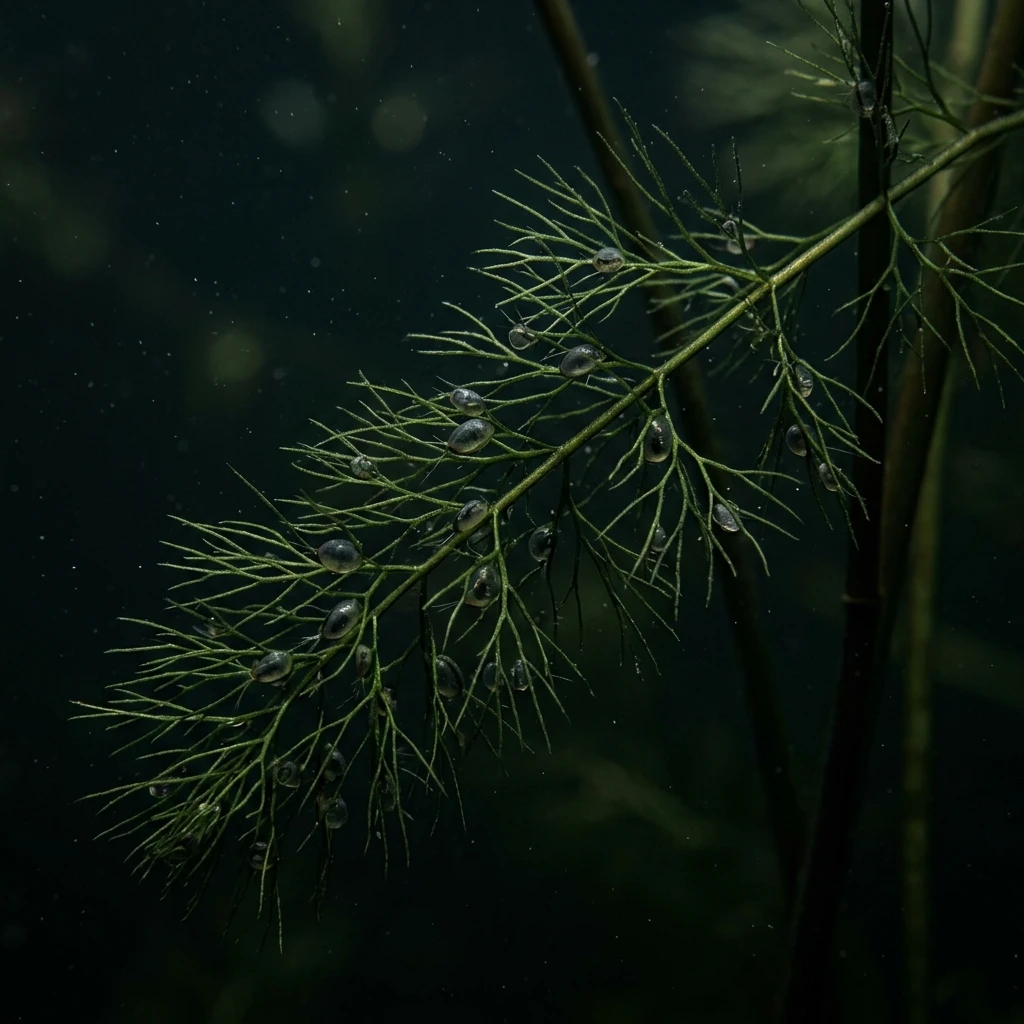
Bladderwort
Scientific Name: Utricularia vulgaris
Bladderwort is an exceptionally unique, floating carnivorous liverwort species native to calm ponds across Europe, Asia, and North America. Celebrzed for its spectacular, thread-like feathery stems equipped with hundreds of tiny hollow trapping bladders, it traps micro-organisms via vacuum suction. Rootless and free-floating, it acts as a gorgeous architectural midground addition.
Lighting Needs
Moderate to High
Water Parameters
Aquatic (pH 5.5-7.5)
Optimal Substrate
Floating (Rootless)
Hardy Temperature
15°C - 28°C
Toxicity Level
Pet Friendly (Non-toxic)
How to Identify Bladderwort
Use our structural morphological markers to verify the identity of your Bladderwort in any local nursery or wild wetland:
-
✔
Overall Visual Shape: Whimsical floating network of thread-like feathery stems with hundreds of tiny hollow trapping bladders.
-
✔
Leaf Morphology: Finely divided capillary thread-like olive-green leaves arranged along creeping, rootless floating stems.
-
✔
Root & Anchoring Structure: Completely rootless; floats freely on the surface or mid-water column, absorbing nutrients carnivorously.
Complete Cultivation & Spawning Guide
Follow our detailed scientific water parameters and care guides to keep your Bladderwort thriving.
pH: 5.5 - 7.5, GH: 3 - 15 dGH. Adapts easily to soft, slightly acidic, or moderately hard freshwater setups.
Low. Grows perfectly without pressurized CO2, though supplemental carbon enhances leaf thickness and size.
Moderate to High. Intense full-spectrum lighting keeps the fine comb leaves tight, preventing lower leaf decay.
Clip old, decaying, or leggy fronds at the base. Harvest baby plantlets that form on leaf margins to multiply.
An water-column feeder. Relies on liquid macro and micro nutrients; substrate fertilizers are secondary.
Completely rootless floating plant. It requires no soil or substrate whatsoever; roots hang freely to absorb water nutrients.
Optimal temperature is 15°C to 28°C (59°F - 82.4°F). Exceptionally cold hardy; survives outdoor pond freezing.
Requires gentle to moderate current. Too strong current will break the delicate feathery stems.
Its microscopic traps are completely harmless to community fish, shrimp, and large fry. Offers superb hiding spots.
Fast growth makes it a brilliant nutrient sponge, starving out hair algae. Clean debris using cherry or Amano shrimps.
Best attached to midground rocks or roots. Leave spacing of 3 to 4 inches from neighboring clumps to allow perfect spread.
Common Diseases & Treatment
🚨 Trap Necrosis (Starvation)
Common Cause: The tiny hollow trapping bladders turn dark black, shrivel, and drop off the thread stems.
Professional Cure: Caused by complete lack of microscopic prey in sterile tanks. Introduce copepods or live daphnia to restore health.
🚨 Filamentous Algae Entanglement
Common Cause: Thread stems get choked by green hair or thread algae, suffocating the plant.
Professional Cure: Prune infected areas. Introduce Amano shrimp and balance nitrates/phosphates to starve the algae.
Frequently Asked Questions
❓ How does Bladderwort trap bugs?
Each bladder has trigger hairs near a one-way trapdoor. When micro prey touches the hair, the trapdoor snaps open in 1 millisecond, sucking in the prey and water via vacuum force.
❓ Does it eat baby shrimp or fry?
No. Submerged traps are extremely tiny (under 0.15 inch), capable of capturing only microscopic water bugs like infusoria, paramecia, and copepods. It is 100% safe for baby shrimp and fry.
❓ Is it an invasive weed?
In nature it spreads fast, but in an aquarium, it can be easily kept in check by regular pruning or using a fish net to scoop out excess clumps.
❓ Does it require soil to grow?
No. Utricularia vulgaris is completely rootless and floats freely in the water column, absorbing all its nutrients directly from the water and prey.