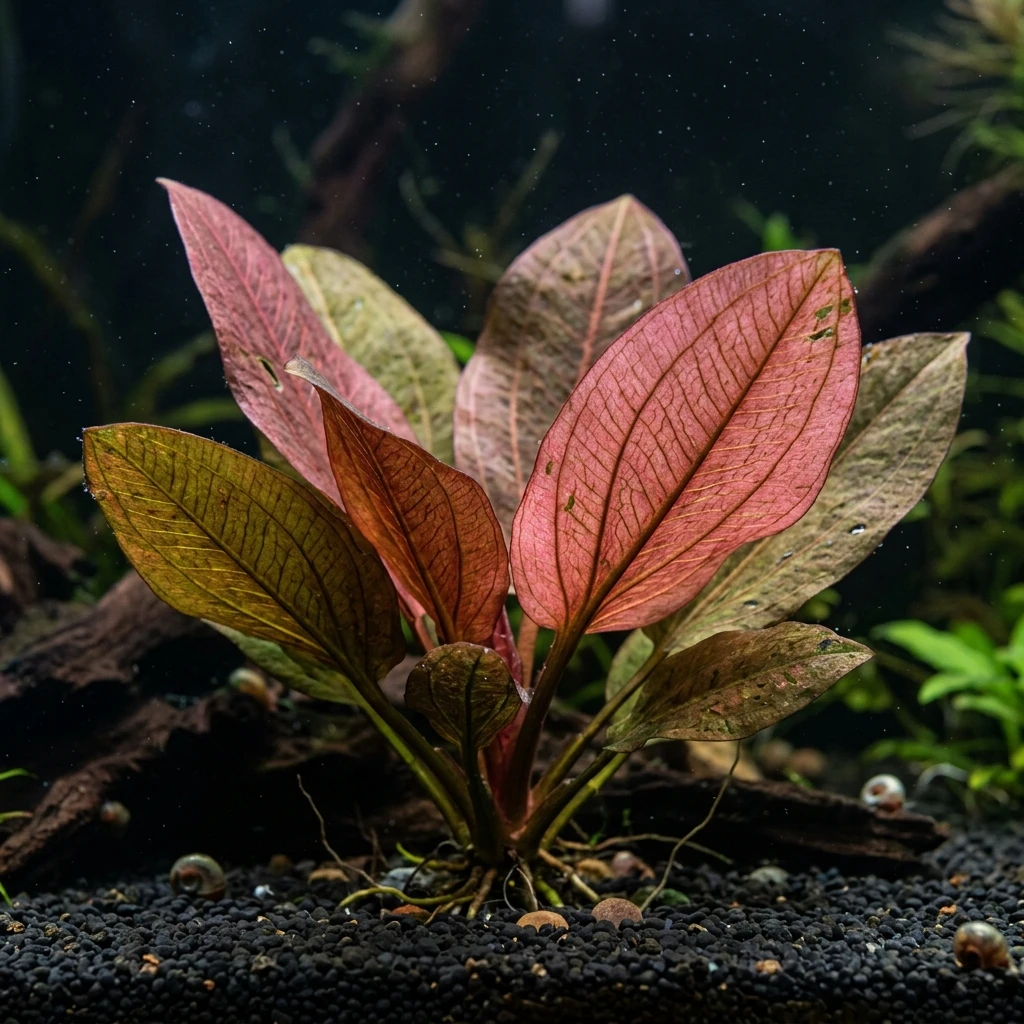
Echinodorus 'Red Melon'

Red Melon Sword Growing & Care Guide

Red Melon Sword is a gorgeous, broad-leaved hybrid celebrated for its spectacular watermelon-red young leaves that gracefully transition to dark-green. Thriving under moderate light and rich substrate nutrients, it serves as a stunning midground focal point in large community community setups.

Lighting Icon
Lighting Moderate Light
Water Hardness Icon
Water Hardness Aquatic (pH 6.5-7.5)
Substrate Icon
Substrate Nutrient-rich clay/soil
Temperature Icon
Water Temp 20°C - 28°C
Toxicity Warning Icon
Toxicity Pet Friendly (Non-toxic)
Botanical macro photography of Red Melon Sword (Echinodorus 'Red Melon') - Plant AI care database

How to Identify Red Melon Sword

Red Melon Sword (Echinodorus 'Red Melon') has key botanical markers. Recognizing these features is crucial for successful aquascaping and thriving growth.

  • Visual Shape & Growth: Upright rosette of sword-shaped reddish-green leaves rising from a central crown.
  • Leaf Morphology: Large, lance-shaped bright-green leaves (up to 12-20 inches tall) with prominent longitudinal veins.
  • Root & Anchoring Structure: Extremely large, dense white root system designed to absorb massive substrate nutrients.
💡 Plant AI Tip: Take a photo with Plant AI to identify aquatic weeds and diagnose fungal spot diseases in 1 second.

Complete Cultivation & Spawning Guide

Follow our detailed scientific water parameters and care guides to keep your Red Melon Sword thriving.

pH: 6.5 - 7.5, GH: 4 - 15 dGH. Adapts well to soft or moderately hard water. High nitrates are absorbed rapidly.
Low. Grows perfectly without pressurized CO2, though supplemental carbon accelerates leaf growth and rosette size.
Moderate light. Too high light triggers spot algae on the broad leaf surfaces; too low light stunts leaf vertical growth.
Cut old, yellowing, or algae-covered outer leaves at the very base of the crown. Never prune leaves in half.
A heavy root feeder. Water column fertilization is helpful, but substrate feeding with root tabs is mandatory.
Requires a deep sand or gravel bed (at least 3 inches) to accommodate its massive root network. Feed heavily with root tabs.
Optimal temperature is 20°C to 28°C (68°F - 82°F). Sensitive to severe cold shocks below 15°C.
Enjoys moderate current. Steady water flow delivers carbon and trace minerals directly to its broad foliage layers.
Extremely cichlid-proof and goldfish-proof due to its tough, fibrous leaf structure. Safe for community setups.
Broad leaves easily gather Green Spot Algae. Employ large Nerite snails or Bristlenose plecos to graze leaves.
Best placed in the background. Space rosettes at least 4 to 5 inches apart to accommodate their massive foliage spread.

Are your Red Melon Sword leaves turning green, pale or melting?

Dose substrate root tabs immediately, ensure adequate iron, and prune dead outer leaves.

Diagnose My Aquatics

Common Diseases & Treatment

Iron Deficiency (Chlorosis)

Symptoms: New leaves at the center of the crown turn pale green, yellow, or translucent white.

Action: The classic sign of iron deficiency. Insert iron-rich root tabs near the crown immediately.

Potassium Deficiency

Symptoms: Mature leaves develop tiny, dark-rimmed holes that grow larger, causing the leaf to drop.

Action: Dose water column potassium sulfate or comprehensive liquid fertilizer weekly.

Frequently Asked Questions

Why is my Red Melon Sword turning green?

Red Melon Sword turns green under low light. Strong light and comprehensive liquid iron dosing are key to develop and maintain its iconic bright red leaf color.

Can I trim the leaves if they grow too long?

While you can trim them, cutting a leaf blade will cause the rest of the leaf to decay. It is best to prune the entire leaf from the crown base.

How do I plant Red Melon Sword correctly?

Dig a small hole in the gravel, place the roots in, and cover them. Then, gently pull the plant upward until the green crown base is visible.

How fast does it grow?

Under moderate light and nutrients, it is a moderate grower, typically producing one new leaf every 7 to 10 days.

Master advanced aquascaping. Start today!

Get Started for Free