Crystalwort Growing & Care Guide
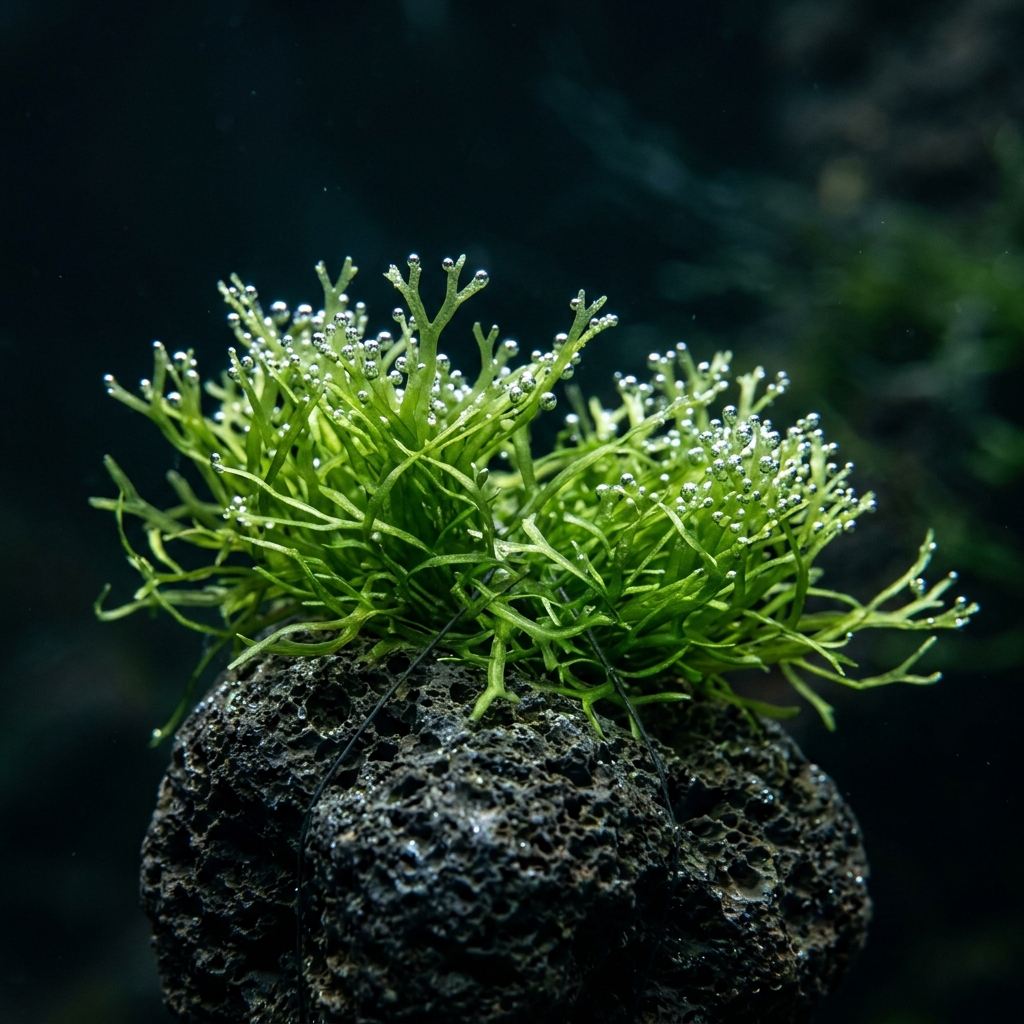
Crystalwort, or Riccia Fluitans, is an exceptionally unique, bright green liverwort species native to temperate regions globally. Celebrated by legendary aquascaper Takashi Amano for its spectacular pearling ability, it features rules-based Y-shaped branching leaves that trap thousands of tiny oxygen bubbles, forming glowing, crystal-like underwater carpets when bound to stones.





How to Identify Crystalwort
Crystalwort (Riccia fluitans) has key botanical markers. Recognizing these features is crucial for successful aquascaping and thriving growth.
-
✔
Visual Shape & Growth: Glowing, bright green vertical clumps of Y-shaped branching flat leaf ribbons.
-
✔
Leaf Morphology: Unique, rules-based Y-shaped (dichotomous) branching flat green leaf ribbons (approx. 0.1 inch wide) without roots.
-
✔
Root & Anchoring Structure: Completely rootless; relies on external mesh, line, or glue to remain bound to hardscape.
Complete Cultivation & Spawning Guide
Follow our detailed scientific water parameters and care guides to keep your Crystalwort thriving.
Common Diseases & Treatment
Clump Detachment (Floating)
Symptoms: The thick green mat detaches from the stone and floats to the surface, rotting at the bottom.
High Temp Decay
Symptoms: Branching ribbons turn pale yellow-brown and dissolve in warm water above 28°C.
Frequently Asked Questions
Q: Why is my Crystalwort floating?
A: Riccia fluitans is naturally a floating plant without roots. When grown submerged, it must be regularly wrapped onto rocks using line or mesh; otherwise, as it grows thicker, it will float away.
Q: How do I trigger its famous pearling?
A: Provide moderate to high lighting, regular comprehensive liquid fertilization, and constant pressurized CO2. The Y-shaped tips will trap thousands of silver bubbles.
Q: How do I prune Riccia correctly?
A: Prune regularly using sharp curved aquascaping scissors to keep the mat thin (under 0.8 inches) to prevent the bottom layer from dying.
Q: Is it safe for shrimp?
A: Yes! Shrimps love climbing on its delicate Y-shaped ribbons, grazing on trapped organic particles and microalgae.