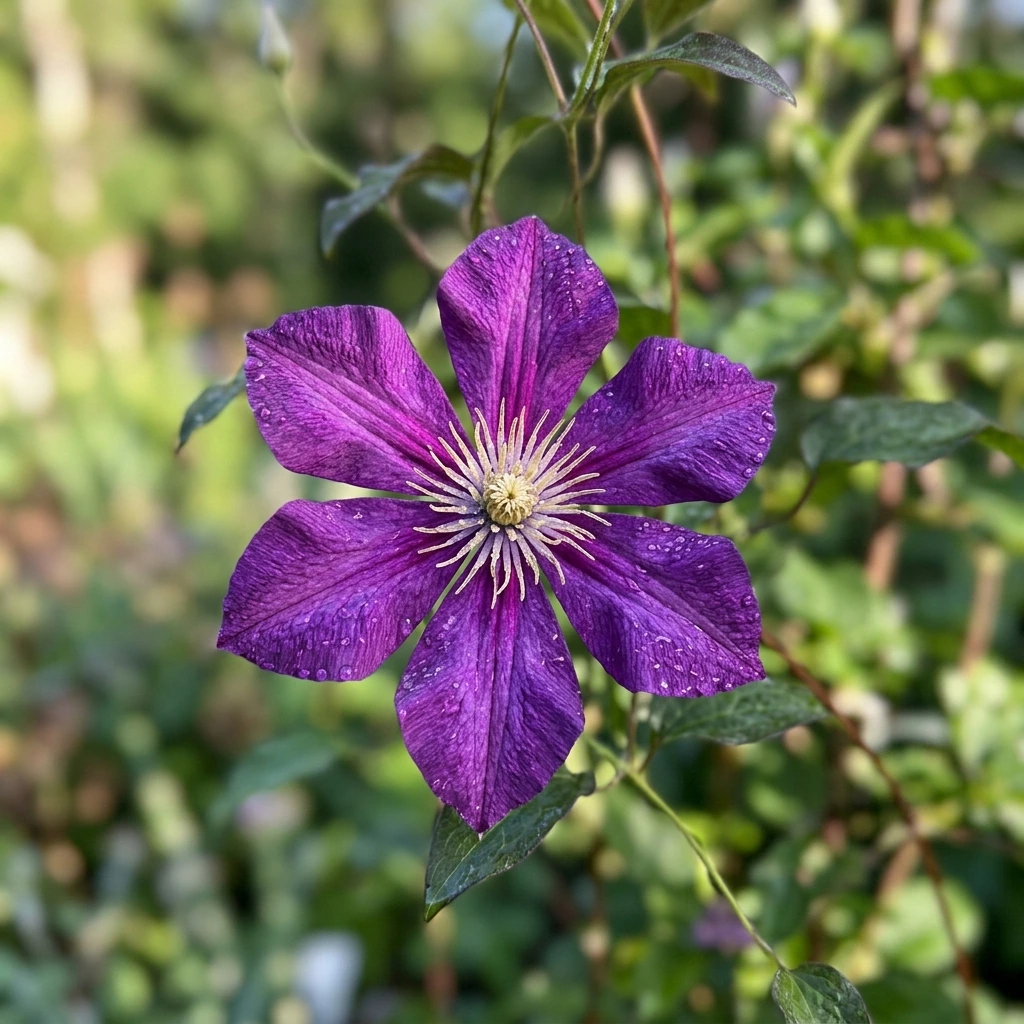
Clematis

Clematis Care & Identification Guide

Crowned the 'Queen of Climbers,' Clematis is a spectacular woody climbing vine that clings using twisting leaf stems. Prized for its massive star-shaped blossoms, it demands a unique microclimate: its leafy canopy must bask in warm sunlight, while its root system must remain deeply shaded and cool. It is widely celebrated by botanists for its distinct environmental adaptability and structural appeal.


Sunlight Icon
Sunlight Full Sun
Watering Icon
Watering Moderate to
Soil Mix Icon
Soil Mix Rich, fertile
Temperature Icon
Temperature 15°C - 25°C
Toxicity Warning Icon
Toxicity Toxic to Pets
Botanical macro photography of Clematis (Clematis) - Plant AI care database

How to Identify Clematis

A sophisticated, woody climbing vine with opposite compound leaves, climbing by twisting leaf petioles, producing massive star-shaped blossoms.

  • Key Visual Features: Twisting leaf stalks (petioles) acting as tendrils, compound leaves with 3-5 leaflets, and large flat blossoms with conspicuous central stamens.
  • Color Variations: Rich deep purple, violet-blue, soft lavender, magenta, pastel pink, pure white, and striking striped double blooms.
  • Common Confusions: Can be confused with Passion Flower vines, but Clematis lacks spiral coiling tendrils and possesses classic star-shaped flat blossoms instead of radial filament rings.
💡 Plant AI Tip: If you are not sure, take a photo with Plant AI to identify it instantly.

Complete Care & Cultivation Guide

Follow our detailed scientific care guide to keep your Clematis thriving and gorgeous all year round.

Clematis requires a highly measured water supply. Typically, water thoroughly until it drains out of the bottom holes only when the top soil layer becomes dry. Based on its specific characteristics: Moderate to High (Requires consistently moist, cool root environment; water deeply once a week). Never allow the roots to sit in stagnant water as it leads to root decay. Reduce watering significantly during autumn and winter dormant phases.
Regular deadheading is essential for Clematis. Snip off faded, spent flowers immediately to prevent seed production and redirect the plant's energy into producing fresh new buds. Trim yellowing or damaged foliage near the stem base using sterilized bypass shears.
Feed Clematis heavily in spring and summer with a fertilizer high in phosphorus to support prolific bud development and rich petal color. Apply a diluted balanced flower liquid fertilizer every 2 to 3 weeks. Avoid excess nitrogen which results in massive green leaves but sparse blooms.
Clematis requires Full Sun to Partial Shade (Requires 'cool roots and warm head'—at least 6 hours of sun for vines; roots shaded). Provide bright, consistent indirect filtered sunlight daily. Avoid exposing the foliage to harsh direct midday sun which can easily bleach, scorch, or dry out the delicate leaves.
The optimal substrate for Clematis is a loose, rich, exceptionally fast-draining potting soil. Based on requirements: Rich, fertile, humus-heavy, deep loamy soil with exceptional drainage (pH 6.5-7.0; dislikes acidic soil). A standard high-aeration mix consists of 50% organic peat moss or coco coir, 30% chunky orchid bark or pumice, and 20% coarse perlite to facilitate excellent oxygen circulation.
Easily propagate Clematis using stem cuttings in spring. Cut a healthy 4-inch stem section just below a node, remove lower leaves, and submerge the node in clean water or moist perlite mix until active roots develop in 3 weeks.
Thrives in standard warm environmental conditions: 15°C - 25°C (59°F - 77°F); hardy, root system survives harsh winters if mulched. Keep the plant safe from cold drafts, drafty windows, air conditioning vents, or direct heaters. Ensure winter protection is maintained to prevent cellular damage and floppy leaf decay.
Choose a heavy unglazed clay or terracotta container with multiple bottom drainage holes. Terracotta allows excess soil moisture to breathe and evaporate safely. Repot the plant every 1 to 2 years in spring, upgrading to a container that is 2 inches wider.
Regularly inspect Clematis leaves for spider mites spinning fine webs under dusty leaves, cottony mealybugs hiding in leaf joints, or scale insects on stems. Treat immediately by wiping foliage with organic neem oil solution or spraying with mild insecticidal soap every 7 days.
Clematis can be affected by: • **Clematis Wilt**: Symptoms include Sudden, dramatic collapse and blackening of entire stems overnight, caused by Phoma fungus.. *Action*: Cut the infected stem back completely to ground level (even below the soil). Disinfect tools. Healthy new shoots will emerge from the crown. | • **Powdery Mildew**: Symptoms include Powdery white fungal growth covering buds and leaves in late summer due to high humidity.. *Action*: Prune crowded stems to maximize ventilation. Spray with neem oil or systemic fungicide.. Always prioritize soil drainage and proper air circulation. Spray leaves with organic fungicides like copper fungicide or chamomile tea sprays to prevent bacterial leaf spot spreads.
The secret to a gorgeous Clematis is consistent placement and cleaning. Avoid rotating or moving the plant frequently as sudden environmental shifts can induce shock. Wipe leaves with a damp microfiber cloth monthly to clear dust and enhance natural photosynthesis.

Is your Clematis foliage turning brown or dropping?

Don't let it wither away. Take a photo with Plant AI to diagnose pests and leaf spots instantly.

Diagnose My Plant

Common Diseases & Treatment

Clematis Wilt

Symptoms: Sudden, dramatic collapse and blackening of entire stems overnight, caused by Phoma fungus.

Action: Cut the infected stem back completely to ground level (even below the soil). Disinfect tools. Healthy new shoots will emerge from the crown.

Powdery Mildew

Symptoms: Powdery white fungal growth covering buds and leaves in late summer due to high humidity.

Action: Prune crowded stems to maximize ventilation. Spray with neem oil or systemic fungicide.

Frequently Asked Questions

What does 'cool feet, warm head' mean for Clematis?

This is the golden rule of Clematis care! The vine needs 6+ hours of sun to bloom, but the root zone must stay cool and damp. Shading the base with ground covers, flat stones, or thick mulch is crucial.

How do I know when and how to prune my Clematis?

Pruning depends on the group! Group 1 (early blooms) needs pruning only after spring flowering. Group 2 (mid-season large blooms) needs light pruning in early spring. Group 3 (late blooms) needs hard pruning to 12 inches in late winter.

Why did my healthy Clematis stem suddenly turn black and die overnight?

This is Clematis Wilt, a devastating fungal pathogen. Don't panic—the root system is usually unaffected. Cut the infected stem back to ground level, discard it, and wait for fresh shoots to sprout.

Is Clematis safe for households with cats and dogs?

No. The entire plant contains protoanemonin, a chemical that causes severe chemical irritation of the mouth, excessive drooling, blistering, and vomiting if chewed. Always protect your pets.

No more dying plants. Grow healthy greens today!

Get Started for Free