Forget-Me-Not Care & Identification Guide
Famous for its charming sky-blue flowers and romance, the Forget-Me-Not is a resilient woodland groundcover. In ideal cool, damp conditions, it is a prolifically self-seeding herb, forming a dense blue carpet under deciduous trees. It is widely celebrated by botanists for its distinct environmental adaptability and structural appeal.





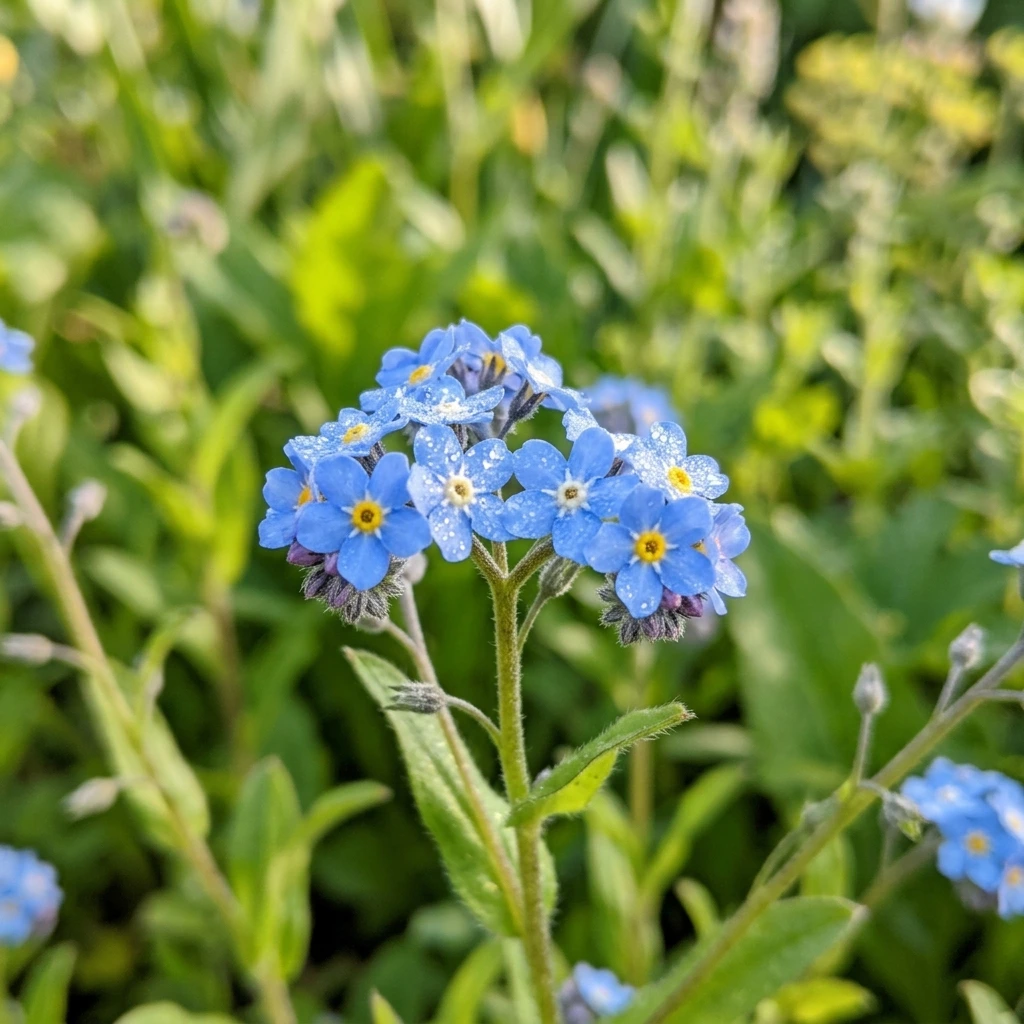
How to Identify Forget-Me-Not
A low-growing, mounding, hairy herbaceous biennial producing sprawling clusters of tiny, brilliant sky-blue five-petaled flowers.
-
✔
Key Visual Features: Soft oblong leaves covered in fine spreading hairs, slender branching stems, and dense clusters of tiny star-like blue blossoms.
-
✔
Color Variations: Signature sky-blue, delicate baby pink, and pure white, all surrounding a vivid yellow central 'eye' ring.
-
✔
Common Confusions: Often confused with Chinese Forget-Me-Not (Cynoglossum) or Brunnera (False Forget-Me-Not). Brunnera has broad heart-shaped leaves and is a perennial, while Cynoglossum has much coarser, taller foliage and lacks the yellow central eye.
Complete Care & Cultivation Guide
Follow our detailed scientific care guide to keep your Forget-Me-Not thriving and gorgeous all year round.
Common Diseases & Treatment
Powdery Mildew (Fungal)
Symptoms: A dusty white flour-like coating spreads across leaves, causing them to curl, yellow, and dry out.
Grey Mold (Botrytis)
Symptoms: Soft, water-soaked brown rot spots develop on leaves and flowers, turning into fuzzy grey mold in wet weather.
Frequently Asked Questions
Why are Forget-Me-Nots considered 'beautiful weeds' in some regions?
Forget-Me-Nots are prolific self-seeders! After blooming, each tiny flower forms hook-covered seeds that easily cling to animal fur and clothes. In cool, moist climates like the Pacific Northwest, they spread aggressively, colonizing wild areas.
Are Forget-Me-Not plants safe around cats and dogs?
Yes! Common garden Forget-Me-Nots (Myosotis sylvatica) are completely non-toxic and pet-safe. However, never confuse them with Chinese Forget-Me-Nots (Cynoglossum amabile), which belong to a different genus and contain toxic pyrrolizidine alkaloids dangerous to liver health.
Why are the leaves of my Forget-Me-Nots covered in white powder?
This is Powdery Mildew, a highly common fungal issue for damp-shade annuals. It triggers in hot, stagnant air with high humidity. Prune nearby crowding plants to improve ventilation, water exclusively at the base, and spray with sulfur fungicide.
How do I ensure my Forget-Me-Nots return every spring?
Do not tidy up the garden too early! Let the spent blue flowers fade, turn brown, and dry completely on the stems. This allows their tiny black seeds to fall naturally onto the soil. They will germinate in autumn and bloom the following spring.