Areca Palm Care & Identification Guide
The Areca Palm, also known as the Golden Cane Palm or Butterfly Palm, is a spectacular, fast-growing tropical palm native to Madagascar. It grows in dense clumps of golden-yellow canes that support wide, arching fronds with dozens of narrow, bright green leaflets. Known as a powerhouse for purifying indoor air and raising humidity, it brings a majestic, resort-like tropical vibe to large indoor spaces. It is widely celebrated by botanists for its distinct environmental adaptability and structural appeal.





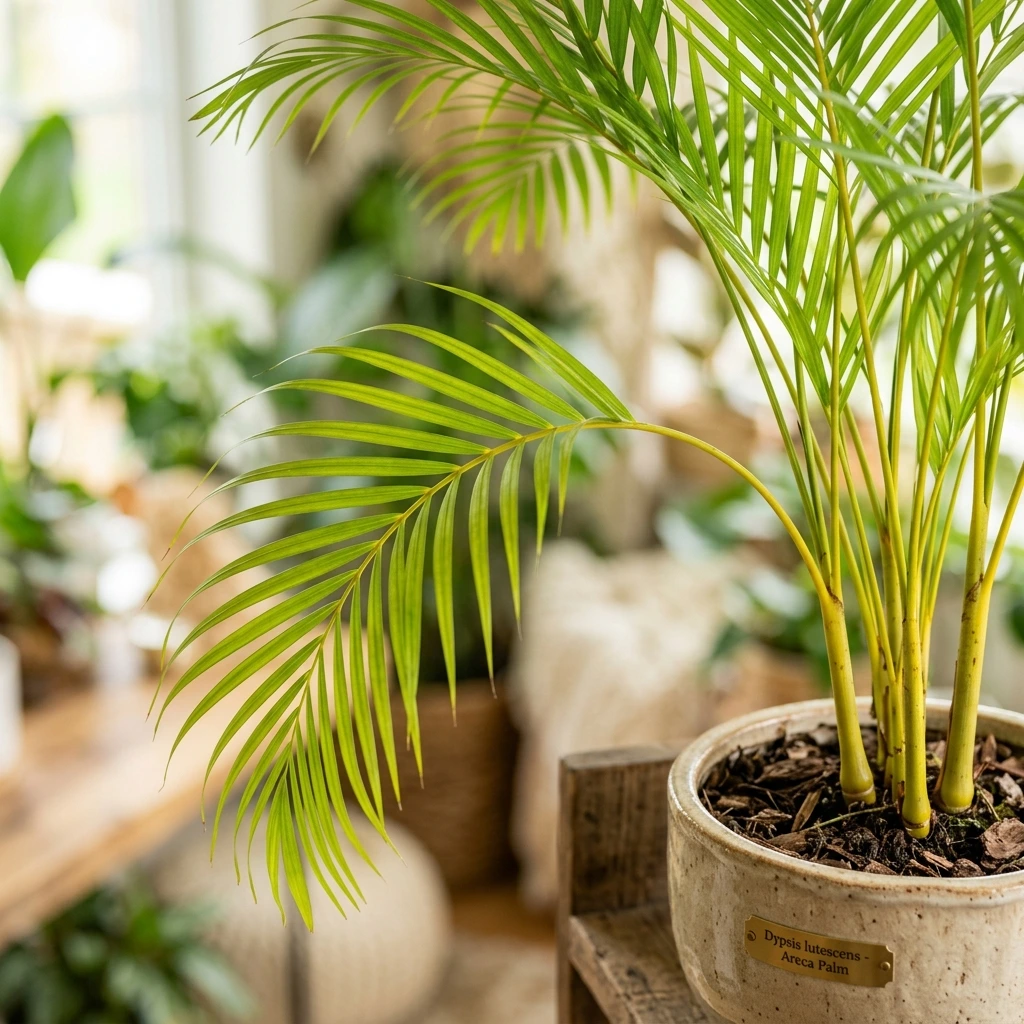
How to Identify Areca Palm
A large, multi-stemmed tropical palm with elegant, arching feather-like fronds on smooth golden-yellow canes.
-
✔
Key Visual Features: Clump-forming growth habit; slender canes with black speckles near the base; wide pinnate leaves with up to 100 leaflets.
-
✔
Color Variations: Bright emerald-green leaflets; golden-yellow or yellowish-green petioles (leaf stalks) and canes.
-
✔
Common Confusions: Distinguished from Kentia and Parlor palms by its clump-forming golden canes and much narrower, more numerous leaflets.
Complete Care & Cultivation Guide
Follow our detailed scientific care guide to keep your Areca Palm thriving and gorgeous all year round.
Common Diseases & Treatment
Helminthosporium Leaf Spot
Symptoms: Small, reddish-brown spots with yellow halos appear on the leaflets, merging to kill whole leaves.
Fluoride Toxicity
Symptoms: Margins and tips of the leaflets turn brown and die, starting with the older outer fronds.
Frequently Asked Questions
Why are the canes of my Areca Palm turning yellow/orange?
Do not worry! Dypsis lutescens is called the Golden Cane Palm because its stems naturally turn a beautiful golden-yellow as they mature. This is a sign of a healthy, mature palm.
Why is my Areca Palm getting brown tips?
Areca Palms are highly sensitive to low humidity and chemical salts in tap water. Raise humidity above 50% using a humidifier, and always water with distilled water, rainwater, or filtered water.
How do I prune an Areca Palm?
Only prune completely dead, brown fronds. Use sharp, sterilized shears to cut them off at the base of the stem. Do not cut green fronds, as the plant relies on them for energy, and never prune the main growing stems.
Is the Areca Palm safe for cats and dogs?
Yes, the Areca Palm is completely non-toxic and pet-safe. It is highly recommended by NASA and ASPCA as a safe, air-purifying plant that poses zero hazard to curious pets.