Echeveria Care & Identification Guide
Echeveria is a highly popular, gorgeous genus of succulent plants native to the semi-desert areas of Mexico. Famous for its flawless, symmetrical, rose-like rosette of thick, fleshy leaves and exquisite pastel colors, it is a magnificent, pet-safe desktop ornament. It is widely celebrated by botanists for its distinct environmental adaptability and structural appeal.





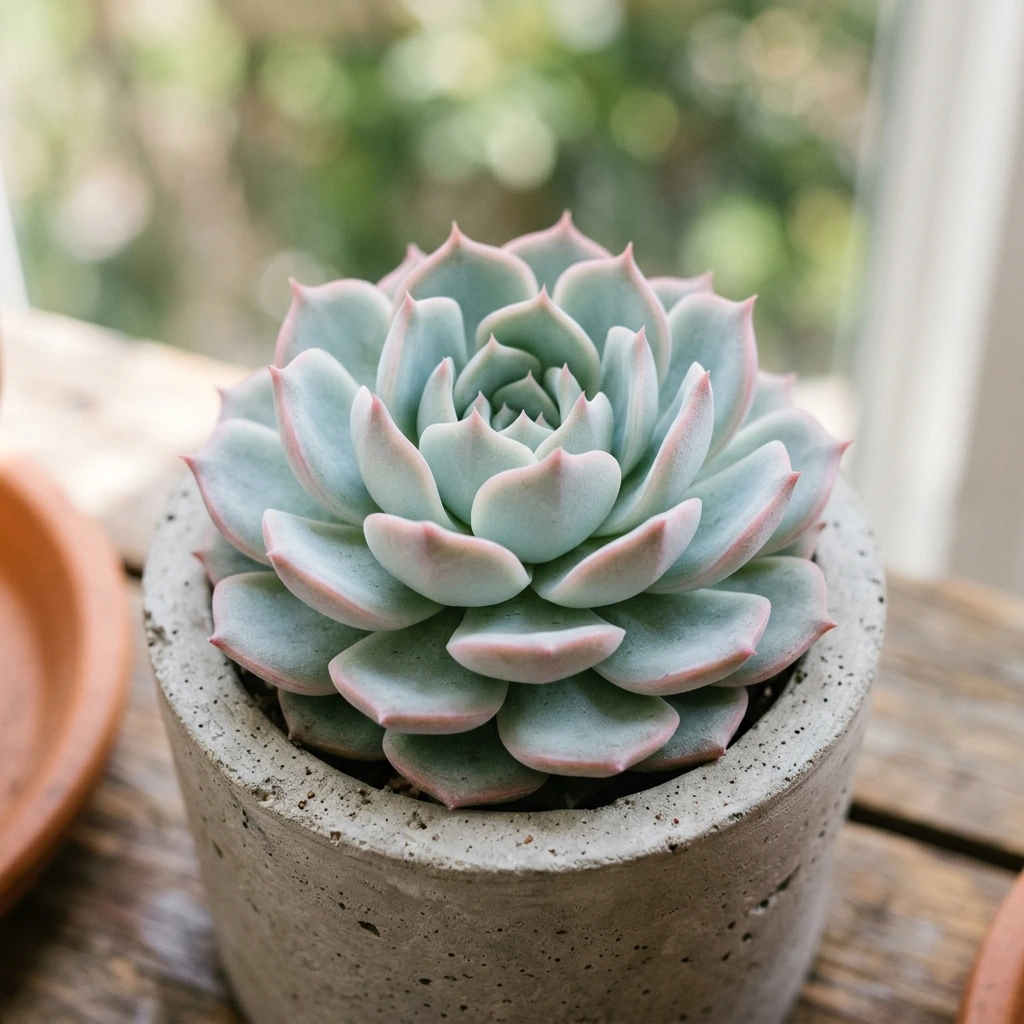
How to Identify Echeveria
A flawless, symmetrical, rose-like rosette of thick, fleshy succulent leaves featuring a light powdery coating.
-
✔
Key Visual Features: Tight, stemless geometrical rosettes of plump leaves with smooth margins, often tapering to a small point.
-
✔
Color Variations: Vibrant colors ranging from pale blue-green and lilac to deep purple, often with bright pink or red margins.
-
✔
Common Confusions: Sometimes confused with Sempervivum (Hens and Chicks) or Graptopetalum, but Echeveria leaves are thicker, lack fine teeth on margins, and are highly sensitive to frost.
Complete Care & Cultivation Guide
Follow our detailed scientific care guide to keep your Echeveria thriving and gorgeous all year round.
Common Diseases & Treatment
Etiolation (Stretching)
Symptoms: The tight rose-like rosette opens up, leaves droop and bend downward, and the stem stretches upward.
Root Rot (Waterlogging)
Symptoms: Base leaves turn translucent, yellow, and mushy, and drop off at the slightest touch; root system decays.
Frequently Asked Questions
How often should I water my Echeveria?
Water only when the soil is 100% bone-dry throughout the pot. During spring and summer, water every 2 weeks. In winter, reduce watering to once a month. Squeeze lower leaves—if plump, don't water!
Why is my Echeveria losing its compact rose shape?
This is called etiolation, caused by a lack of light. Echeverias need strong, direct sunlight to keep their tight rosettes. Without enough light, they stretch toward the sun.
What is the powdery coating on my Echeveria leaves?
That is epicuticular wax, commonly called farina! It is a natural powder that protects the succulent from strong sun and water. Try to avoid touching it, as it will rub off and not grow back.
Is Echeveria safe for cats and dogs?
Yes! The entire Echeveria genus is completely non-toxic and highly pet-safe for both cats and dogs, making it a very secure choice for indoor decoration.