Ash Tree Bolete Foraging & Identification Guide
The Ash Tree Bolete (Boletinellus merulioides) is an extraordinary and edible wild mushroom native to deciduous forests in Eastern North America and parts of Asia. Highly unique in the fungal kingdom, it boasts an incredible symbiotic relationship: it does not form mycorrhizae with the Ash tree itself, but rather with an aphid-like insect (the leaf curl ash aphid) that feeds on the tree's roots. Featuring an irregular, eccentric stem and exceptionally wide, shallow, honeycomb-like yellow pores, it is a fascinating biological wonder and a fun, quirky find for woodland foragers.





How to Identify Ash Tree Bolete
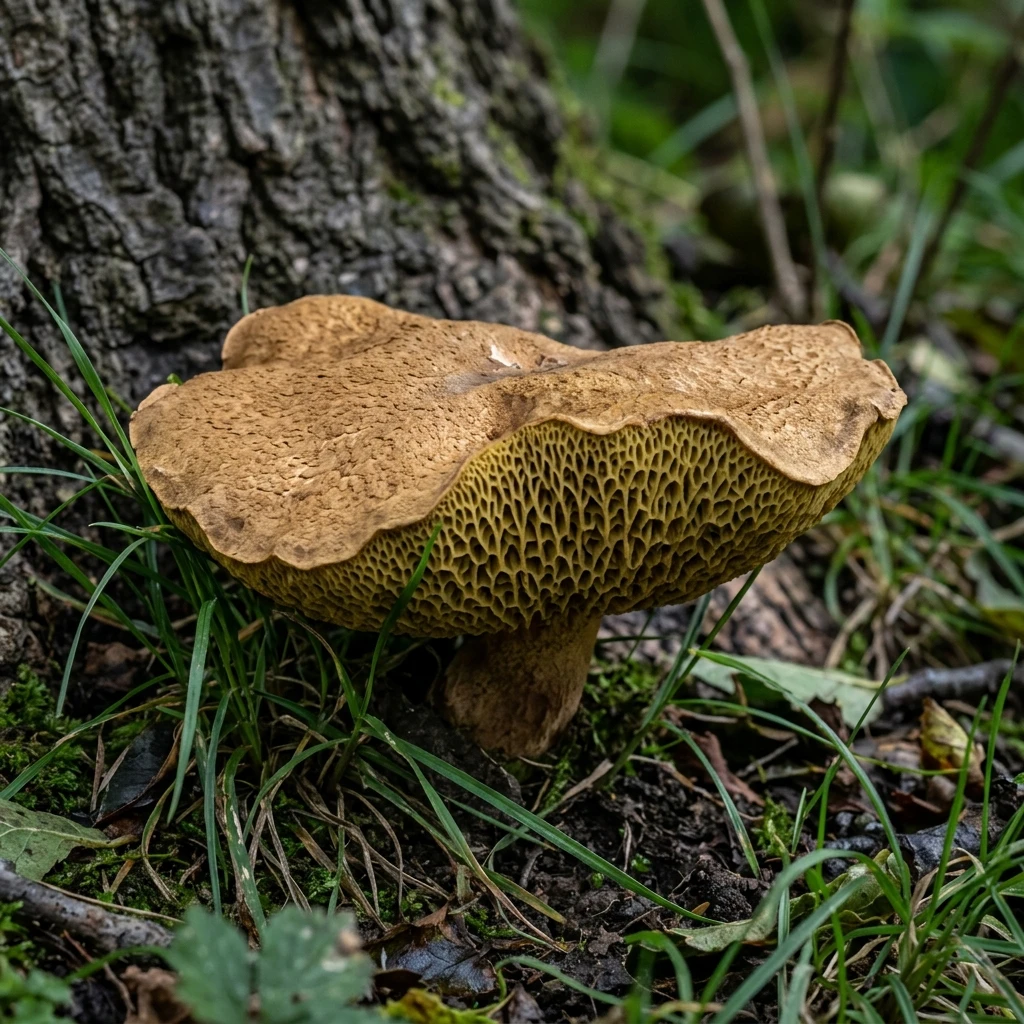
A flat, dull yellow-brown cap with highly irregular, exceptionally wide, honeycomb-like yellow pores underneath, growing under ash trees.
-
✔
Key Visual Features: A medium-sized, somewhat irregular mushroom with a dull, yellowish-brown, often dry and slightly wavy cap. The stem is usually off-center (eccentric), short, and reddish-brown towards the base.
-
✔
Spore Print & Gills/Pores: Unlike standard boletes with tiny, round tubes, this mushroom features extremely wide, shallow, irregular, vein-like pores that resemble a honeycomb. The pores are bright yellow and bruise slowly brown. Spore print is olive-brown.
-
✔
Common Confusions: Its highly distinct honeycomb pores and strict association with Ash trees (Fraxinus species) make it nearly unmistakable. It could loosely be confused with some Suillus species, but Suillus grow with pines and lack the eccentric stem and shallow honeycomb pores.
Detailed Mycology Profile & Foraging Guide
Follow our detailed scientific field guide and environmental parameters to identify and study Ash Tree Bolete safely.
Common Look-alikes & Foraging Danger
Pore Decay (Waterlogging)
Symptoms: The yellow honeycomb pores turn a dark, soggy brownish-gray and melt into a soft mass.
Cap Fading
Symptoms: The smooth yellow-brown cap turns a pale grayish-yellow and loses its velvety texture.
Frequently Asked Questions
Why does it only grow under Ash trees?
It grows under Ash trees due to a unique three-way relationship. The Ash Woolly Aphid feeds on ash roots and secretes honeydew. The Ash Tree Bolete feeds on this honeydew, forming a symbiotic bond with the aphids and the tree.
What are honeycomb pores?
Unlike standard boletes with tiny, round pore holes, the Ash Tree Bolete has exceptionally wide, shallow, and irregular pores that resemble a natural honeycomb or a wrinkled network of veins.
Is the Ash Tree Bolete good to eat?
It is edible and safe, with a mild, pleasant flavor. It is not considered a top-tier gourmet mushroom due to its relatively tough, elastic texture, but it is highly valued by foragers for its uniqueness.
Does it stain blue when cut?
Yes, but very slowly and weakly. Slicing the yellow flesh can cause it to stain a faint, slow blue-green over several minutes, which is a classic bolete trait.