Bitter Bolete Foraging & Identification Guide
The Bitter Bolete (Tylopilus felleus) is a highly common, deceptive, and completely inedible wild mushroom native to coniferous and broadleaf forests across Europe and North America. Growing on acidic soils and decaying conifer stumps, it is a legendary hazard for wild food foragers. While it looks virtually identical to the highly prized, delicious King Bolete (Porcini), it possesses two absolute diagnostic checks: its tube pores turn a distinct pale pinkish color as they mature, and its flesh has an intensely, agonizingly bitter taste. A single specimen will completely ruin an entire cooked dish.





How to Identify Bitter Bolete
The Bitter Bolete (Tylopilus felleus) is a highly common, deceptive, and completely inedible wild mushroom native to coniferous and broadleaf forests across Europe and North America. Growing on acidic soils and decaying conifer stumps, it is a legendary hazard for wild food foragers. While it looks virtually identical to the highly prized, delicious King Bolete (Porcini), it possesses two absolute diagnostic checks: its tube pores turn a distinct pale pinkish color as they mature, and its flesh has an intensely, agonizingly bitter taste. A single specimen will completely ruin an entire cooked dish.
-
✔
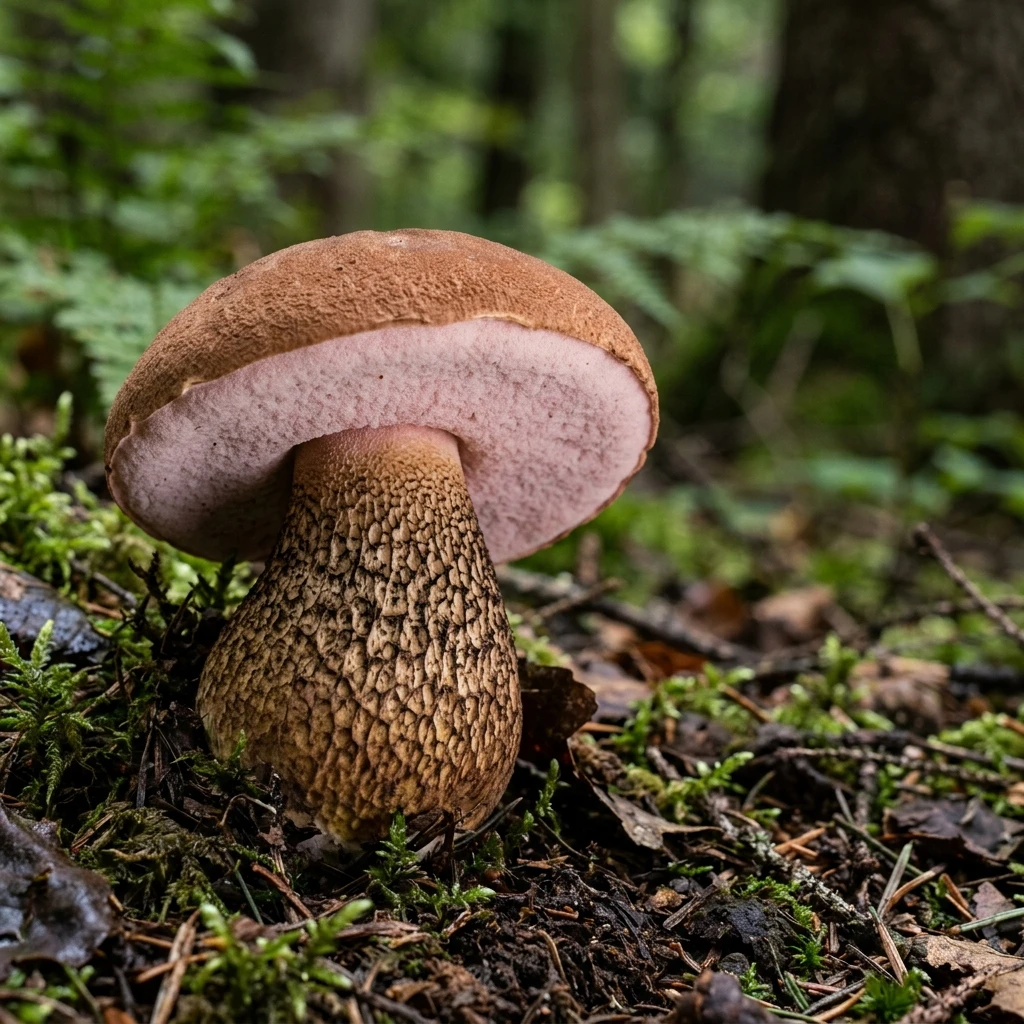
Key Visual Features: Looks remarkably similar to a Porcini, featuring a large, smooth, light-brown to tan convex cap. The stem is thick, bulbous at the base, and covered with a very coarse, prominent, dark brown raised netting (reticulation), unlike the white netting of a true Porcini.
-
✔
Spore Print & Gills/Pores: Lacks gills. The underside consists of a spongy layer of pores. When young, the pores are white, making it very deceptive, but as spores mature, the pores take on a distinctly pinkish or flesh-colored hue. Spore print is pinkish-brown.
-
✔
Common Confusions: The ultimate Porcini (Boletus edulis) look-alike. To distinguish them, check the stem netting (Bitter Bolete has dark netting; Porcini has white netting), check the mature pore color (pinkish vs. greenish-yellow), and perform a 'nibble and spit' taste test of a tiny piece of raw flesh—the Bitter Bolete is instantly, intensely bitter.
Detailed Mycology Profile & Foraging Guide
Follow our detailed scientific field guide and environmental parameters to identify and study Bitter Bolete safely.
Common Look-alikes & Foraging Danger
Pinkish Pore Development (Mature)
Symptoms: The sponge pores under the cap turn from white to a distinct, soft pinkish-rose color.
Bitter Spoilage
Symptoms: Your cooked wild mushroom risotto or soup tastes incredibly bitter and has to be thrown away.
Frequently Asked Questions
Is the Bitter Bolete poisonous?
It is not chemically poisonous or lethal to humans, but it is considered completely inedible and unpalatable because of its intense, bile-like bitterness, which can cause mild stomach upset if swallowed.
Why does it taste so bitter?
It contains highly concentrated bitter compounds called tylopilins. This bitterness is a natural evolutionary defense mechanism to deter mammals, slugs, and insects from eating its spores.
How do you distinguish it from a Porcini?
The Porcini (Boletus edulis) has a sweet, nutty taste, pores that turn yellow-green at maturity, and a stem with fine white netting. The Bitter Bolete (Tylopilus felleus) has a very bitter taste, pores that turn pinkish, and a stem with coarse dark-brown netting.
Does the bitterness disappear when cooked?
No. In fact, the bitterness becomes even more concentrated and soluble in water when heated, so a single bitter bolete slice will ruin an entire pot of soup or risotto.