Crested Coral Foraging & Identification Guide
The Crested Coral (Clavulina coralloides), also known as the Wrinkled Coral Fungi or White Crested Coral, is a highly common, beautiful, and edible wild coral-like mushroom native to temperate woodlands across Europe, North America, and temperate Asia. Growing in symbiotic mycorrhizal association with both broadleaf and coniferous trees, it does not resemble a traditional cap-and-gill mushroom, but instead forms a highly detailed, pure-white to pale-gray clustered structure of upright branches. It is celebrated by mycology enthusiasts for its delicate branches which terminate in highly intricate, crested, and feathered tooth-like tips that resemble a miniature forest crown.





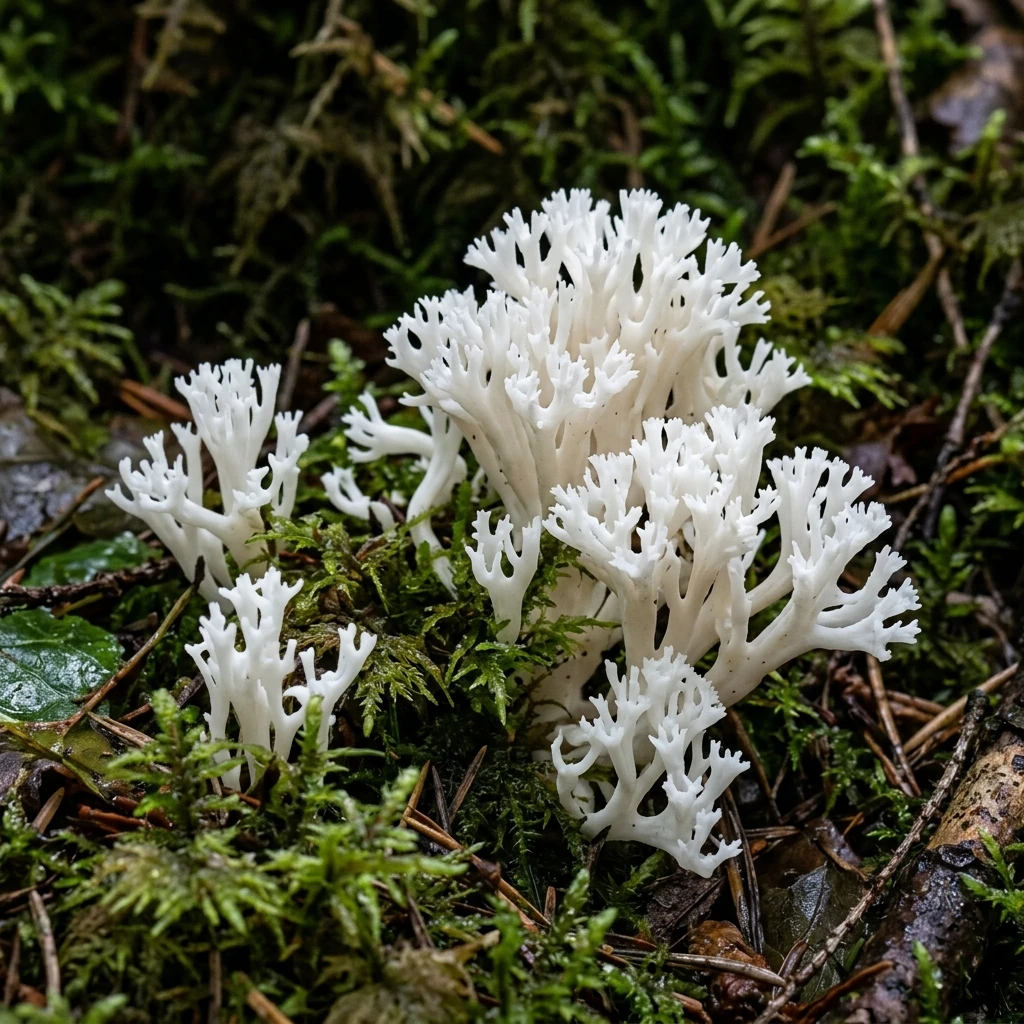
How to Identify Crested Coral
The Crested Coral (Clavulina coralloides), also known as the Wrinkled Coral Fungi or White Crested Coral, is a highly common, beautiful, and edible wild coral-like mushroom native to temperate woodlands across Europe, North America, and temperate Asia. Growing in symbiotic mycorrhizal association with both broadleaf and coniferous trees, it does not resemble a traditional cap-and-gill mushroom, but instead forms a highly detailed, pure-white to pale-gray clustered structure of upright branches. It is celebrated by mycology enthusiasts for its delicate branches which terminate in highly intricate, crested, and feathered tooth-like tips that resemble a miniature forest crown.
-
✔
Key Visual Features: A small to medium coral fungus forming dense, bushy clusters. The branches are initially pure white, aging to a pale greyish or yellowish-white. The most distinguishing feature is the tips of the branches, which are flattened, multi-pointed, and deeply fringed or 'crested', looking like tiny moose antlers or cock's combs.
-
✔
Spore Print & Gills/Pores: Lacks gills, pores, and a true cap. The spore-bearing surface covers the smooth, upper parts of the vertical branches. The flesh is slightly tough, brittle, and white, with no distinct odor. Spore print is white.
-
✔
Common Confusions: Often confused with other white coral fungi, particularly the White Coral Mushroom (Ramariopsis kunzei), which lacks the distinctly fringed/crested tips, or the Wrinkled Club (Clavulina rugosa), which is much less branched and looks like single wrinkled fingers. Can sometimes be parasitized by a mold that turns it completely gray.
Detailed Mycology Profile & Foraging Guide
Follow our detailed scientific field guide and environmental parameters to identify and study Crested Coral safely.
Common Look-alikes & Foraging Danger
Gray-Black Discoloration (Parasitism)
Symptoms: The pure-white branches turn a dull gray, purple-gray, or charcoal-black and feel soft.
Brittle Melting
Symptoms: The fragile white branches become extremely brittle, soggy, and melt into a soft mass after heavy rains.
Frequently Asked Questions
Why is it called 'Crested Coral'?
It is named the 'Crested Coral' (Clavulina cristata) because its branching structure strongly resembles natural ocean coral reef formations, and the tips of the branches are highly divided and flat-toothed, like a rooster's crest or crown.
Is it safe to eat?
Yes, it is edible and safe, with a very mild, subtle flavor and a pleasant, slightly crisp texture. It is not considered a top-tier gourmet mushroom due to its mildness, but it is highly valued for its beautiful appearance in dishes.
What is the black coating sometimes found on it?
If you see a gray or black coating, do not eat it. This is not dirt, but rather a parasitic mold (Helminthosphaeria clavariarum) that feeds on the Crested Coral, turning it black and making it unfit for consumption.
Are there toxic look-alikes?
There are no highly toxic look-alikes that resemble pure-white coral with flat crested tips. Some other coral fungi (like Ramaria) can be mildly toxic and cause stomach upset, but they are usually larger, much more branched, yellow, pink, or orange, and lack the feathered tips.