Chaga Foraging & Identification Guide
Chaga (Inonotus obliquus), often called the 'Black Gold of the Forest', is an extremely potent and unique medicinal fungus native to cold boreal forests across the Northern Hemisphere. Rather than a standard fruiting body, what is harvested is a massive, cracked, charcoal-black sterile conk (sclerotium) that erupts from the trunks of living white birch trees. Legendary in Siberian and Russian folk medicine, this slow-growing wood-decay parasite absorbs unique compounds from the birch sap, most notably betulinic acid, and is heavily commercialized globally for its outstanding antioxidant capacity and immune-supporting properties.





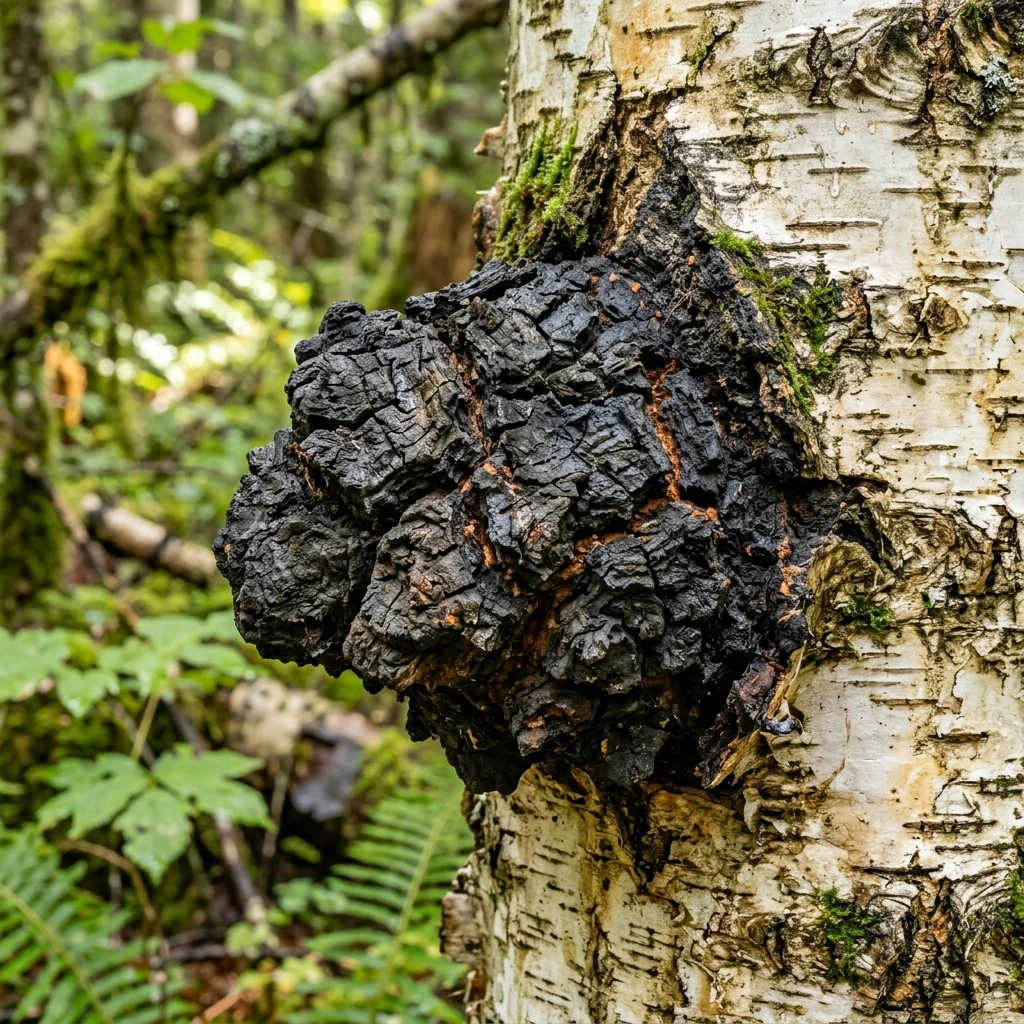
How to Identify Chaga
Chaga (Inonotus obliquus), often called the 'Black Gold of the Forest', is an extremely potent and unique medicinal fungus native to cold boreal forests across the Northern Hemisphere. Rather than a standard fruiting body, what is harvested is a massive, cracked, charcoal-black sterile conk (sclerotium) that erupts from the trunks of living white birch trees. Legendary in Siberian and Russian folk medicine, this slow-growing wood-decay parasite absorbs unique compounds from the birch sap, most notably betulinic acid, and is heavily commercialized globally for its outstanding antioxidant capacity and immune-supporting properties.
-
✔
Key Visual Features: Looks remarkably like a large, burnt piece of charcoal or a black, crusty tumor growing out of a tree trunk. The exterior is deeply cracked, brittle, and coal-black. However, when broken open or chopped off the tree, the interior flesh is a vibrant, corky, golden-orange to rusty-yellow color.
-
✔
Spore Print & Gills/Pores: The visible 'Chaga' is a sterile sclerotium, meaning it does not have gills, pores, or produce spores. The actual fruiting body of Inonotus obliquus is a very rare, flat, greyish pore crust that appears under the bark only after the host tree has died, and is almost never seen by foragers.
-
✔
Common Confusions: Can be easily confused with massive tree burls, but burls are solid wood with bark over them, whereas Chaga has a black crust and a golden, corky interior. It may also be confused with the cracked, black Cherry Scab (Apiosporina morbosa) on cherry trees, but true medicinal Chaga is harvested almost exclusively from Birch trees (Betula species).
Detailed Mycology Profile & Foraging Guide
Follow our detailed scientific field guide and environmental parameters to identify and study Chaga safely.
Common Look-alikes & Foraging Danger
Wood Decay Contamination
Symptoms: The golden core turns white, powdery, soft, and crumbles easily like rotten wood.
Storage Mold
Symptoms: Fuzzy white mold growing in the dark crevices of the black cracked exterior.
Frequently Asked Questions
Why is Chaga called the 'King of Medicinal Mushrooms'?
Chaga contains an incredibly high concentration of antioxidants (measured by ORAC score) that is far higher than blueberries or acai berries. It uniquely absorbs therapeutic betulin from birch tree sap.
What does Chaga tea taste like?
It has a very smooth, mild, and pleasant flavor. It tastes earthy with a slight bitterness, closely resembling weak black coffee or dark tea, with a subtle natural vanilla aroma.
Can Chaga cure cancer?
While not a cure, Chaga extracts are heavily researched for their ability to naturally inhibit tumor cell growth, stimulate white blood cells, and reduce the toxic side effects of radiation therapies.
How do you brew Chaga correctly?
Take 2-3 small chunks of dried Chaga. Simmer in 1 liter of hot (80°C / 176°F) water for 1 to 2 hours. Do not boil vigorously, as high heat can break down some of its delicate active antioxidants.