Chanterelle Foraging & Identification Guide
The Golden Chanterelle (Cantharellus cibarius), is one of the most universally beloved, easily recognized, and highly prized wild edible mushrooms in the world. Famous for its brilliant, bright egg-yolk yellow color and elegant, trumpet-like funnel shape, this globally distributed forest delicacy grows in mycorrhizal association with hardwood and conifer roots. Emitting a highly distinctive, sweet and fruity aroma reminiscent of fresh apricots, it offers a firm, meaty texture that holds up exceptionally well in cooking, making it a highly coveted ingredient in professional kitchens and gourmet home cooking alike.





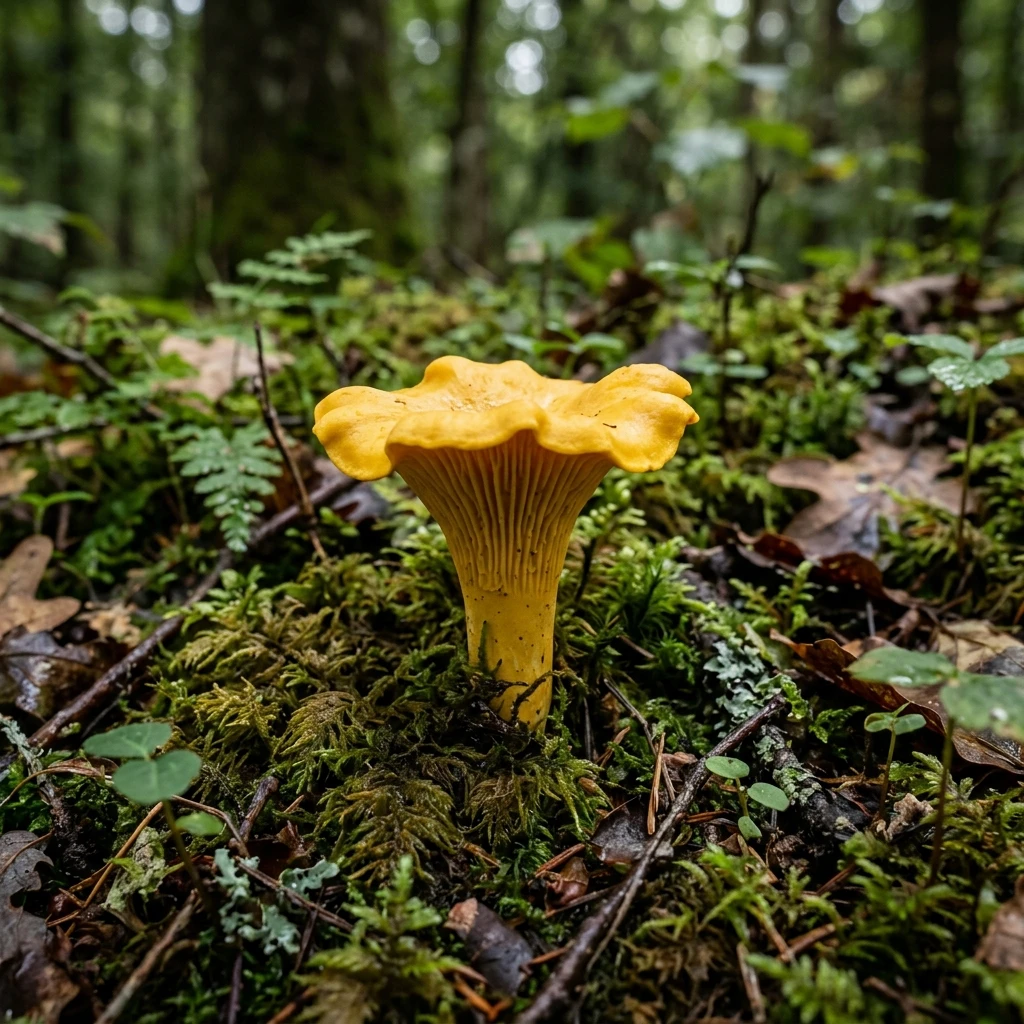
How to Identify Chanterelle
The Golden Chanterelle (Cantharellus cibarius), is one of the most universally beloved, easily recognized, and highly prized wild edible mushrooms in the world. Famous for its brilliant, bright egg-yolk yellow color and elegant, trumpet-like funnel shape, this globally distributed forest delicacy grows in mycorrhizal association with hardwood and conifer roots. Emitting a highly distinctive, sweet and fruity aroma reminiscent of fresh apricots, it offers a firm, meaty texture that holds up exceptionally well in cooking, making it a highly coveted ingredient in professional kitchens and gourmet home cooking alike.
-
✔
Key Visual Features: A bright golden-yellow to orange-yellow mushroom with a cap that starts convex but quickly becomes funnel-shaped or trumpet-shaped with wavy, irregular margins. The stem is solid and the same color as the cap, tapering downwards.
-
✔
Spore Print & Gills/Pores: A critical identifying feature: Chanterelles do NOT have true, blade-like, fragile gills. Instead, they have 'false gills'—thick, blunt, forking folds or wrinkles that run far down the stem (decurrent) and cross-connect with each other. The flesh is white on the inside and stringy like string cheese when pulled apart. Spore print is pale yellow to whitish.
-
✔
Common Confusions: Often confused with the poisonous Jack-o'-Lantern mushroom (Omphalotus illudens), which grows in large clusters on wood, has TRUE, deep, blade-like gills, and lacks the apricot smell. It may also be confused with the False Chanterelle (Hygrophoropsis aurantiaca), which has true, easily removable gills and a thinner, less meaty cap.
Detailed Mycology Profile & Foraging Guide
Follow our detailed scientific field guide and environmental parameters to identify and study Chanterelle safely.
Common Look-alikes & Foraging Danger
Soggy Waterlogging
Symptoms: Trumpet cap turns mushy, waterlogged, and loses its golden color.
Woodland Mold
Symptoms: White powdery mold appearing in the folds of the false gills.
Frequently Asked Questions
What are 'false gills' on a Chanterelle?
False gills are blunt, shallow ridges or folds on the underside of the cap that are part of the mushroom's flesh. They cannot be easily scraped off or separated, unlike the thin, blade-like 'true gills' of standard mushrooms.
Why does a Chanterelle smell like apricots?
Chanterelles contain high concentrations of natural volatile compounds called octenols and lactones, which give them their characteristic sweet, fruity aroma.
Can you freeze fresh Chanterelles?
Never freeze them raw, as they will turn bitter and rubbery when thawed. You must sauté them in butter or dry-sauté them first, then freeze the cooked mushrooms.
How do you separate a Chanterelle from a Jack-O'-Lantern?
A True Chanterelle grows singly on soil, has blunt false gills, is solid white inside, and smells like apricots. A poisonous Jack-O'-Lantern grows in dense clusters on dead wood, has thin true gills, is orange inside, and has no fruity smell.