Common Earthstar Foraging & Identification Guide
The Common Earthstar (Geastrum triplex), or Fringed Earthstar, is a highly unique, star-shaped, and inedible wild fungus native to temperate deciduous and coniferous forests worldwide. Sprouting initially as a buried, onion-like white egg, it features a remarkable outer skin (exoperidium) that splits and unfolds backward into a beautiful, fleshy star-like flower. In this species, the thick fleshy layer often cracks and forms a distinct 'collar' around the central rounded spore bag, elevating it off the soil. A classic icon of mycology, it represents a brilliant physical adaptation that utilizes falling raindrops to puff its spores into the wind.





How to Identify Common Earthstar
The Common Earthstar (Geastrum triplex), or Fringed Earthstar, is a highly unique, star-shaped, and inedible wild fungus native to temperate deciduous and coniferous forests worldwide. Sprouting initially as a buried, onion-like white egg, it features a remarkable outer skin (exoperidium) that splits and unfolds backward into a beautiful, fleshy star-like flower. In this species, the thick fleshy layer often cracks and forms a distinct 'collar' around the central rounded spore bag, elevating it off the soil. A classic icon of mycology, it represents a brilliant physical adaptation that utilizes falling raindrops to puff its spores into the wind.
-
✔
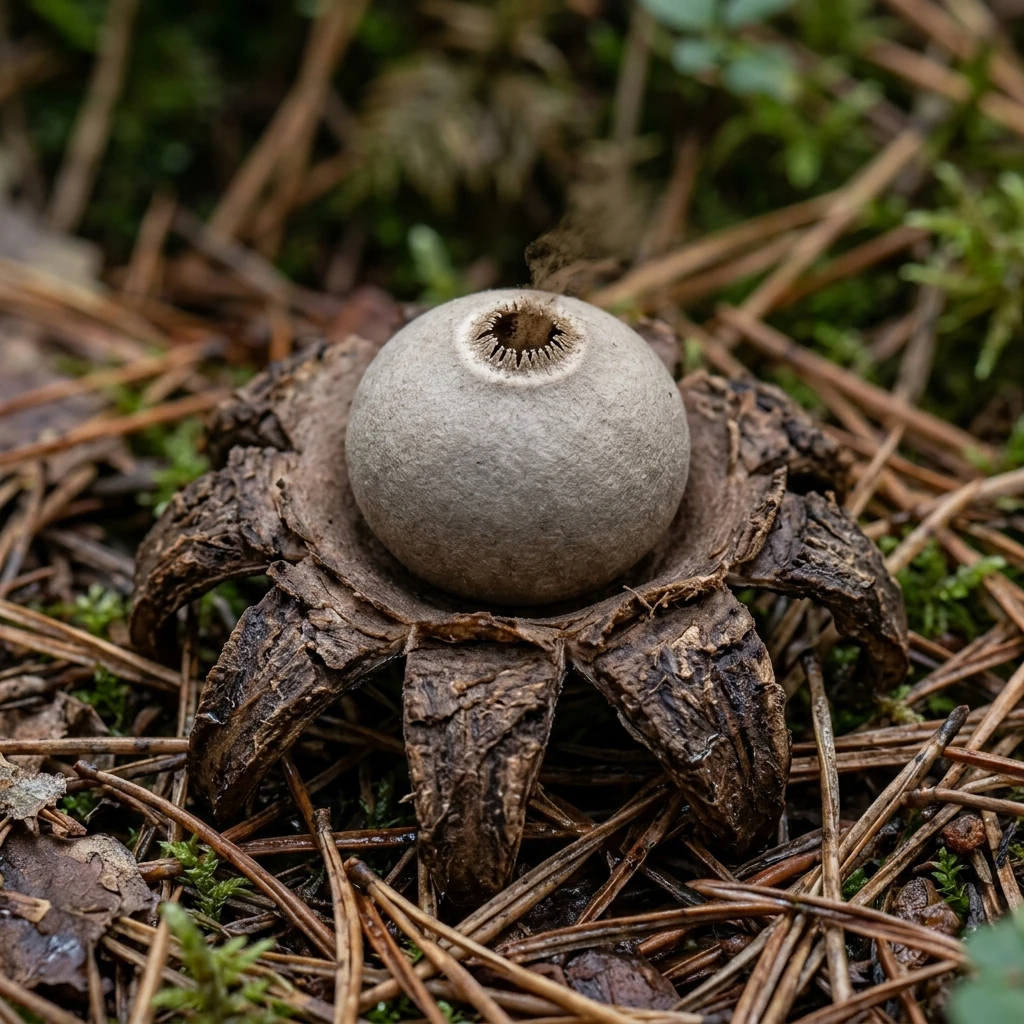
Key Visual Features: Begins as an onion-shaped bulb. As it matures, the thick outer layer splits into 5 to 8 pointed 'rays' that peel backward, forming a star shape up to 10 cm across. In Geastrum triplex, the thick fleshy layer of these rays often cracks and peels off to form a distinctive saucer-like 'collar' or 'saucer' under the central spore sac.
-
✔
Spore Print & Gills/Pores: Lacks gills and pores. Features a central, pale gray to brownish, papery puffball-like sac (endoperidium) that contains the spores. The sac has a single hole (peristome) at the top, surrounded by a distinct, paler circular zone or 'fringe' (hence 'Fringed Earthstar'). When squeezed or struck by a raindrop, it puffs out brown spores.
-
✔
Common Confusions: Can be confused with other Earthstars (Geastrum species), particularly the Sessile Earthstar (Geastrum fimbriatum), which lacks the characteristic cracked 'collar' under the spore sac, or the Collared Earthstar (Geastrum michelianum), which is very similar. All Earthstars are considered inedible due to their tough, leathery texture.
Detailed Mycology Profile & Foraging Guide
Follow our detailed scientific field guide and environmental parameters to identify and study Common Earthstar safely.
Common Look-alikes & Foraging Danger
Rays Closing (Dry Weather)
Symptoms: The star-like rays fold inward, wrapping tightly around the central spore bag, hiding the star shape.
Soggy Decay
Symptoms: The leathery rays become black, soggy, mushy, and covered in green mold after heavy rains.
Frequently Asked Questions
Why is it called an 'Earthstar'?
It is named 'Earthstar' because its tough outer skin splits and peels backward into a beautiful, star-like pattern resting flat on the ground, resembling a little star fallen from the sky.
Is the Common Earthstar poisonous?
No, it is not chemically toxic. However, it is considered completely inedible due to its tough, leathery, and dry structure, which makes it impossible to chew or digest.
How does it release its spores?
It utilizes a splash-jet mechanism. The central spore sac is elastic and has a small hole on top. When a falling raindrop hits the sac, it acts like a pump, shooting a puff of spore dust out of the hole into the wind.
Why does it roll up in dry weather?
The rays are hygroscopic (moisture-sensitive). They roll up around the spore bag during dry weather to prevent the spores from being wasted when the air is too dry, and unfold again when it rains to ensure successful dispersal.