Dead Man's Fingers Foraging & Identification Guide
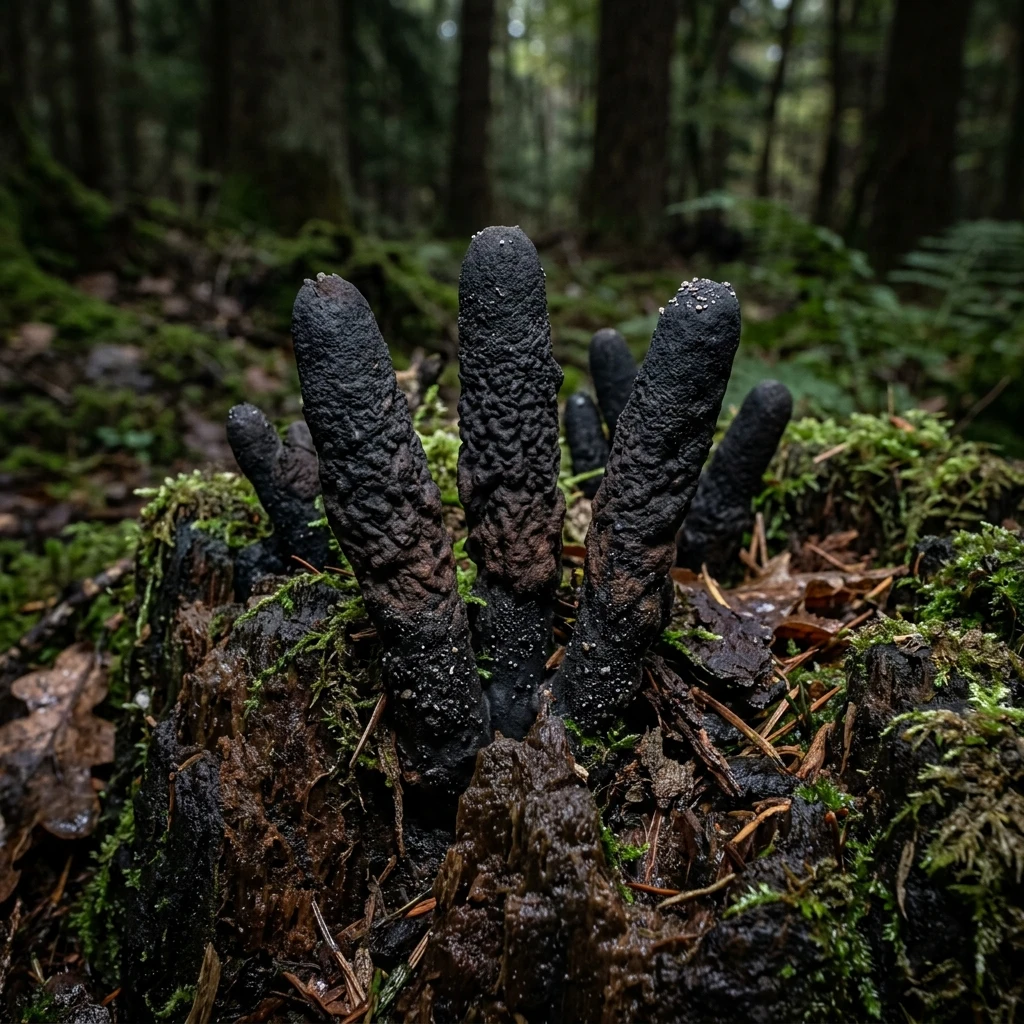
The Dead Man's Fingers (Xylaria polymorpha) is a highly famous, bizarre, and inedible wood-decaying wild fungus native to temperate deciduous forests globally. Typically emerging vertically from the base of rotting deciduous stumps or buried wood, it is named for its uncanny, startling resemblance to swollen, stiff, charcoal-black human fingers clawing their way out of the earth. Stiff and carbon-hard like charcoal when mature, it is a magnificent decomposer of wood and a perennial favorite subject of gothic mycology and nature photography.




How to Identify Dead Man's Fingers
The Dead Man's Fingers (Xylaria polymorpha) is a highly famous, bizarre, and inedible wood-decaying wild fungus native to temperate deciduous forests globally. Typically emerging vertically from the base of rotting deciduous stumps or buried wood, it is named for its uncanny, startling resemblance to swollen, stiff, charcoal-black human fingers clawing their way out of the earth. Stiff and carbon-hard like charcoal when mature, it is a magnificent decomposer of wood and a perennial favorite subject of gothic mycology and nature photography.
-
✔
Key Visual Features: Grows in clusters of 3 to 6 'fingers' that are roughly 3 to 8 cm tall and 1 to 3 cm thick. When very young in the spring, they are pale blue-gray with a white, powdery tip (often likened to a fingernail). As they mature through summer and fall, they become black, wrinkled, hard, and crusty, looking exactly like charred wood or necrotic fingers.
-
✔
Spore Print & Gills/Pores: Lacks gills, pores, and teeth. It is an Ascomycete fungus. The spores are produced in tiny flask-like structures (perithecia) embedded just below the black, pimply outer crust. The interior flesh of the 'finger' is stark white and very tough, eventually hollowing out with age.
-
✔
Common Confusions: Often confused with other Xylaria species like the Dead Moll's Fingers (Xylaria longipes), which are much thinner and more delicate, or the Stag's Horn Fungus (Xylaria hypoxylon), which is branched like tiny black-and-white antlers. When old and black, it can be mistaken for actual pieces of charcoal or burnt wood lying on the forest floor.
Detailed Mycology Profile & Foraging Guide
Follow our detailed scientific field guide and environmental parameters to identify and study Dead Man's Fingers safely.
Common Look-alikes & Foraging Danger
Pale Blue-Gray Coating (Spring Stage)
Symptoms: The fingers are covered in a smooth, pale blue-gray or dusty white coating instead of charcoal-black.
Lawn Encroachment
Symptoms: Finger-like black growths emerging directly out of your green grass lawn, away from visible wood.
Frequently Asked Questions
Why is it called 'Dead Man's Fingers'?
It is named for its creepy, uncanny resemblance to swollen, dark, decaying human fingers clawing their way up through the forest soil from buried wood roots, resembling a zombie hand.
Is Dead Man's Fingers poisonous?
It is not known to be chemically toxic. However, it is considered completely inedible because it is as hard as wood or charcoal, making it impossible to chew, swallow, or digest.
Does it grow on living trees?
Normally it only grows on dead, decaying hardwood stumps and logs. However, it can occasionally act as a weak parasite on stressed trees, causing root rot that eventually hollows the tree base.
What does it look like inside?
If you slice one of the hard black fingers open, it reveals a solid, dense, pure white interior, which contrasts sharply with the coal-black outer skin. This white core remains solid and woody.