European Destroying Angel Foraging & Identification Guide
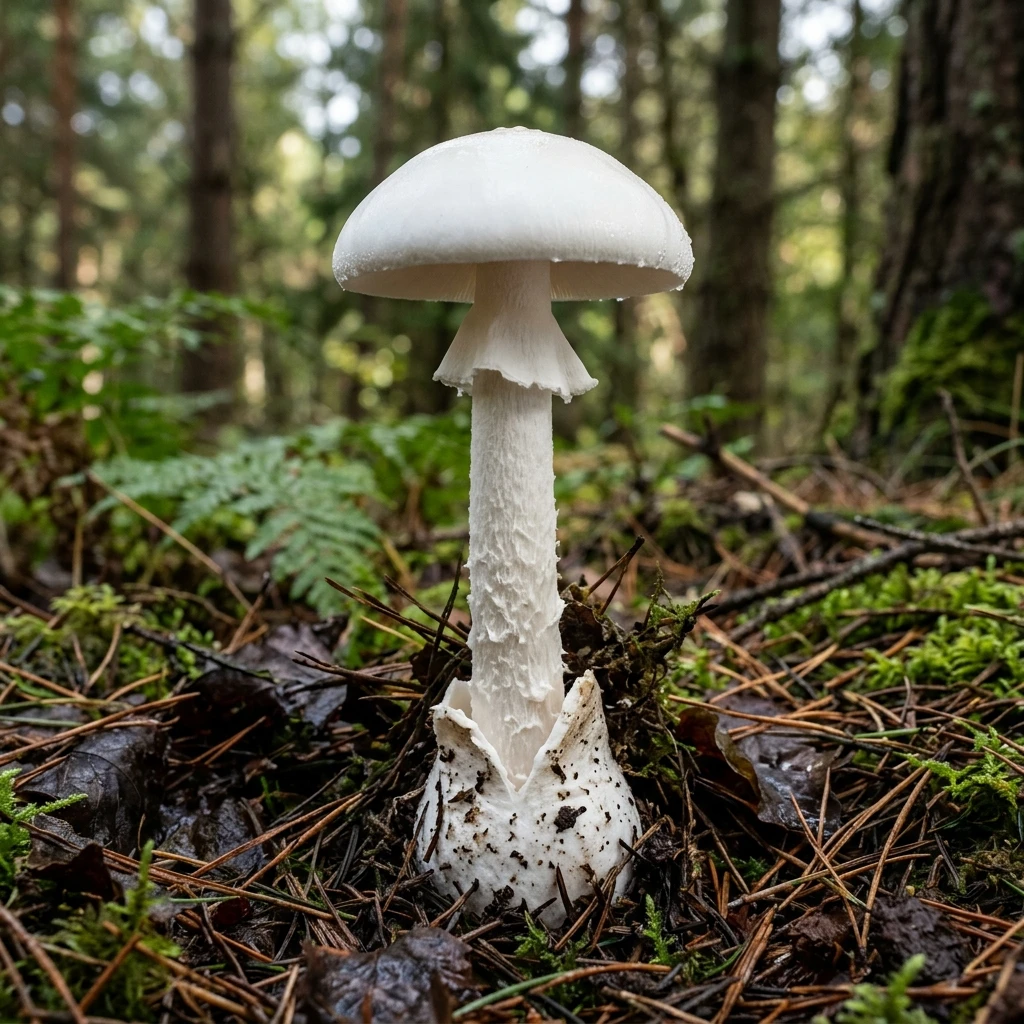
The European Destroying Angel (Amanita virosa) is one of the most deadly, toxic, and highly dangerous wild mushrooms in the world, native to broadleaf and coniferous forests across Europe and parts of Asia. Eerily beautiful in its pure, flawless, snow-white appearance, it represents the ultimate danger in mycology. Growing in mycorrhizal symbiosis with trees, it features a smooth white cap, a characteristically shaggy stem, a delicate high ring, and a prominent bag-like white cup (volva) at the base. Ingesting even a single bite causes lethal liver and kidney failure, making rigorous identification critical.



How to Identify European Destroying Angel
The European Destroying Angel (Amanita virosa) is one of the most deadly, toxic, and highly dangerous wild mushrooms in the world, native to broadleaf and coniferous forests across Europe and parts of Asia. Eerily beautiful in its pure, flawless, snow-white appearance, it represents the ultimate danger in mycology. Growing in mycorrhizal symbiosis with trees, it features a smooth white cap, a characteristically shaggy stem, a delicate high ring, and a prominent bag-like white cup (volva) at the base. Ingesting even a single bite causes lethal liver and kidney failure, making rigorous identification critical.
-
⚠️
Key Visual Features: A stark, pure white mushroom. The cap is smooth, often somewhat sticky when wet, and lacks warts. Unlike the North American A. bisporigera, the stem of Amanita virosa is often noticeably shaggy or scaly. It features a fragile, white, skirt-like ring near the top of the stem, which sometimes tears off or sticks to the cap margin.
-
⚠️
Spore Print & Gills/Pores: CRITICAL SAFETY CHECK: The gills are pure white, crowded, and free (they do not attach to the stem). The spore print is white. Most importantly, the base of the stem is bulbous and encased in a distinct, membranous, sac-like white cup (the volva), which is frequently hidden beneath leaf litter or soil.
-
⚠️
Common Confusions: Extremely dangerous because it is often confused with edible white mushrooms. Foragers searching for the edible Field Mushroom (Agaricus campestris) or Wood Mushroom (Agaricus silvicola) are at the highest risk. Unlike the Destroying Angel, Agaricus species have gills that turn pink and then dark chocolate brown, and they lack a volval sack at the base. It can also be confused with edible puffballs when in the "egg" stage.
Detailed Mycology Profile & Foraging Guide
Follow our detailed scientific field guide and environmental parameters to identify and study European Destroying Angel safely.
Common Look-alikes & Foraging Danger
Yellow KOH Staining
Symptoms: Dropping a tiny amount of potassium hydroxide (KOH) chemical on the white cap skin.
Stem Scale Loss
Symptoms: The warty, shaggy scales on the stem are washed away, leaving a smooth white stem.
Frequently Asked Questions
Why is it called 'Destroying Angel'?
It is named 'Destroying Angel' because of its elegantly beautiful, pure snow-white appearance, which resembles an angel, combined with its lethal, merciless toxicity that destroys human organs.
What are the first symptoms of Destroying Angel poisoning?
There is a highly dangerous delay of 6 to 24 hours with zero symptoms. Then, sudden, violent gastrointestinal cramps, explosive watery diarrhea, and severe vomiting begin, lasting for 24 hours, often leading to severe dehydration.
Why is the delay in symptoms so dangerous?
Because by the time the symptoms appear (up to 24 hours after eating), the liver and kidney cells have already absorbed the amatoxins, and irreversible tissue destruction has already occurred, making treatment extremely difficult.
How do you distinguish it from an edible field mushroom?
Edible field mushrooms (Agaricus species) have gills that start pink and turn chocolate-brown, and they never have a cup at the base of the stem. The lethal Destroying Angel has pure white gills that never turn brown, and its stem base is wrapped in a large, white, bag-like volva cup.