Destroying Angel Foraging & Identification Guide
The Destroying Angel (Amanita bisporigera) is a strikingly beautiful but extremely deadly pure-white mushroom native primarily to eastern North America. Belonging to the lethal Amanita family, it grows in mycorrhizal association with deciduous trees, particularly oaks. Containing lethal levels of amatoxins—the exact same cellular toxins found in the Death Cap—its elegant, clean, all-white structure masks a highly fatal poison that irreversibly destroys the liver and kidneys within days. It represents the ultimate warning for wild mushroom foragers and is responsible for many fatal poisonings every year.





How to Identify Destroying Angel
The Destroying Angel (Amanita bisporigera) is a strikingly beautiful but extremely deadly pure-white mushroom native primarily to eastern North America. Belonging to the lethal Amanita family, it grows in mycorrhizal association with deciduous trees, particularly oaks. Containing lethal levels of amatoxins—the exact same cellular toxins found in the Death Cap—its elegant, clean, all-white structure masks a highly fatal poison that irreversibly destroys the liver and kidneys within days. It represents the ultimate warning for wild mushroom foragers and is responsible for many fatal poisonings every year.
-
⚠️
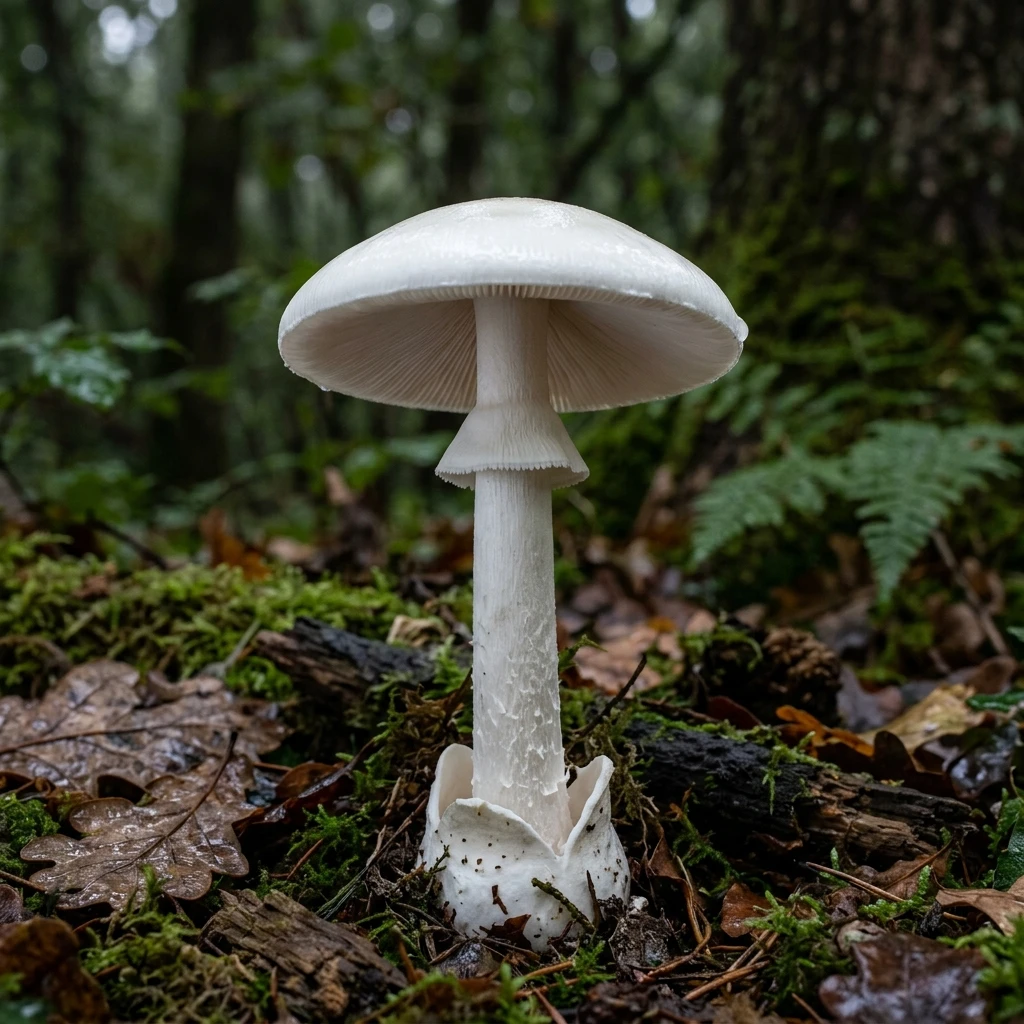
Key Visual Features: A strikingly elegant, medium-to-large mushroom that is completely pure, satin-white from top to bottom. The cap is smooth and lacks the warts seen on other Amanitas. The long white stem features a delicate, skirt-like white ring (annulus) near the top, though this ring can sometimes tear or wash away in the rain.
-
⚠️
Spore Print & Gills/Pores: CRITICAL SAFETY CHECK: The gills are pure white, crowded, and free from the stem (they do not touch it). The spore print is also pure white. The most crucial identifying feature is the base of the stem, which is encased in a distinct, membranous, white cup or sack (the volva). This cup is often hidden entirely underground, which is why foraging without digging up the base is highly dangerous.
-
⚠️
Common Confusions: Frequently and fatally confused with edible white mushrooms such as the Meadow Mushroom (Agaricus campestris), which has pink-to-brown gills and a brown spore print, or the edible White Button and Portobello mushrooms. In its early "egg" stage, it looks identical to edible puffballs, requiring foragers to always slice puffballs perfectly in half to check for the hidden silhouette of gills.
Detailed Mycology Profile & Foraging Guide
Follow our detailed scientific field guide and environmental parameters to identify and study Destroying Angel safely.
Common Look-alikes & Foraging Danger
Ring Tearing
Symptoms: The delicate white hanging ring on the stem tears, collapses, or disappears completely.
Cap Spotting
Symptoms: Small yellow-brown spots or dirt patches appearing on the pure white cap.
Frequently Asked Questions
What is the primary danger of the Destroying Angel?
It is completely snow-white, looking exceptionally clean, pure, and edible. Foragers confuse it with white buttons or puffballs, leading to severe, often fatal amatoxin poisoning within days.
What are the early symptoms of poisoning?
Symptoms appear after a long delay of 6 to 24 hours. The patient suffers from violent abdominal cramps, explosive watery diarrhea, and severe vomiting, leading to dangerous dehydration.
Does the Destroying Angel grow on wood?
No. It is a mycorrhizal soil mushroom that only grows on the ground near hardwood trees (especially oaks). If a white mushroom is growing directly on a decaying log, it is a different species (though still potentially toxic).
How can you tell it apart from a Puffball?
A young Destroying Angel 'egg' can look like a Puffball. However, slicing a Puffball vertically shows a solid white interior like cream cheese, whereas slicing a Destroying Angel egg reveals the outline of a miniature capped mushroom inside.