Fairy Ring Mushroom Foraging & Identification Guide
The Fairy Ring Mushroom (Marasmius oreades), also known as the Scotch Bonnet, is a small, excellent edible wild mushroom famous for its ability to grow in vast, expanding circular rings on grassy lawns, pastures, and golf courses. Highly resilient, it has a unique ability to completely dry out in dry weather and revive, fresh and pliable, when rained upon. Boasting a sweet, nutty, almost almond-like flavor due to high concentrations of trehalose sugar, it is a favorite among grassland foragers and is often dehydrated to flavor soups and broths.





How to Identify Fairy Ring Mushroom
The Fairy Ring Mushroom (Marasmius oreades), also known as the Scotch Bonnet, is a small, excellent edible wild mushroom famous for its ability to grow in vast, expanding circular rings on grassy lawns, pastures, and golf courses. Highly resilient, it has a unique ability to completely dry out in dry weather and revive, fresh and pliable, when rained upon. Boasting a sweet, nutty, almost almond-like flavor due to high concentrations of trehalose sugar, it is a favorite among grassland foragers and is often dehydrated to flavor soups and broths.
-
✔
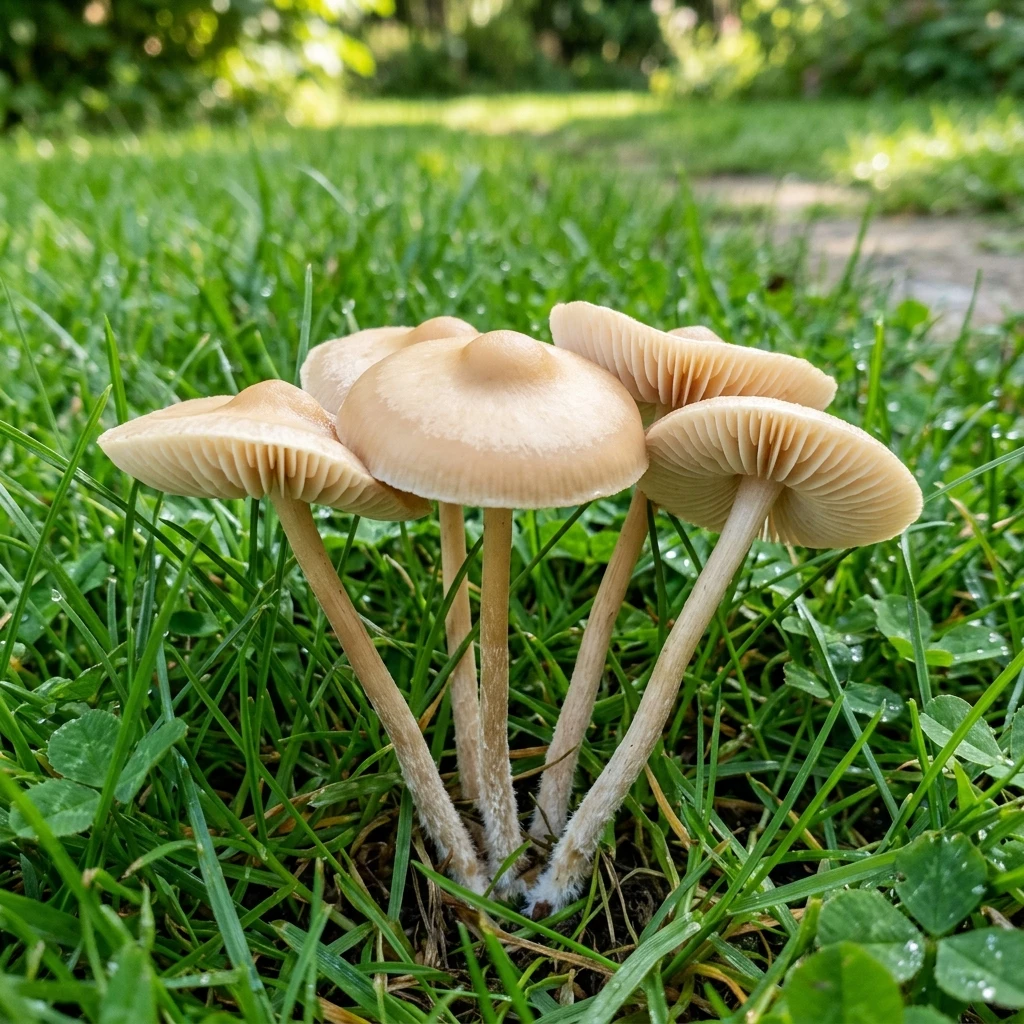
Key Visual Features: A small mushroom (cap 2-5 cm across) that grows directly from grass or soil (never wood). The cap is pale tan to buff, usually featuring a distinct, slightly darker central bump (an umbo). A crucial identifying feature is the stem, which is incredibly tough, leathery, and flexible; it can often be bent completely in half or twisted several times without snapping.
-
✔
Spore Print & Gills/Pores: The gills are creamy white to pale tan and are widely spaced (not crowded together). The gills are free from the stem or just barely attached. The spore print is white. It does not have a ring on the stem.
-
✔
Common Confusions: Because it grows in grass, it must be carefully distinguished from toxic grassland species. It is most dangerously confused with the deadly toxic Fool's Funnel (Clitocybe dealbata) and the Sweating Mushroom (Clitocybe rivulosa), both of which have decurrent, crowded gills, no central bump on the cap, and brittle stems that snap easily. It can also be confused with the non-toxic but unpalatable Haymaker's Mushroom (Panaeolina foenisecii), which has a dark brown spore print.
Detailed Mycology Profile & Foraging Guide
Follow our detailed scientific field guide and environmental parameters to identify and study Fairy Ring Mushroom safely.
Common Look-alikes & Foraging Danger
Dry Shriveling
Symptoms: The small tan caps shrivel up, turning dry, brown, and paper-thin during dry lawn spells.
Fragile Snapping Stem
Symptoms: Small tan mushrooms in a grass ring have stems that snap instantly like chalk when bent.
Frequently Asked Questions
Why do they grow in circles?
The underground mycelium starts from a single point and grows outwards in a uniform circle. As the older central mycelium dies, the active outer ring decomposes organic matter, releasing nutrients that fertilize the grass, creating a visible green ring where mushrooms sprout.
How do you test the stem of a Fairy Ring Mushroom?
Grasp the stem firmly between your fingers and twist or bend it. A true Fairy Ring Mushroom stem is incredibly tough and fibrous; it will twist like a rope without snapping. If the stem snaps easily, it is a dangerous look-alike.
Are the stems edible?
No. The stems are extremely tough, leathery, and woody. Foragers only clip and eat the tender caps, using the stems only if finely powdered for mushroom seasonings.
What causes their sweet almond smell?
Their pleasant, sweet fragrance is due to the presence of small amounts of benzaldehyde and high levels of trehalose sugar, which gives the mushroom a delicious sweet flavor when cooked.