False Parasol Foraging & Identification Guide
The False Parasol (Chlorophyllum molybdites), also known as the Green-Spored Lepiota, is a large, highly common toxic mushroom widely distributed across lawns, parks, and suburban meadows in North America and subtropical regions. Growing in spectacular 'fairy rings' on grassy turf after warm summer rains, it is famously named for its unique dull-green gills (when mature) and green spore print. Because it closely resembles edible parasol mushrooms and common white button mushrooms, it is notoriously known as the most frequent cause of severe gastrointestinal mushroom poisoning in North America.





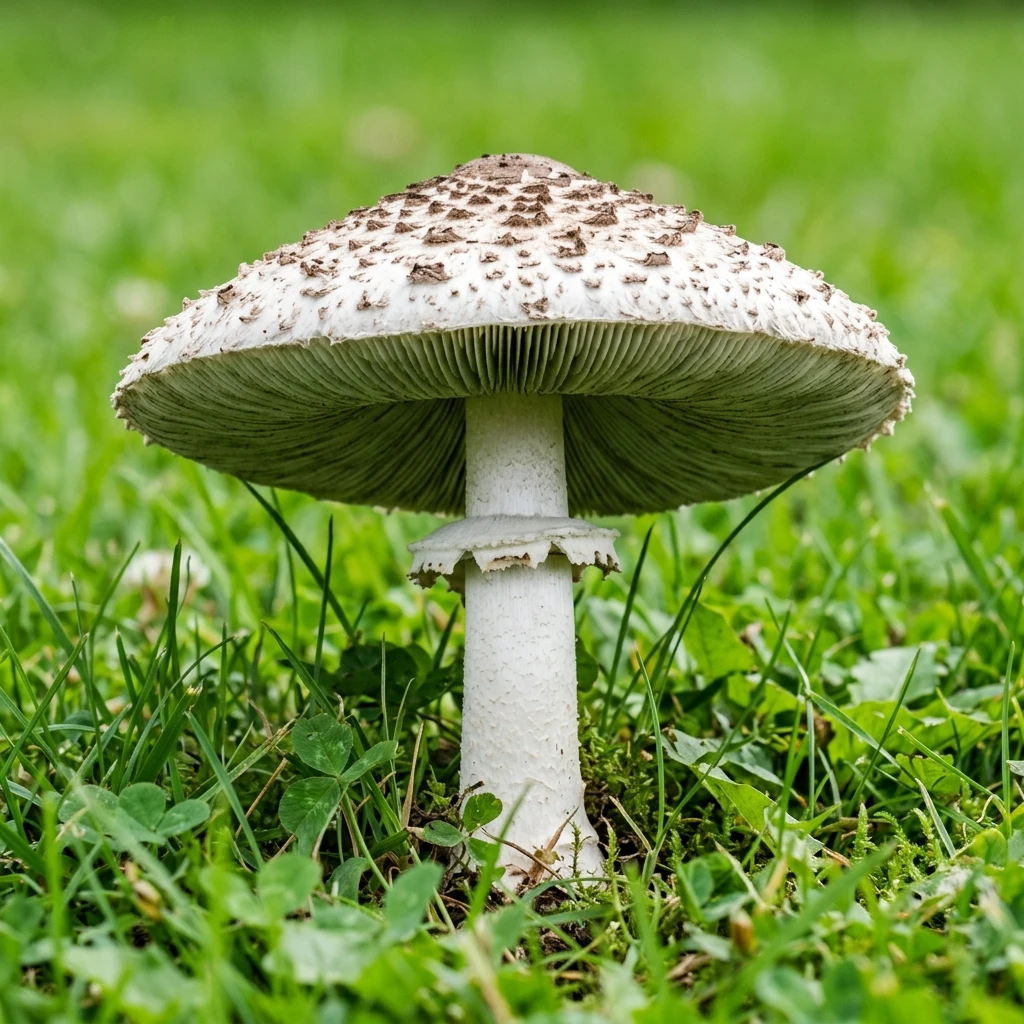
How to Identify False Parasol
The False Parasol (Chlorophyllum molybdites), also known as the Green-Spored Lepiota, is a large, highly common toxic mushroom widely distributed across lawns, parks, and suburban meadows in North America and subtropical regions. Growing in spectacular 'fairy rings' on grassy turf after warm summer rains, it is famously named for its unique dull-green gills (when mature) and green spore print. Because it closely resembles edible parasol mushrooms and common white button mushrooms, it is notoriously known as the most frequent cause of severe gastrointestinal mushroom poisoning in North America.
-
⚠️
Key Visual Features: A very large, stately mushroom that grows exclusively in grass (never on wood). The cap starts as a sphere and expands flat (often 10-20 cm across). It is whitish but covered in coarse, brownish, shaggy scales, particularly concentrated at the dark brown center. The thick white stem features a prominent, thick, double-edged ring that can often slide up and down the stem.
-
⚠️
Spore Print & Gills/Pores: CRITICAL SAFETY CHECK: The defining feature of this mushroom is the color of its mature gills and spores. While young gills are white, as they mature they turn a distinct grayish-green or olive-green. Taking a spore print will yield a pale olive-green print, which is highly unusual and confirms the identification instantly.
-
⚠️
Common Confusions: Extremely dangerous because it is frequently mistaken for edible species like the true Parasol Mushroom (Macrolepiota procera) and the Shaggy Parasol (Chlorophyllum rhacodes), both of which have white spore prints and never turn green. It is also often eaten by inexperienced foragers who mistake young specimens for edible meadow mushrooms (Agaricus campestris) or store-bought white button mushrooms.
Detailed Mycology Profile & Foraging Guide
Follow our detailed scientific field guide and environmental parameters to identify and study False Parasol safely.
Common Look-alikes & Foraging Danger
Pale White Gills
Symptoms: Young mushrooms in a lawn ring have pure white gills, with no hint of green.
Fairy Ring Grass Death
Symptoms: A perfect ring of dark green grass with a dead zone of dried grass inside, where mushrooms emerge.
Frequently Asked Questions
Why is this mushroom called the 'False Parasol'?
It is named 'False Parasol' because it looks almost identical to the highly prized edible Parasol Mushroom (Macrolepiota procera) in cap size, brown scales, and stem ring, but carries severe toxins.
What happens if you eat a False Parasol?
Within 1 to 3 hours, it triggers extremely violent gastrointestinal distress: severe abdominal pain, explosive watery and bloody diarrhea, vomiting, and extreme dehydration, often requiring hospitalization.
Can cooking make the False Parasol safe to eat?
No. The toxic protein molybdophyllysin is highly heat-resistant and cannot be deactivated or broken down by boiling, baking, pan-searing, or drying. It remains highly toxic.
How do you distinguish it from the Shaggy Parasol?
Perform a spore print: the False Parasol produces a unique dull green spore print, whereas the Shaggy Parasol (Chlorophyllum rhacodes) produces a pure white spore print and its flesh stains bright saffron-red when cut.