Fluted Bird's Nest Foraging & Identification Guide
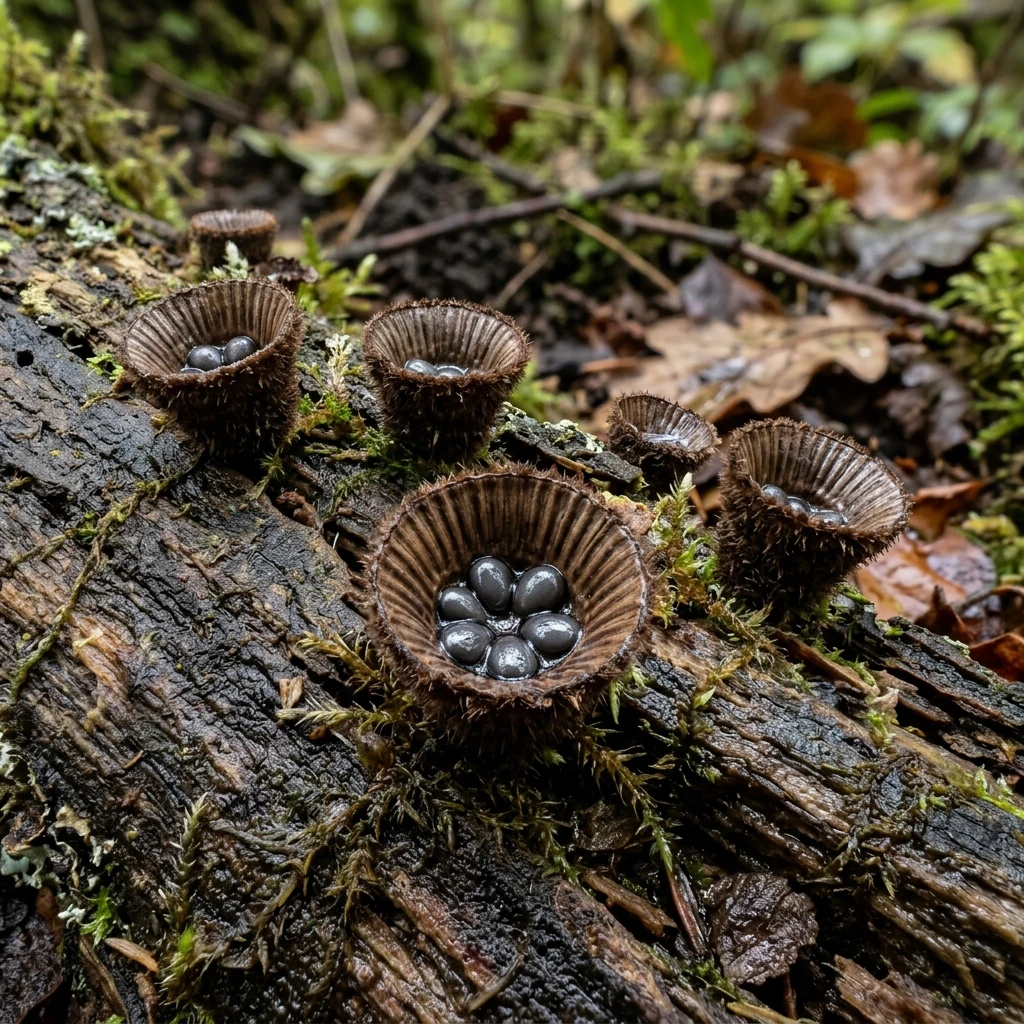
The Fluted Bird's Nest (Cyathus striatus) is a highly intricate, fascinating, and inedible micro-fungus widely distributed in temperate forests worldwide. Typically growing in dense, clustered colonies on decaying hardwood logs, mulch, and twigs, it is named for its striking, miniature resemblance to a bird's nest filled with tiny eggs. Featuring tiny brown cups with fine, vertical fluted ridges inside and holding small gray spore-bearing discs, it utilizes a brilliant physical mechanism to disperse its spores: raindrops fall into the cup, violently splashing the "eggs" out onto nearby surfaces.





How to Identify Fluted Bird's Nest
The Fluted Bird's Nest (Cyathus striatus) is a highly intricate, fascinating, and inedible micro-fungus widely distributed in temperate forests worldwide. Typically growing in dense, clustered colonies on decaying hardwood logs, mulch, and twigs, it is named for its striking, miniature resemblance to a bird's nest filled with tiny eggs. Featuring tiny brown cups with fine, vertical fluted ridges inside and holding small gray spore-bearing discs, it utilizes a brilliant physical mechanism to disperse its spores: raindrops fall into the cup, violently splashing the "eggs" out onto nearby surfaces.
-
✔
Key Visual Features: Extremely small (usually only 7-10 mm tall and 6-8 mm wide). It forms tiny, cone-shaped or funnel-shaped cups that are covered in shaggy, coarse brown hairs on the outside. When mature, the inside of the cup is exposed, revealing distinct, vertical grooves or lines (striations/fluting) that run down the inner walls.
-
✔
Spore Print & Gills/Pores: Lacks gills or pores entirely. Instead, the "nest" holds several tiny, silver-gray, lentil-shaped discs called peridioles (the "eggs"). These peridioles contain the spores. They are attached to the inside of the cup by microscopic, coiled threads that uncoil and tangle around twigs or grass when splashed out by rain.
-
✔
Common Confusions: Easily confused with other species of Bird's Nest fungi. It is distinguished from the Common Bird's Nest (Crucibulum laeve) by its shaggy exterior, darker colored eggs, and most importantly, the vertical grooves (striations) on the inside of the cup. Crucibulum laeve has a smooth inner cup and white eggs. It is entirely inedible due to its tiny size and tough, woody texture.
Detailed Mycology Profile & Foraging Guide
Follow our detailed scientific field guide and environmental parameters to identify and study Fluted Bird's Nest safely.
Common Look-alikes & Foraging Danger
White Membrane Cover (Young Stage)
Symptoms: The tiny cups are closed at the top, covered by a thin, white-to-orange fuzzy membrane.
Empty Nest Cups
Symptoms: The brown fluted cups are completely empty, with no gray eggs left at the bottom.
Frequently Asked Questions
How do the 'eggs' get out of the nest?
This fungus uses a 'splash cup' mechanism. The cup is shaped and angled so that when a raindrop hits the bottom, the water pressure hurls the gray spore-bearing eggs out of the cup, launching them up to 2 meters away.
Are the 'eggs' real eggs?
No. The 'eggs' are actually peridioles—hard, protective discs containing millions of microscopic spores. As the peridiole slowly decays on a nearby twig, it releases the spores to colonize new wood.
Does it harm garden plants?
No. Fluted Bird's Nest is completely saprophytic, feeding only on dead wood and mulch. It is highly beneficial for your garden soil, converting wood into rich organic matter.
How do you tell it apart from the Crucible Fungus?
Fluted Bird's Nest has a furry, dark-brown cup with vertical ridges inside and gray eggs. Crucible Fungus (Crucibulum laeve) has a smooth, bright yellow-to-cream cup interior and white eggs.