Fly Agaric Identification & Safety Foraging & Identification Guide
Fly Agaric (Amanita muscaria) is perhaps the most iconic, widely recognized, and visually striking wild mushroom in the world. Famous for its bright red cap studded with white, wart-like spots, it has been immortalized in fairy tales, video games, and pop culture. Native to temperate and boreal regions of the Northern Hemisphere, it grows in a symbiotic, mycorrhizal relationship with birch, pine, and spruce trees. However, beneath its beautiful exterior lies high toxicity due to psychoactive alkaloids like ibotenic acid and muscimol.





How to Identify Fly Agaric Identification & Safety
Fly Agaric (Amanita muscaria) is perhaps the most iconic, widely recognized, and visually striking wild mushroom in the world. Famous for its bright red cap studded with white, wart-like spots, it has been immortalized in fairy tales, video games, and pop culture. Native to temperate and boreal regions of the Northern Hemisphere, it grows in a symbiotic, mycorrhizal relationship with birch, pine, and spruce trees. However, beneath its beautiful exterior lies high toxicity due to psychoactive alkaloids like ibotenic acid and muscimol.
-
⚠️
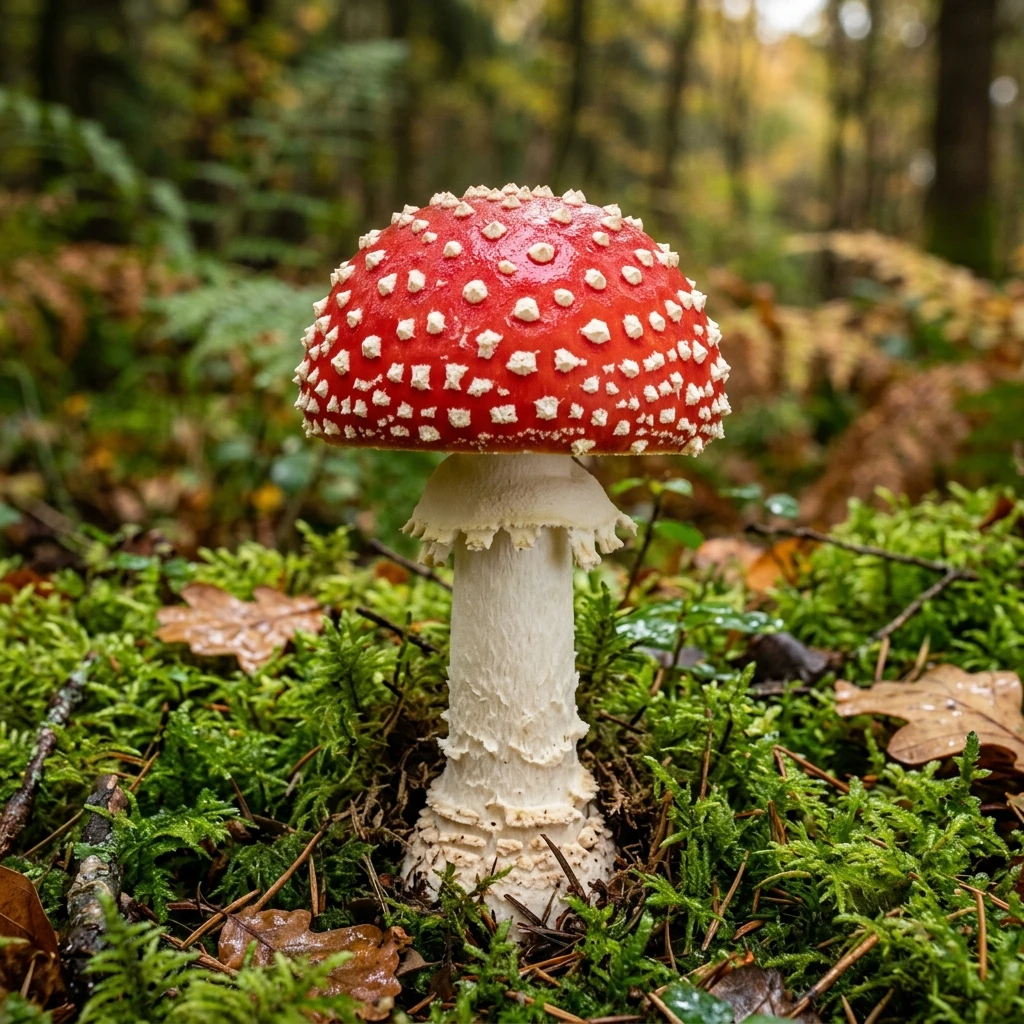
Key Visual Features: A large, fleshy forest mushroom immediately recognizable by its scarlet-red cap dotted with white pyramid-like patches (remnants of a universal veil). It has a white, sturdy stem with a skirt-like ring (annulus) and a bulbous base covered in shaggy bands of tissue (volva).
-
⚠️
Spore Print & Gills/Pores: CRITICAL TOXICITY WARNING: The gills are pure white, densely packed, and free from the stem. It yields a stark white spore print. The flesh is white, slightly yellowish under the red cap cuticle.
-
⚠️
Common Confusions: Distinctive enough to rarely be confused with edible species. However, heavy rain can wash the white spots off the red cap, making it resemble the edible Caesar's Mushroom (Amanita caesarea), which has yellow gills and a yellow stem, unlike the white gills/stem of the Fly Agaric. In North America, there are yellow/orange variants (var. guessowii or var. flavivolvata) that look different from the classic red European type.
Detailed Mycology Profile & Foraging Guide
Follow our detailed scientific field guide and environmental parameters to identify and study Fly Agaric Identification & Safety safely.
Common Look-alikes & Foraging Danger
Amanita caesarea (Caesar's Mushroom)
Symptoms: A similar orange-red cap, but featuring golden-yellow gills, yellow stem, yellow ring, and a sack-like volva.
Amanita pantherina (Panther Cap)
Symptoms: Bronze or brown cap covered with similar white spots, white gills, white stem, and a prominent ring.
Frequently Asked Questions
Is Fly Agaric lethal to humans?
While Fly Agaric (Amanita muscaria) is highly toxic and hallucinogenic, fatalities in healthy adult humans are extremely rare. However, ingesting it causes severe gastrointestinal distress, confusion, visual distortions, and loss of coordination. It is highly dangerous and must never be consumed.
Why does the Fly Agaric have white spots on its red cap?
The iconic white patches or spots are actually remnants of the 'universal veil' - a protective egg-like membrane that enclosed the entire mushroom when it was in its immature button stage. As the red cap expands, the veil tears apart, leaving behind scaly white patches.