Funeral Bell Foraging & Identification Guide
The Funeral Bell (Galerina marginata), also known as the Deadly Galerina, is a small, unremarkable but highly lethal wood-decaying mushroom found throughout temperate forests globally. Typically growing in clusters on rotting conifer and hardwood logs, its small, orange-brown caps mask a deadly concentration of amatoxins, the same poison found in the Death Cap. Due to its size and wood-decay habitat, it presents an extreme hazard, frequently confused with popular edible wood-inhabiting mushrooms like the Sheathed Woodtuft or the Velvet Foot (Enoki).





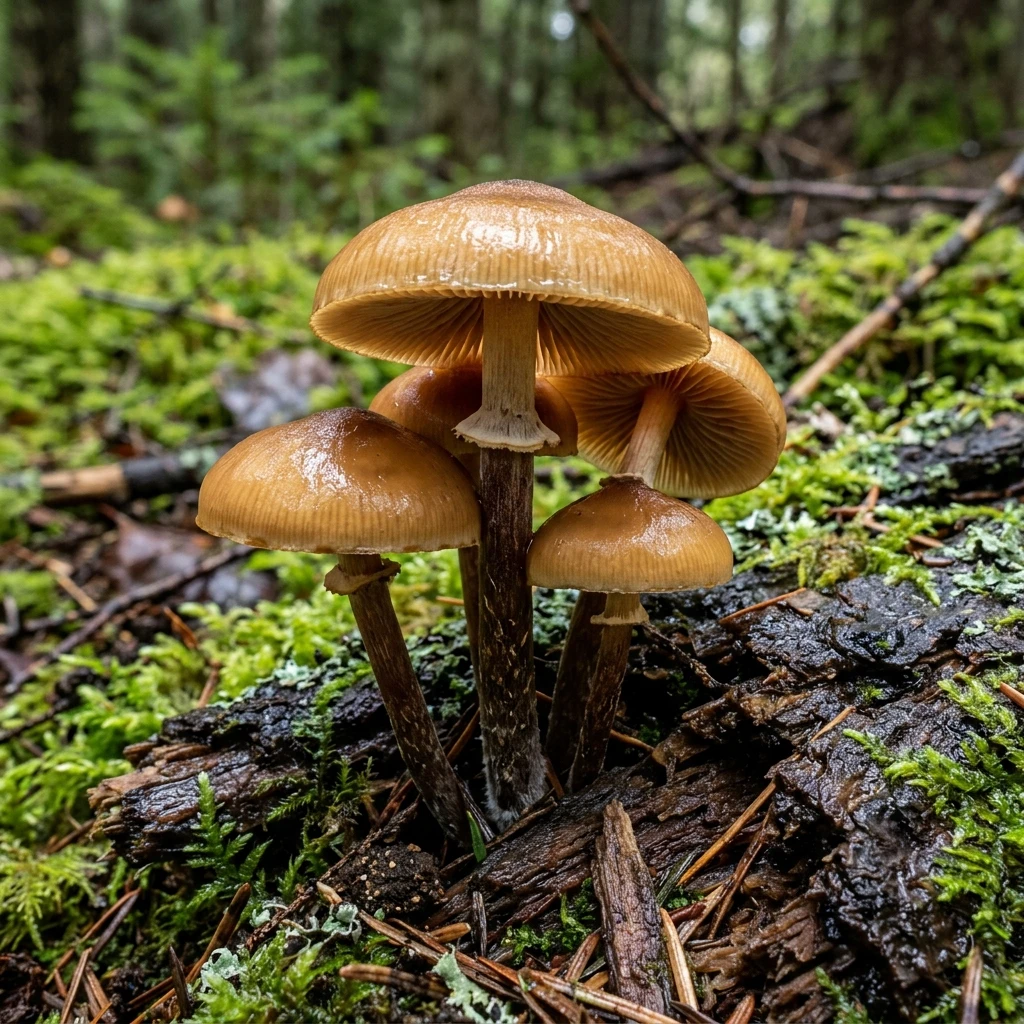
How to Identify Funeral Bell
The Funeral Bell (Galerina marginata), also known as the Deadly Galerina, is a small, unremarkable but highly lethal wood-decaying mushroom found throughout temperate forests globally. Typically growing in clusters on rotting conifer and hardwood logs, its small, orange-brown caps mask a deadly concentration of amatoxins, the same poison found in the Death Cap. Due to its size and wood-decay habitat, it presents an extreme hazard, frequently confused with popular edible wood-inhabiting mushrooms like the Sheathed Woodtuft or the Velvet Foot (Enoki).
-
⚠️
Key Visual Features: Features a small (1-4 cm), broadly convex to flat, sticky, yellowish-brown to tawny-orange cap that is often striate (lined) near the margin when moist. The stem is brownish, fibrous, and bears a small, fragile, membranous ring that may disappear with age. It always grows on decaying wood.
-
⚠️
Spore Print & Gills/Pores: CRITICAL TOXICITY WARNING: The gills are attached to the stem, close together, and yellowish-brown to rusty-brown. It yields a distinct rusty-brown spore print. The flesh is thin and brownish.
-
⚠️
Common Confusions: Highly dangerous due to its resemblance to the edible Sheathed Woodtuft (Kuehneromyces mutabilis) and the Velvet Foot/Enoki (Flammulina velutipes) in the wild. Enoki has a white spore print and no ring, while the Funeral Bell has a rusty-brown spore print and a ring. Magic mushroom foragers also mistake it for Psilocybe species which have dark purplish-brown spores.
Detailed Mycology Profile & Foraging Guide
Follow our detailed scientific field guide and environmental parameters to identify and study Funeral Bell safely.
Common Look-alikes & Foraging Danger
Ring Disappearance
Symptoms: The tiny, fragile whitish ring on the slender stem disappears or turns invisible.
Color Bleaching
Symptoms: The moist brownish-orange cap dries out to a dull, pale yellowish-tan.
Frequently Asked Questions
What toxins does the Funeral Bell contain?
It contains deadly amatoxins (specifically alpha-amanitin), the exact same family of cytotoxins found in the Death Cap. Amatoxins destroy liver and kidney cells, leading to organ failure.
What is the most dangerous look-alike of the Funeral Bell?
Its most dangerous look-alikes are the edible Wild Enoki (Velvet Foot) and the Sheathed Woodtuft, as all grow in dense brown clusters on decaying forest logs during the same autumn season.
How do you distinguish Funeral Bell from Wild Enoki?
Perform a spore print: Funeral Bell has a rusty-brown spore print and a stem ring, whereas Wild Enoki has a white spore print, a velvety dark-brown stem base, and completely lacks a ring.
Can a child die from eating a Funeral Bell?
Yes. Because the mushroom is small, children are at high risk. Ingesting even one or two small caps contains enough amatoxin to cause fatal liver failure in a child.