Glowing Mycena Foraging & Identification Guide
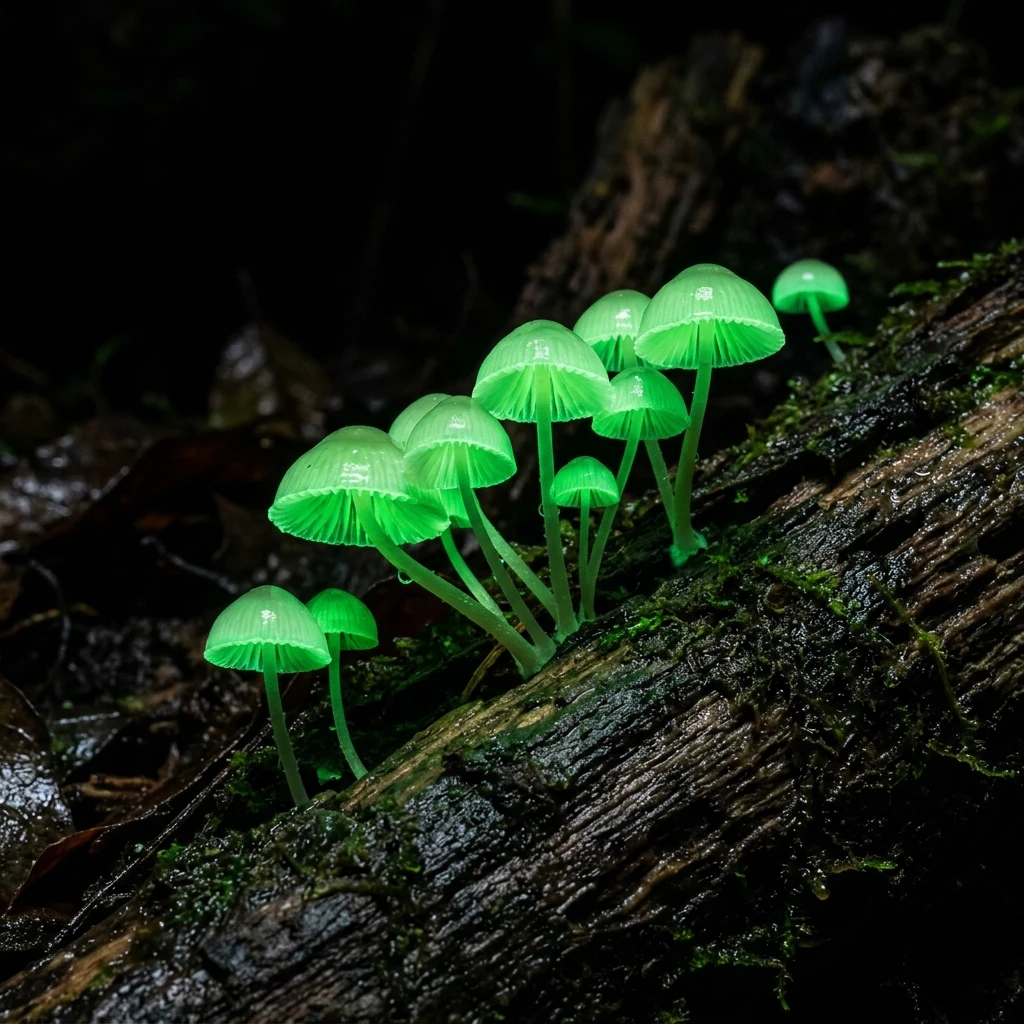
The Glowing Mycena (Mycena chlorophos), also known as the Pale-Green Bioluminescent Mycena, is a spectacular and legendary bioluminescent micro-mushroom native to subtropical forests across East Asia, Australia, and the Pacific Islands. Renowned for its astonishing ability to emit a bright, eerie, pale-green light in complete darkness, it is a magnificent marvel of natural biochemistry. Typically growing in delicate clusters on decaying hardwood branches and bamboo stems, it represents a peak interest in nocturnal forest ecology. Note: This mushroom is strictly for observational enjoyment and is not edible.





How to Identify Glowing Mycena
The Glowing Mycena (Mycena chlorophos), also known as the Pale-Green Bioluminescent Mycena, is a spectacular and legendary bioluminescent micro-mushroom native to subtropical forests across East Asia, Australia, and the Pacific Islands. Renowned for its astonishing ability to emit a bright, eerie, pale-green light in complete darkness, it is a magnificent marvel of natural biochemistry. Typically growing in delicate clusters on decaying hardwood branches and bamboo stems, it represents a peak interest in nocturnal forest ecology. Note: This mushroom is strictly for observational enjoyment and is not edible.
-
✔
Key Visual Features: In daylight, it appears as an unremarkable, tiny, pale gray to whitish mushroom. The cap is bell-shaped to convex, highly viscid (sticky) when wet, measuring only 5-30 mm across. The stem is slender, fragile, and whitish. In total darkness, both the cap and gills emit a steady, vivid pale-green glow.
-
✔
Spore Print & Gills/Pores: Gills: The gills are whitish or pale gray, attached to the stem or slightly decurrent. They emit the strongest bioluminescence of any part of the mushroom. Spore Print: White.
-
⚠️
Common Confusions: Due to its striking bioluminescence, it is hard to confuse at night. However, during the day, it resembles many other small, nondescript Mycena or white-spored mushrooms. Other bioluminescent fungi, like the Ghost Fungus (Omphalotus nidiformis) or Panellus stipticus, glow similarly but differ significantly in size, shape, and substrate preferences.
Detailed Mycology Profile & Foraging Guide
Follow our detailed scientific field guide and environmental parameters to identify and study Glowing Mycena safely.
Common Look-alikes & Foraging Danger
Loss of Bioluminescence
Symptoms: The mushroom cap looks healthy but completely stops emitting its pale-green light at night.
Shriveling and Wilting
Symptoms: The delicate white stalks fold, dry up, and turn into thin black threads within hours of rising sun.
Frequently Asked Questions
How does the Glowing Mycena emit light?
It glows through a process called bioluminescence. A chemical called fungal luciferin reacts with oxygen in the presence of an enzyme called luciferase, releasing energy in the form of a bright, cold, pale-green light.
Why does the mushroom glow in the dark?
Biologists believe the glow serves to attract nocturnal insects like beetles, flies, and gnats. These insects crawl over the glowing mushroom, get covered in spores, and help disperse the spores throughout the dark forest.
Can you grow Glowing Mycena at home?
Yes. It can be cultivated in sterile agar cultures and grown on pasteurized hardwood sawdust blocks inside highly humid, temperature-controlled terrariums (kept at 25-27°C).
Is the green glow warm to the touch?
No. Like fireflies, the mushroom's light is 'cold light.' Almost 100% of the energy from the chemical reaction is converted into light rather than heat, so the mushroom remains completely cool.