Gilled Bolete Foraging & Identification Guide
The Gilled Bolete (Phylloporus rhodoxanthus), also known as the Golden-gilled Bolete, is a highly unique, fascinating, and edible wild mushroom native to temperate broadleaf and mixed forests across North America, Europe, and Asia. Growing in mycorrhizal symbiosis with oak and beech, it represents a legendary evolutionary link in mycology. Uniquely for a member of the Boletaceae family (which normally have sponge-like pores), it features highly prominent, bright golden-yellow sheet-like gills that are thick, wavy, and run slightly down the stem. This remarkable transitional structure makes it an essential study in fungal evolution.





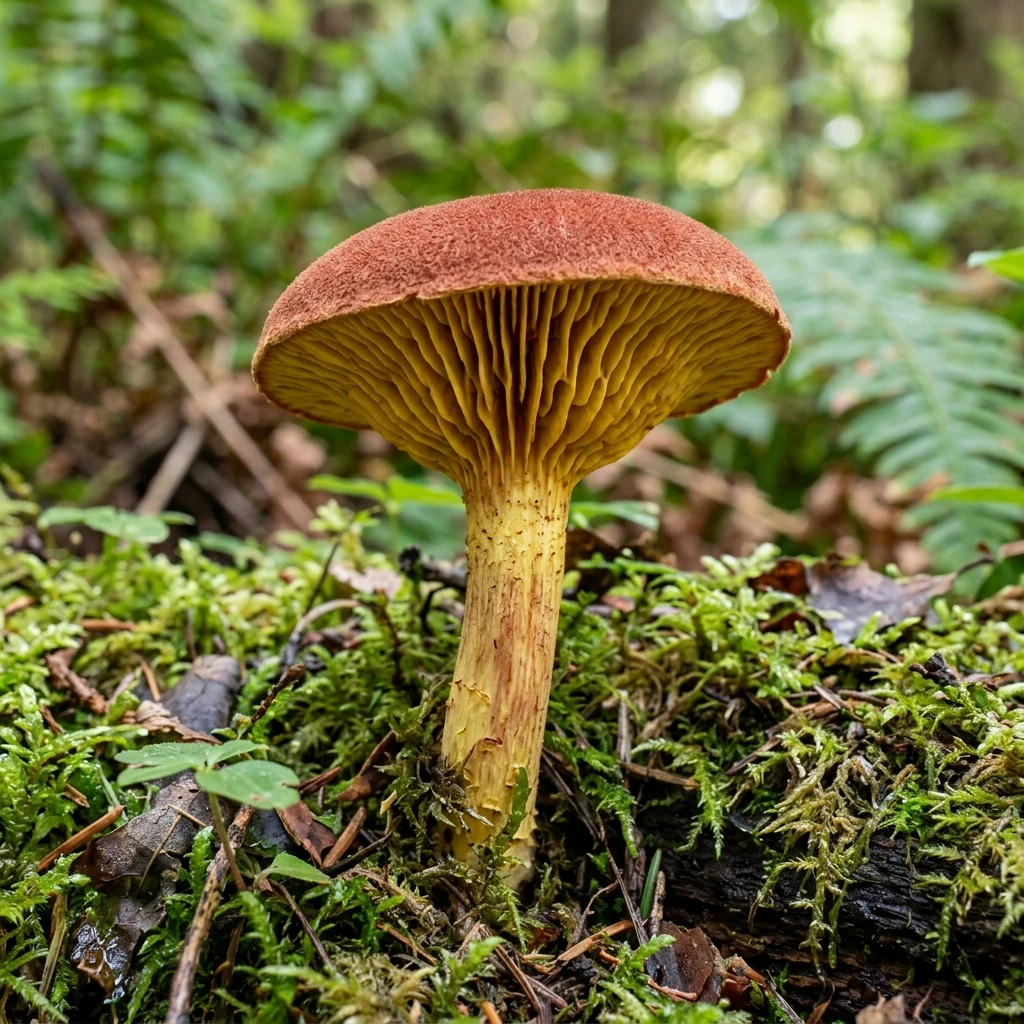
How to Identify Gilled Bolete
The Gilled Bolete (Phylloporus rhodoxanthus), also known as the Golden-gilled Bolete, is a highly unique, fascinating, and edible wild mushroom native to temperate broadleaf and mixed forests across North America, Europe, and Asia. Growing in mycorrhizal symbiosis with oak and beech, it represents a legendary evolutionary link in mycology. Uniquely for a member of the Boletaceae family (which normally have sponge-like pores), it features highly prominent, bright golden-yellow sheet-like gills that are thick, wavy, and run slightly down the stem. This remarkable transitional structure makes it an essential study in fungal evolution.
-
✔
Key Visual Features: Caps are 3-10 cm across, initially convex but becoming flat, dry, velvety, and reddish-brown, cinnamon-brown, or dark red. The stem is 3-8 cm long, relatively slender compared to typical boletes, and yellowish to reddish-brown, sometimes tapering towards the base.
-
✔
Spore Print & Gills/Pores: Gills: The gills are bright golden-yellow, thick, widely spaced, and frequently have cross-veins or forks (anastomosing), especially near the stem. They run slightly down the stem (decurrent) and may slowly stain weak blue-green or not at all when damaged. Spore Print: Yellowish-brown to olivaceous-brown.
-
⚠️
Common Confusions: The unique combination of a "bolete-like" fleshy cap and stem with thick, yellow gills makes it easily recognizable. It could potentially be confused with Paxillus involutus (Brown Roll-rim), which is toxic, but Paxillus has a strongly inrolled margin, browner gills that stain dark brown, and lacks the bright yellow, thick gills of Phylloporus.
Detailed Mycology Profile & Foraging Guide
Follow our detailed scientific field guide and environmental parameters to identify and study Gilled Bolete safely.
Common Look-alikes & Foraging Danger
Gill Decay (Waterlogging)
Symptoms: The bright golden-yellow gills turn a dark, soggy brownish-gray and melt into a soft mass.
Cap Fading
Symptoms: The velvety reddish-brown cap turns a pale grayish-yellow and loses its velvety texture.
Frequently Asked Questions
Why is it called 'Gilled Bolete'?
It is named 'Gilled Bolete' because it is a member of the bolete family that has evolved to have true sheet-like gills instead of the standard sponge-like tube pores typical of other boletes.
Is it safe to eat?
Yes. It is edible and safe, with a mild, pleasant flavor. It is not considered a top-tier gourmet mushroom due to its relatively small size and soft texture, but it is highly valued by foragers for its uniqueness.
Does the Gilled Bolete turn blue?
Yes. Both its golden-yellow gills and its inner yellow flesh stain a slow, faint blue-green when scratched, cut, or bruised, which is a classic chemical trait shared with many other boletes.
How do you distinguish it from the toxic Jack-O'-Lantern?
The toxic Jack-O'-Lantern (Omphalotus illudens) is large, bright orange, grows in dense clusters strictly on dead wood or buried stumps, and never stains blue. The edible Gilled Bolete is small, has a reddish-brown velvety cap, grows singly on mossy soil under oak trees, and turns slow blue-green.