Golden Oyster Foraging & Identification Guide
The Golden Oyster Mushroom (Pleurotus citrinopileatus) is an incredibly beautiful and vibrant edible fungus native to subtropical forests in Eastern Asia. Famous for its brilliant, bright golden-yellow caps and funnel-shaped margins, this wood-decaying saprophyte grows in large, dense clusters on decaying hardwoods, offering a delicate texture and a pleasant peppery, nutty flavor. It is widely cultivated for food and has also escaped cultivation in some regions.





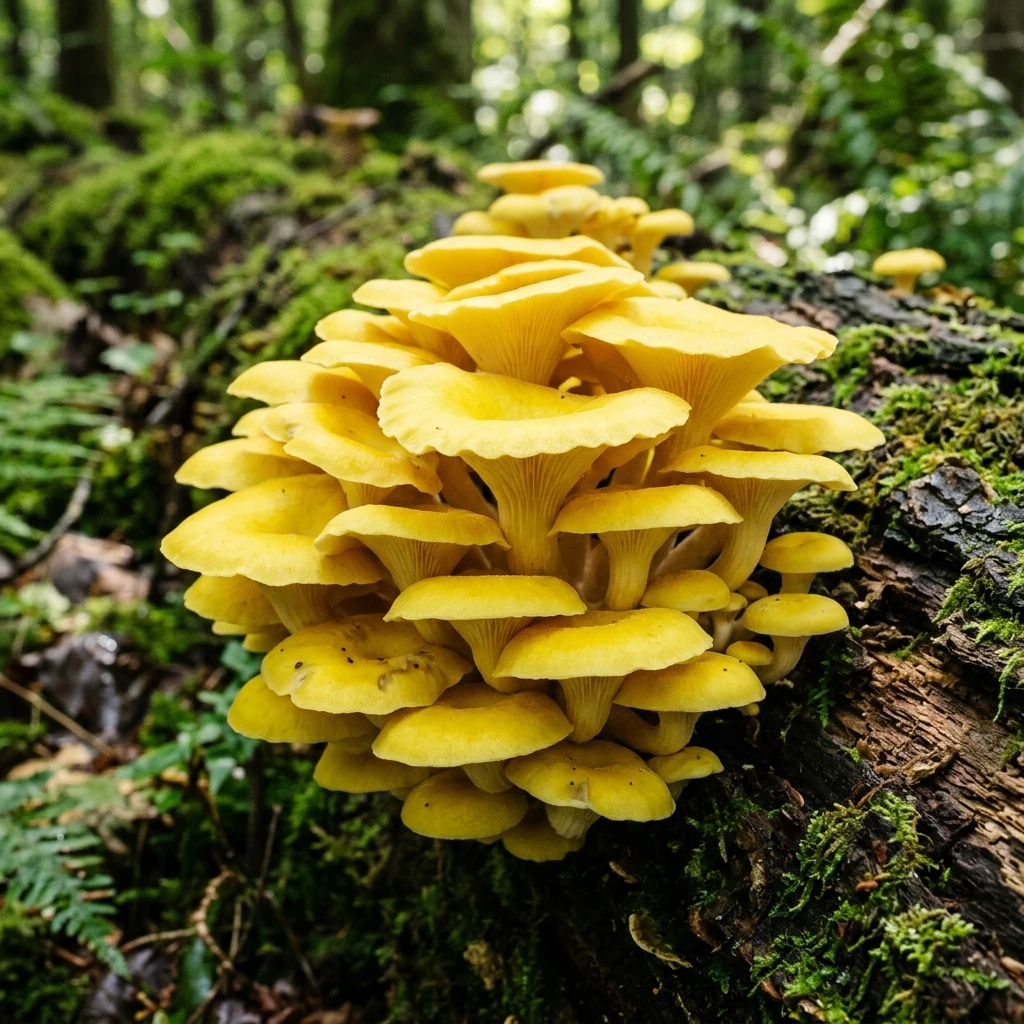
How to Identify Golden Oyster
The Golden Oyster Mushroom (Pleurotus citrinopileatus) is an incredibly beautiful and vibrant edible fungus native to subtropical forests in Eastern Asia. Famous for its brilliant, bright golden-yellow caps and funnel-shaped margins, this wood-decaying saprophyte grows in large, dense clusters on decaying hardwoods, offering a delicate texture and a pleasant peppery, nutty flavor. It is widely cultivated for food and has also escaped cultivation in some regions.
-
✔
Key Visual Features: Grows in prominent, dense clusters. The cap is initially bright yellow to golden yellow, fading slightly with age, convex but becoming depressed or funnel-shaped (infundibuliform). The cap surface is smooth and dry. The stem is white to pale yellow, often curved, and typically central to slightly off-center.
-
✔
Spore Print & Gills/Pores: Gills: The gills are white to cream, crowded, and run down the stem (decurrent). Spore Print: Pale pinkish to lilac-tinged.
-
✔
Common Confusions: The striking bright yellow caps make it relatively easy to identify. It might be confused with other yellow mushrooms, but the combination of its decurrent gills, growth on dead hardwood in tight clusters, and characteristic oyster mushroom shape help distinguish it. Be aware that it may resemble some Gymnopilus species (which have rusty-orange spore prints and bitter taste, and some are toxic) if not examined carefully.
Detailed Mycology Profile & Foraging Guide
Follow our detailed scientific field guide and environmental parameters to identify and study Golden Oyster safely.
Common Look-alikes & Foraging Danger
Light Deprivation Paleness
Symptoms: The caps turn pale off-white, lose their golden color, and stems grow excessively long.
Cap Edge Cracking
Symptoms: The edges of the yellow caps turn dry, curled upwards, and develop cracks.
Frequently Asked Questions
Does the yellow color stay after cooking?
The bright yellow cap color will fade slightly to a light beige-yellow when cooked, but pan-searing them quickly on high heat preserves the maximum color and creates a delicious crispy edge.
What does a Golden Oyster mushroom taste like?
It has a mild, savory taste with a pleasant cashew-nutty aroma and a slightly peppery finish. The texture is tender and slightly crispy in the cap.
How fast do Golden Oysters grow?
They are incredibly fast growers. Once pinheads emerge, they can reach full harvest size in just 3 to 4 days, requiring close monitoring during the final fruiting phase.
How do you store them?
Because they are thin and fragile, they have a short shelf life. Store them in a ventilated paper bag in the fridge and consume within 3 days for peak quality.