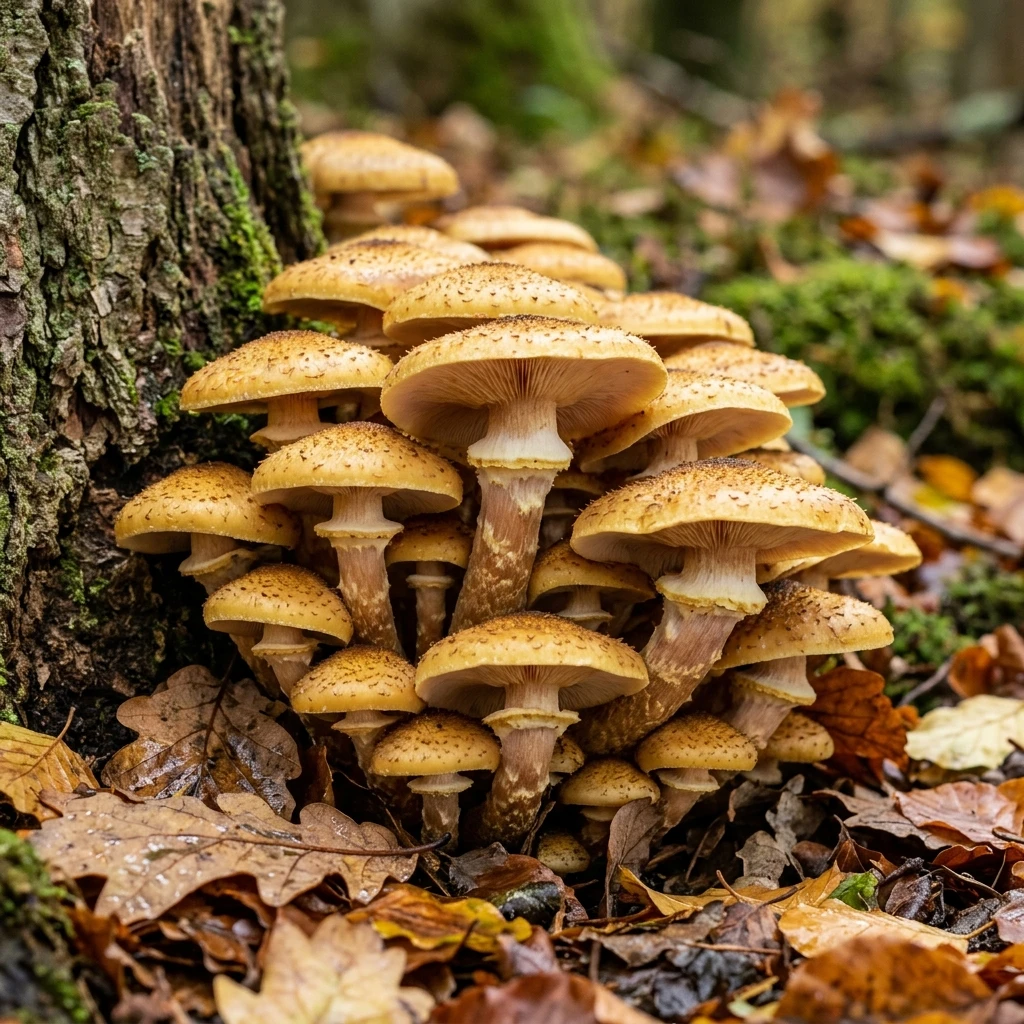
Armillaria mellea

Honey Mushroom Foraging & Identification Guide

The Honey Mushroom, or Bootlace Fungus, is a highly common, popular, and choice wild edible mushroom native to temperate forests globally. Eerily famous as a massive forest parasite, it spreads underground using black, wire-like cords (rhizomorphs) that can grow to be the largest living organisms on Earth. Growing in spectacular, massive clusters at the base of trees, it features a honey-yellow cap covered in tiny, dark hair-like scales, and a fibrous stem with a distinct waxy ring. However, it is a crucial study in safety as it has a lethal, poisonous look-alike.


Environment Icon
Environment Broadleaf Deciduous Forests
Humidity Icon
Humidity High Humidity (70-80%)
Substrate Icon
Substrate / Host Living Oak trunks / Hardwood Logs
Size Icon
Size 3cm - 15cm
Category Icon
Category Edible
Botanical macro photography of Honey Mushroom (Armillaria mellea) - Plant AI care database

How to Identify Honey Mushroom

Dense, massive clusters of honey-yellow mushrooms with white gills, a waxy ring on the stem, and tiny dark hairs on the cap.

  • Cap: Varies by species.
  • Spore: Critical check.
💡 Plant AI Tip: 🍳 MANDATORY COOKING: Highly delicious, but Toxic Raw! It contains heat-sensitive gastrointestinal irritants. It must be boiled or cooked thoroughly for at least 15 minutes, which completely destroys the toxins, rendering it choice edible.

Detailed Mycology Profile & Foraging Guide

Follow our detailed scientific field guide and environmental parameters to identify and study Honey Mushroom safely.

Grows as a powerful parasite and wood-decomposer on deciduous hardwood trees, especially Oak, Beech, and Maple. Fruits in massive, spectacular clusters at the base of living trunks or hollow stumps in autumn.
Requires cool, damp autumn conditions (8-16°C). It sprouts abundantly within a few days after heavy autumn downpours in mixed forests.
Thrives in shaded broadleaf woodlands, nestled under dense canopies. Complete shade helps protect the honey-yellow cap from drying out.
Cap is convex, 3 to 15 cm. Gills are white, densely spaced, and run slightly down the stem, producing white spores.
Produces a pure white spore print. This is the most critical safety test to distinguish it from dangerous brown-spored look-alikes.
Flesh is firm, white, with a highly pleasant, sweet mushroom smell. Stems are solid, fibrous, lacking a volva cup.
Harvest only the tender caps. Stems are extremely tough, fibrous, and woody, making them indigestible. Sauté and freeze only the clean caps.
Choice edible when cooked. It has an excellent, rich, sweet, and nutty flavor and a firm, meaty texture. Excellent in stews, soups, or sautéed with garlic.
Rich in essential amino acids, minerals, and unique bioactive compounds showing moderate antioxidant and immune-supportive properties in laboratory tests.
CRITICAL WARNING: Fatal look-alike warning! Never forage Honey Mushroom without taking a spore print. It grows in the same clusters and season as the Lethally Poisonous Funeral Bell (Galerina marginata) and Sulphur Tuft (Hypholoma fasciculare). The poisonous Funeral Bell features a rust-brown spore print and a smooth cap with NO hairs, whereas the edible Honey Mushroom has a PURE WHITE spore print and tiny dark hairs in the center of the cap. The Sulphur Tuft has greenish-yellow gills and a dark purple-brown spore print. Always check the spores!
This species is a white-rot fungus. It produces powerful extracellular enzymes that break down both lignin and cellulose in hardwood. Its underground black cords (rhizomorphs) can grow to massive size; a single organism in Oregon is estimated to cover 9 square kilometers, making it the largest living organism on Earth!

Is your Honey Mushroom showing signs of rot, decay or discoloration?

Ensure foraging safety and keep your specimens healthy. Take a photo with Plant AI to identify wild mushrooms and get instant toxicity warnings.

Diagnose Specimen Now

Common Look-alikes & Foraging Danger

Brown Spore Dust

Symptoms: The caps in your cluster are dusted with a distinct, rusty-brown powdery coating.

Action: DISCARD IMMEDIATELY. Edible Honey Mushroom produces only white spores. A rust-brown coating indicates you have harvested the deadly poisonous Funeral Bell (Galerina marginata). Double-check every single stem.

Scale Loss (Heavy Rain)

Symptoms: The honey-yellow cap loses its warty dark scales, turning dry, pale yellow, and completely smooth.

Action: This is caused by heavy rain. The cap scales are fragile. Always check the spore print and stem ring to confirm the species even if the cap appears smooth.

Frequently Asked Questions

Why is it called 'Honey Mushroom'?

It is named 'Honey Mushroom' because of the beautiful, golden honey-yellow color of its cap, which resembles fresh honeycomb in the autumn sun.

What are the underground black cords?

These are called rhizomorphs. They are thick, shoestring-like networks of fungal mycelium covered in a protective dark shell. They grow under the bark and underground, traveling great distances to infect new host trees.

How do you tell it apart from the lethal Funeral Bell?

The lethal Funeral Bell (Galerina marginata) has a completely smooth cap with no hairs, a stem with a faint waxy ring, and produces a rust-brown spore print. The edible Honey Mushroom has tiny, dark, hair-like scales in the center of its cap, and produces a pure white spore print.

Is the Honey Mushroom safe to eat raw?

No. Like many wild mushrooms, it contains mild, heat-sensitive toxins when raw that cause severe stomach cramps and vomiting. You must cook it thoroughly for at least 15 minutes to render it safe and delicious.

Understand nature safely. Identify mushrooms instantly!

Get Started for Free