Identify Larch Bolete (Suillus grevillei) - Plant AI mycology guides
Home / Mushrooms / Larch Bolete

Larch Bolete

Scientific Name: Suillus grevillei

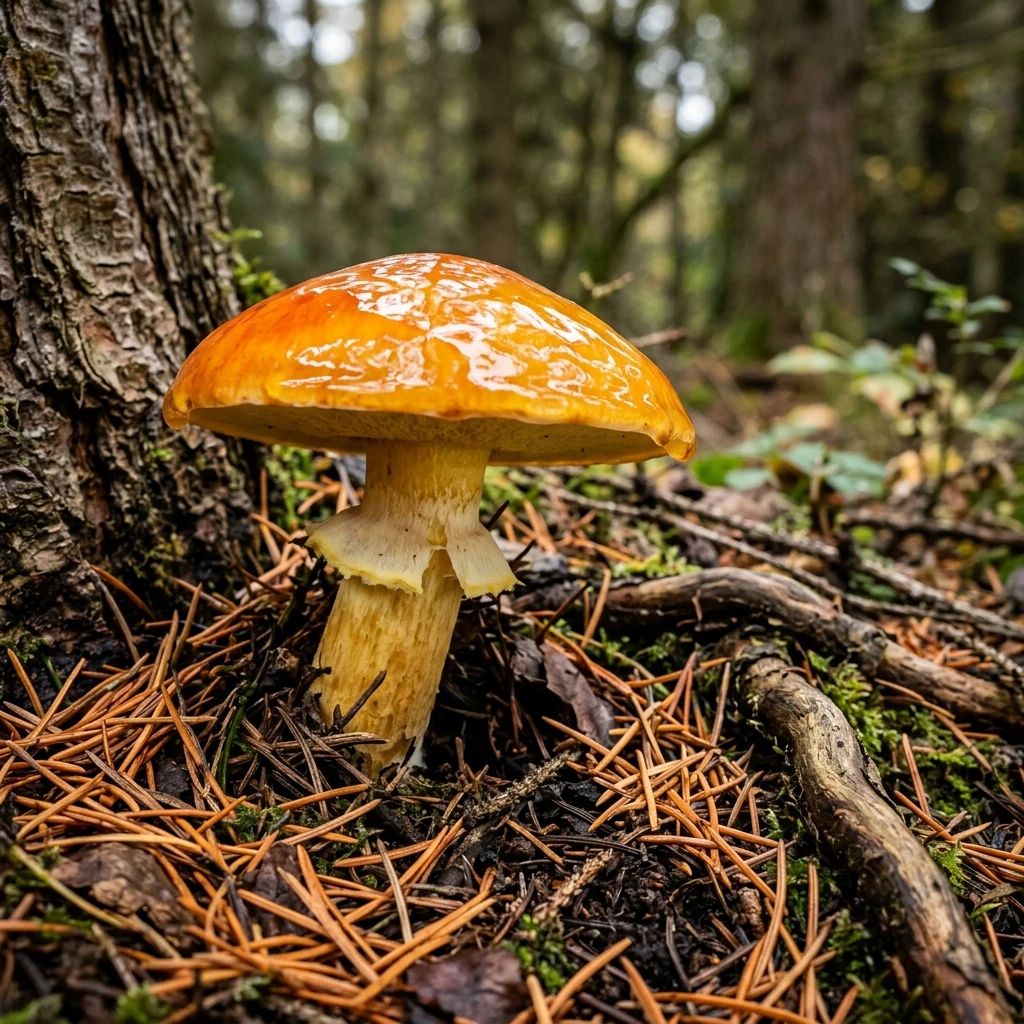
The Larch Bolete is a highly celebrated, choice wild edible mushroom native to temperate zones across the Northern Hemisphere. It is a strict obligate mycorrhizal partner, growing exclusively in close proximity to Larch trees. Instantly recognizable by its brilliant, glistening orange-yellow cap covered in a thick, sticky gel layer, its pale yellow pores, and a distinct, fragile membranous ring on the upper stem, it represents a classic early autumn indicator of conifer health.


🌍 Environment Larch Conifer Forests
💧 Humidity High Humidity (70-80%)
🪵 Substrate / Host Larch Root Symbiosis
📏 Size 5cm - 12cm
🍄 Category Choice Edible
🔍

How to Identify

A sticky, glistening orange-yellow cap with pale yellow pores underneath, and a stem featuring a fragile white-yellow ring.

  • Glistening Sticky Cap: A convex cap, 5 to 12 cm, ranging from bright lemon-yellow to golden-orange, covered in a highly glossy slime.
  • Fragile Stem Ring: The upper stem features a distinct, fragile, membranous white-to-yellow ring (veil remains).
  • Larch Host Association: Strictly grows within a few meters of deciduous Larch trees (*Larix*), nestled in their needle litter.
🧼 Preparation Step: The sticky cap slime has a slightly sour taste and can cause mild digestive sensitivity in some people. Always peel the slippery cap skin off before cooking!

Detailed Mycology Profile & Safety Guide

Click on any dimension to expand detailed field guides, substrate requirements, and safety warnings.

Forms strict mycorrhizal relationships exclusively with Larch trees (*Larix*). Fruits in scattered groups on Larch needle litter and grass from summer to late autumn.
Requires high moisture and cool autumn climates. Sprouting is highly stimulated by autumn rains and cool night temperatures.
Thrives in partial shade under open larch forest canopies. Sunlight helps develop its brilliant golden-orange cap pigments.
No gills. The cap is convex, 5 to 12 cm, slimy. Underside consists of a pale yellow sponge of tiny, angular pores, turning olive-yellow.
Produces a clay-brown to olive-brown spore print. Spores are smooth and spindle-shaped, wind-dispersed from the pores.
Flesh is solid, yellow, tasting mild with a faint, pleasant fruity smell. Stems are solid, yellow, featuring a fragile membranous ring.
Harvest young, firm button caps. Carry a pocket knife to peel the sticky cap skin in the field, keeping your harvesting basket clean.
Choice edible when peeled. It has a pleasant, mild, slightly sweet flavor and a tender, slippery texture. Excellent in soups, stews, and sautéed with garlic.
Rich in vitamin C, B vitamins, and unique polysaccharides showing moderate antioxidant and immune-stimulant properties in laboratory research.
CRITICAL WARNING: Safe foraging! It has virtually no toxic look-alikes due to its strict association with Larch trees, its sticky orange cap, and its stem ring. Do not confuse with toxic orange mushrooms that **have true gills or grow on soil away from Larch**, such as the toxic **Jack-O'-Lantern** (Omphalotus), which **lacks a ring and grows on dead wood**.
The presence of a membranous ring and a highly glutinous (slimy) cap are the defining taxonomic features of the genus *Suillus* (Slippery Jacks). *Suillus grevillei* is highly valued for its predictability—if you find a Larch tree in autumn, you are almost guaranteed to find this mushroom!
AI Diagnoser

Is your Larch Bolete growing moldy or decaying?

Take a photo with the Plant AI app to instantly diagnose fungal diseases, green mold, or wood decay, and get expert botanical recommendations in 1 second.

Scan Mushroom Now
🦠

Debris Entrapment (Slime)

Symptoms: The highly sticky cap is covered in a dense layer of larch needles, dirt, and dead leaves that are impossible to brush off.

Action: Action: Do not wash. Washing makes the slime stickier. Instead, use a sharp pocket knife to catch the edge of the cap skin at the margin and peel the entire slimy cuticle off like a sticker.

🍂

Ring Loss (Dryness)

Symptoms: The fragile membranous ring on the stem shrivels, falls off, or becomes virtually invisible.

Action: Action: Verify host. In dry winds, the ring dries and disappears quickly. Always confirm the mandatory proximity to deciduous Larch trees to ensure correct identification.

Frequently Asked Questions

Why does it only grow under Larch trees?

It is an obligate mycorrhizal fungus. It has a symbiotic relationship with Larch roots, exchanging water and soil minerals for sugars produced by the tree. It cannot survive or fruit without a living Larch tree host.

Why must you peel the cap skin?

The sticky, slimy cap gel has a slightly sour, unpleasant taste and can cause mild stomach upset or laxative effects in sensitive individuals. Peeling the skin leaves only the delicious, firm yellow flesh.

How do you cook Larch Boletes?

After peeling the cap, sauté them in butter with garlic and parsley. They have a wonderfully tender, slippery texture that is highly valued in soups, stews, and noodle dishes.

Is the Larch Bolete safe for beginner foragers?

Yes, it is exceptionally safe. Because it only grows under Larch trees, has a bright orange-yellow slimy cap, and has a distinct stem ring, it is virtually impossible to mistake for any toxic species.

Understand nature safely. Identify mushrooms instantly!

Get Started for Free