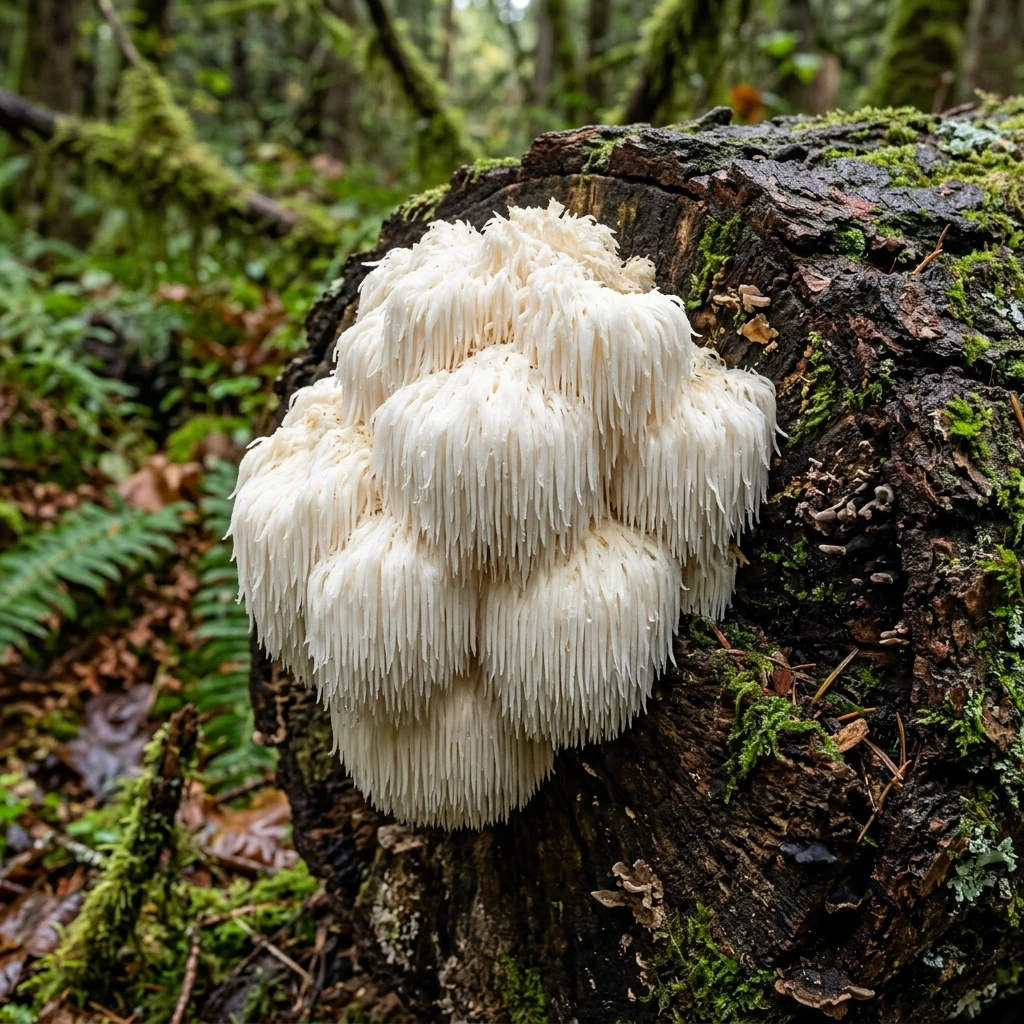
Hericium erinaceus

Lion's Mane Identification & Cultivation

Lion's Mane, or Bearded Tooth, is a highly unique and breathtaking medicinal and culinary mushroom native to North America and Asia. Growing on dead or dying hardwood trees, this tooth-fungus lacks a standard cap and gills, forming instead a gorgeous, snow-white cascade of icicle-like spines. It is globally celebrated for its delicious lobster-like flavor and outstanding cognitive-boosting properties.


Environment Icon
Environment Hardwood Logs / Decaying Trunks
Humidity Icon
Humidity High Humidity (85-95%)
Substrate Icon
Substrate Dead Oak / Beech Wood
Cap Diameter Icon
Cap Diameter 5cm - 25cm
Edibility Icon
Edibility Choice Edible / Medicinal
Botanical macro photography of Lion's Mane (Hericium erinaceus) - Plant AI care database

How to Identify Lion's Mane

A snow-white, globose clump covered in long, cascading icicle-like soft teeth (spines) growing on hardwood trees.

  • No Cap or Gills: Entirely lacks a standard cap, stem, or gills, forming a single compact bulbous mass.
  • Cascading Spines: The surface is densely covered with soft, hanging white spines or teeth measuring 1 to 5 cm long.
  • Pure White Color: Brilliant snow-white color when fresh, turning yellow or light brown as it ages.
💡 Safety Tip: Lion's Mane has no toxic look-alikes, making it one of the safest and easiest mushrooms for beginner foragers to identify.

Complete Scientific Cultivation & Identification

Follow our professional mycological parameters and identification guidelines for safe foraging.

Lion's Mane grows as a saprophyte or weak parasite on dead or dying hardwood trees (Oak, Beech, Maple). It causes a slow white rot in the timber.
Requires very high relative humidity (>85%) to develop its long, cascading spines. Mist indoor cultivation blocks regularly to prevent spine drying.
Thrives in shaded forest settings. Indoors, it requires low ambient ambient light to initiate fruiting, but direct sunlight will scorch and yellow the white teeth.
Lacks cap and gills. The reproductive spores are produced on the surfaces of the cascading spines (teeth) that cover the globose fruiting body.
Produces a pure white spore print. Lion's Mane is highly responsive to commercial cultivation on sterilized hardwood sawdust or hardwood logs.
The flesh is dense, springy, white, and slightly chewy, with a texture highly resembling crab or lobster meat. There is no stem or ring.
Harvest by slicing the dense woody attachment point off the tree trunk using a sharp knife. Handle gently to prevent bruising the delicate cascading spines.
A choice edible of outstanding quality. Known for its seafood-like, sweet lobster or crab-like flavor. Sauté in butter with garlic, slice into thick steaks and sear, or use in vegetarian 'crab cakes'.
Legendary for containing hericenones and erinacines, which stimulate **Nerve Growth Factor (NGF)** synthesis in the brain, promoting neurogenesis and memory.
CRITICAL WARNING: 100% safe. Other *Hericium* species (like Coral Tooth) are also choice edibles. Avoid harvesting yellowed, decaying specimens which cause stomach upset.
Slice Lion's Mane into thick rounds, press lightly in a hot dry pan to release natural water, then add generous butter and sear until the edges are crispy and golden.

Is your Lion's Mane turning yellow, dry or losing its spines?

Raise ambient humidity, shield from direct dry air conditioning drafts, and harvest before spines turn yellow-brown.

Identify My Mushroom

Common Diseases & Wild Contamination

Low Humidity Drying

Symptoms: Symptoms: Spines stay extremely short, stunted, and the tips turn dry, brown, and brittle.

Action: Action: Raise humidity immediately. Place a humidity tent (plastic bag with holes) over the cultivation block and mist the interior walls regularly.

Browning Decadence

Symptoms: Symptoms: The white body turns dark yellow-brown, spongy, and absorbs water like a soggy sponge.

Action: Action: Harvest immediately. Trim away the yellow, soggy exterior. The mushroom is overripe; young pure white clumps are the tastiest and most medicinal.

Frequently Asked Questions

Why is Lion's Mane called a 'Nootropic' mushroom?

It contains active compounds that cross the blood-brain barrier to stimulate the growth of brain cells, improving memory, focus, cognitive function, and protecting against neurological decline.

What does Lion's Mane taste like?

When cooked, it has a highly unique savory-sweet flavor and fibrous texture that is incredibly similar to crab meat, lobster, or scallops.

How do you cultivate Lion's Mane at home?

Purchase a hardwood sawdust fruiting block. Slice an 'X' in the plastic bag, place in a humid area out of direct sun, and mist 2 to 3 times a day. Mushrooms will fruit in 10 to 14 days.

How do you dry Lion's Mane?

Slice into 1/2 inch thick pieces and dehydrate at 45°C (113°F) until completely dry. Grind into a fine white powder and add to coffee, tea, or smoothies for a daily brain boost.

Understand nature safely. Identify mushrooms instantly!

Get Started for Free