White-Pored Chicken Foraging & Identification Guide
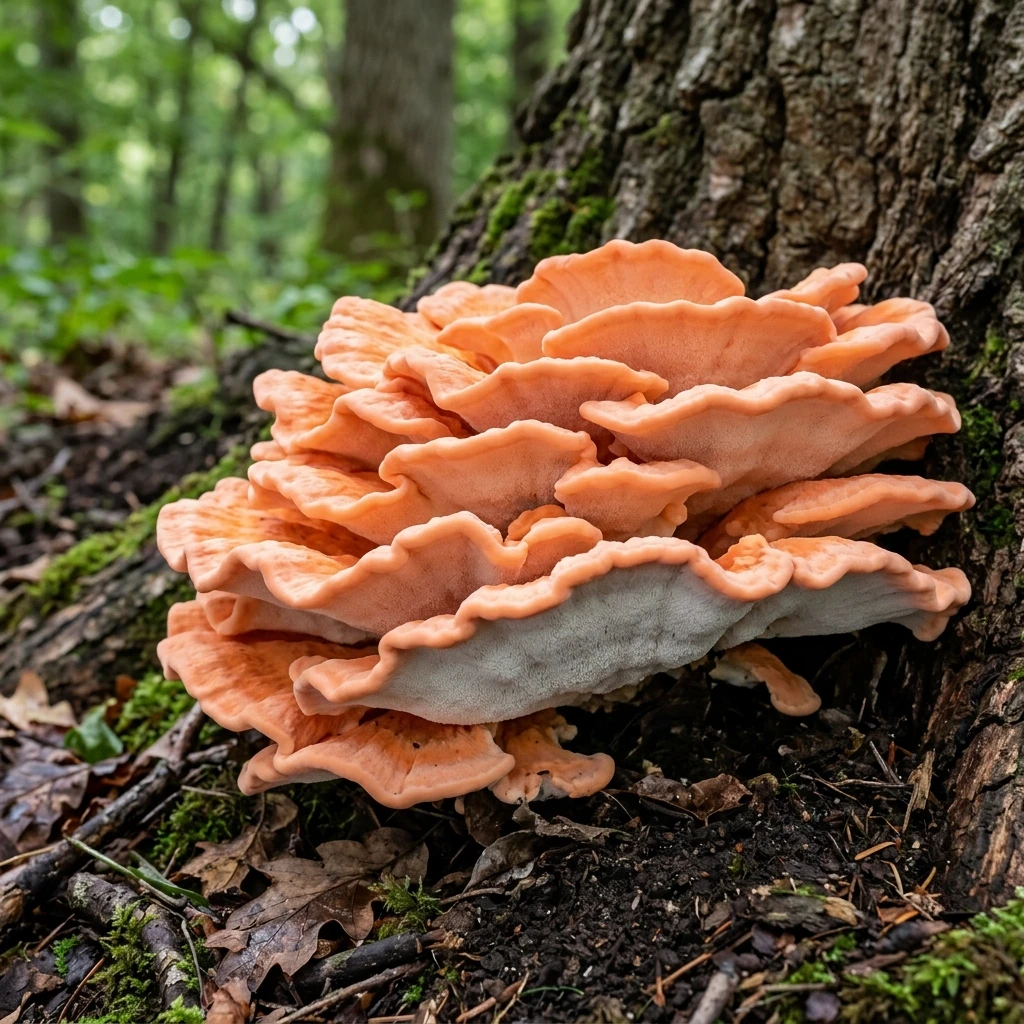
The White-Pored Chicken of the Woods, or White-Pored Sulfur Shelf, is an exceptionally highly prized, choice wild edible polypore mushroom native to broadleaf forests across Eastern North America. Eerily beautiful, it grows in massive, spectacular overlapping clusters of peach-orange to pink-orange fan-shaped shelves. Unlike the standard Chicken of the Woods (which grows on tree trunks and has yellow pores), the White-Pored Chicken grows directly from the soil at the base of Oak trees, featuring a pure white pore layer underneath and a tender, chicken-like flavor.





How to Identify White-Pored Chicken
Massive, overlapping peach-orange fan-shaped shelves growing from the soil at the base of Oak trees, with a pure white pore layer underneath.
-
✔
Cap: Varies by species.
-
✔
Spore: Critical check.
Detailed Mycology Profile & Foraging Guide
Follow our detailed scientific field guide and environmental parameters to identify and study White-Pored Chicken safely.
Common Look-alikes & Foraging Danger
Fading and Chalkiness
Symptoms: The bright peach-orange shelves turn a dull, dry, chalky-white color and crumble easily.
Yew Tree Host
Symptoms: The orange shelves are growing on a needle-bearing conifer tree, specifically Yew or Pine.
Frequently Asked Questions
Does it really taste like chicken?
Yes. It has a remarkably fibrous, meaty texture that is almost identical to cooked chicken breast or crab meat when shredded. Its flavor is mild, savory, and slightly lemony, making it a famous vegan chicken substitute.
Why is harvesting from conifer trees dangerous?
Laetiporus cincinnatus easily absorbs chemical compounds from its host tree. When growing on conifers like Yew (Taxus) or Eucalyptus, it absorbs toxic alkaloids and oils which remain in the mushroom flesh and cause severe food poisoning.
Which parts of the mushroom should you harvest?
Use a sharp knife to slice off only the soft, pliable outer margins (the peach edges). The inner parts close to the tree trunk are extremely tough, dry, woody, and fibrous, and are completely indigestible.
Does it have a toxic look-alike?
It has few look-alikes. However, some confuse it with the toxic Jack-O'-Lantern (Omphalotus illudens) which is orange but has true blade gills and a stem, whereas White-Pored Chicken has white pores and lacks a stem completely.