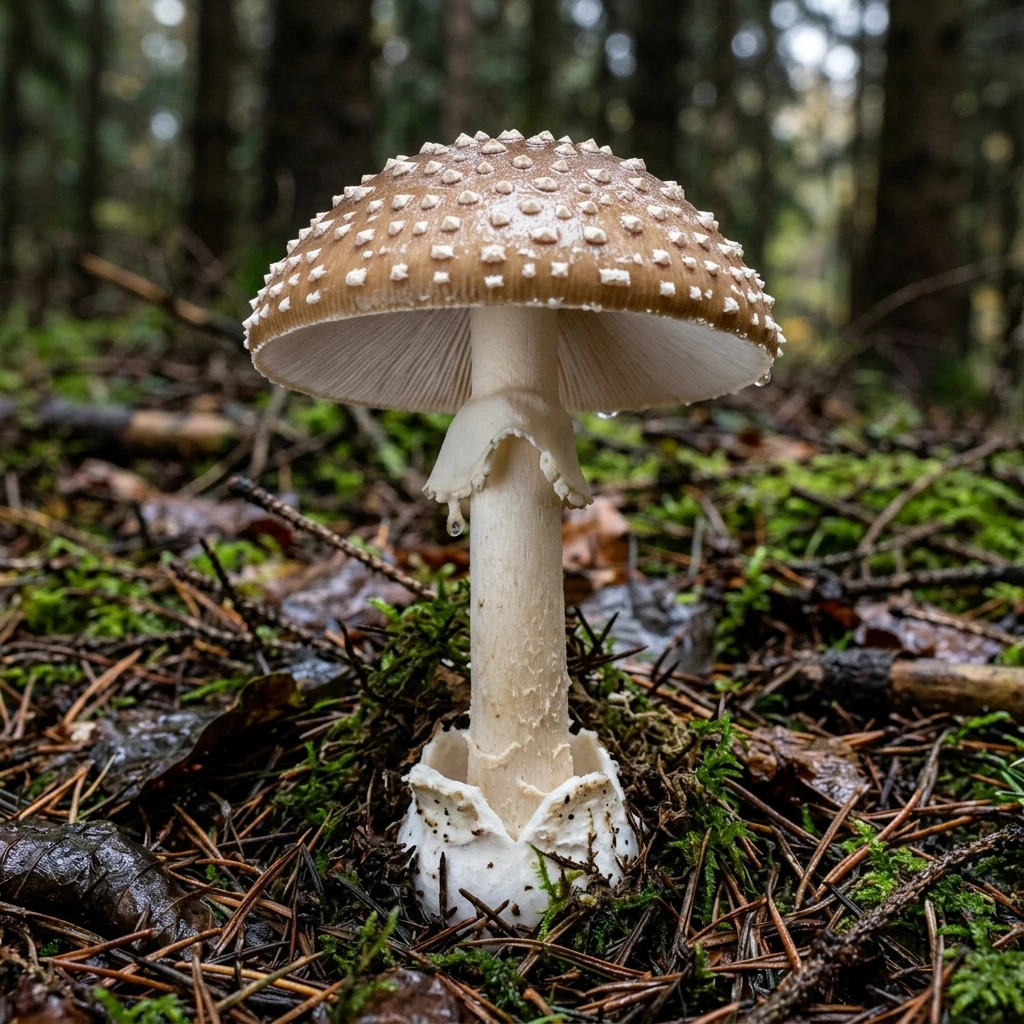
Identify Panther Cap (Amanita pantherina) - Plant AI mycology guides
Home / Mushrooms / Panther Cap

Panther Cap

Scientific Name: Amanita pantherina

The Panther Cap is an exceptionally toxic, highly dangerous woodland mushroom distributed across temperate forests in Europe and Asia. Growing in mycorrhizal association with beech and conifer trees, its beautiful bronze-brown cap is covered in small, neat, pure white pyramidal warts. Containing massive concentrations of muscimol and ibotenic acid, it is significantly more toxic than the Fly Agaric, posing a major poisoning risk.


🌍 Environment Conifer & Beech Woods
💧 Humidity Moderate Humidity (65-75%)
🪵 Substrate / Host Soil / Beech & Conifer Root Symbiosis
📏 Size 5cm - 12cm
🍄 Category Highly Toxic 💀
🔍

How to Identify

A brown cap covered in neat white dots, white gills, a white stem ring, and a collared bulbous base.

  • Panther-pattern Cap: A smooth, glistening tan-brown or olive-brown cap covered in small, neat, white warty scales.
  • Crowded White Gills: Gills are free, pure white, and produce a white spore print.
  • Collared Volva: White stem features a low ring and a distinct bulbous base with a neat, ring-like collar rim.
🔴 CRITICAL WARNING: Extremely toxic. Contains muscimol and ibotenic acid in concentrations much higher than the Fly Agaric. Causes severe central nervous system poisoning.

Detailed Mycology Profile & Safety Guide

Click on any dimension to expand detailed field guides, substrate requirements, and safety warnings.

Forms mycorrhizal relationships with both deciduous and coniferous trees, particularly Beech, Oak, Pine, and Douglas Fir. Fruits on rich forest soils during late summer and autumn.
Requires moderate humidity (65-75%) and cool autumn weather to fruit. Emerge rapidly after warm autumn rains.
Thrives in shaded forest floors, near tree roots. Light helps develop the deep bronze-brown cap color.
The cap is 5 to 12 cm, bronze-brown, shiny, covered in neat white warts. Gills are pure white, crowded, and free from the stem.
Produces a pure white spore print. The fungus propagates through rootlet association and wind-dispersed spores.
Flesh is white, firm, and lacks color change when cut. Stem is white, featuring a low hanging ring and a distinct bulbous base with a neat, ring-like collar.
NEVER harvest. Avoid gathering any brown wild mushrooms with white spots, as they represent the highly toxic members of the Amanita family.
Highly toxic and inedible. Raw ingestion causes severe neurological poisoning. Cooking does not eliminate the neurotoxins.
Extremely rich in **muscimol** and **ibotenic acid**, which are GABA receptor agonists. Concentrations are significantly higher than in the Fly Agaric.
CRITICAL WARNING: Often confused with the edible **The Blusher** (Amanita rubescens) or the **Panther Amanita** (Amanita excelsa). The Blusher has **flesh that bruises red-pink** and a **striated ring**, whereas the Panther Cap has **flesh that remains pure white** and a **collared bulbous base**. Always check for bruising!
The Panther Cap is easily identified by its extremely neat, white pyramidal warts on a brown cap, resembling a panther's pattern. The low ring and collared bulbous base are key identification features.
AI Diagnoser

Is your Panther Cap growing moldy or decaying?

Take a photo with the Plant AI app to instantly diagnose fungal diseases, green mold, or wood decay, and get expert botanical recommendations in 1 second.

Scan Mushroom Now
🦠

Wart Loss

Symptoms: The neat white warty spots disappear, leaving a plain, smooth brown cap.

Action: Action: Do not trust smooth caps. Heavy rains can wash away the fragile white warts. Always check the collared bulbous base and white gills.

🍂

Ring Tearing

Symptoms: The fragile white stem ring tears, collapses, or disappears completely.

Action: Action: This is common. galerina and Amanita rings are extremely thin. Check the collared bulbous base and white gills to confirm the identification.

Frequently Asked Questions

Why is it called the 'Panther Cap'?

It is named 'Panther Cap' due to its bronze-brown cap covered in small, neat, white warty scales, which resemble the spotted coat of a panther.

How toxic is the Panther Cap compared to the Fly Agaric?

The Panther Cap is significantly more toxic than the Fly Agaric. It contains much higher concentrations of muscimol and ibotenic acid, leading to more severe and dangerous poisoning.

What happens if someone eats a Panther Cap?

Within 30 minutes, it causes severe central nervous system excitation: muscle twitching, confusion, delirium, manic behavior, and deep coma-like sleep, requiring immediate medical care.

How do you tell it apart from The Blusher?

The Blusher (Amanita rubescens) is an edible mushroom whose white flesh turns red-pink when bruised or cut. The Panther Cap's flesh remains pure white and never changes color.

Understand nature safely. Identify mushrooms instantly!

Get Started for Free