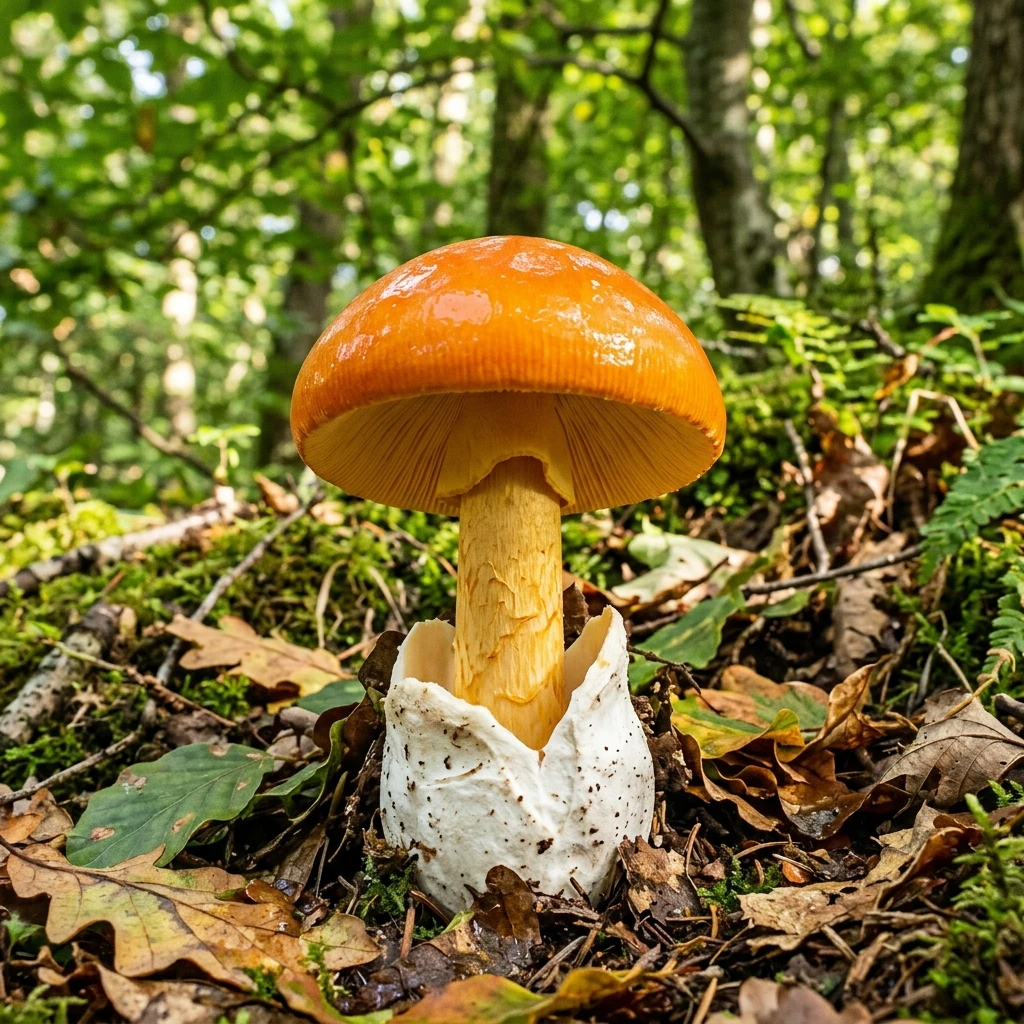
Amanita caesarea

Caesar's Mushroom Foraging & Identification Guide

The Caesar's Mushroom, also known as the Royal Amanita, is an exceptionally highly prized, choice wild edible mushroom native to warm deciduous woodlands across Southern Europe, North Africa, and temperate Asia. Growing in mycorrhizal symbiosis with mature Oak and Chestnut trees, it represents one of the most famous, historic culinary delicacies in human history, historically served exclusively to Roman Emperors. Instantly recognizable by its brilliant, striking golden-orange cap, its gorgeous golden-yellow gills and stem, and its massive, thick, pure-white cup-like volva at the base, it boasts a deeply rich, sweet, and nutty flavor.


Environment Icon
Environment Broadleaf Oak Woodlands
Humidity Icon
Humidity Moderate Humidity (60-70%)
Substrate Icon
Substrate / Host Warm Soil / Mature Oak Roots
Size Icon
Size 8cm - 20cm
Category Icon
Category Choice Edible
Botanical macro photography of Caesar's Mushroom (Amanita caesarea) - Plant AI care database

How to Identify Caesar's Mushroom

A brilliant golden-orange cap with gold gills, a golden-yellow stem with a hanging gold ring, emerging from a massive, thick white cup-like volva.

  • Cap: Varies by species.
  • Spore: Critical check.
💡 Plant AI Tip: ⚠️ Egg-Stage Warning: During its early growth, the Caesar's Mushroom resembles a completely white, egg-like structure wrapped in a universal veil. Never harvest it in the egg stage, as it is virtually identical to the lethal Death Cap (Amanita phalloides) in its egg stage. Only harvest when the orange cap has fully emerged and the golden gills are clearly visible!

Detailed Mycology Profile & Foraging Guide

Follow our detailed scientific field guide and environmental parameters to identify and study Caesar's Mushroom safely.

Forms mycorrhizal symbioses primarily with Oak (Quercus) and Chestnut (Castanea) trees. Fruits on warm, sandy, acidic soils in open woodlands and forest edges in summer and early autumn.
Requires warm, dry summer climates paired with moderate humidity. It is highly heat-tolerant, sprouting abundantly after warm summer rainstorms in Mediterranean-like climates.
Thrives in partial shade along forest edges. Sunlight is essential to trigger the development of its brilliant golden-orange cap pigments.
Cap is convex, expanding to flat, 8 to 20 cm, smooth, golden-orange. Gills are free, densely spaced, and a striking golden-yellow, which is highly unique in the Amanita family.
Produces a pale yellow-to-cream spore print. Spores are smooth and cylindrical, carried by summer woodland drafts.
Flesh is thick, white, yellow under the cap skin, with a pleasant, sweet nutty smell. Stem is golden-yellow, solid, with a hanging golden ring, lacking warty scales.
Harvest mature, fully expanded specimens to ensure 100% correct identification. Brush away soil carefully. Cut above the white volva base or pull gently to inspect the volva cup.
Choice edible. Famous as a peak culinary delicacy since antiquity. It has an exceptionally rich, sweet, and nutty flavor. Traditionally shaved raw in thin slices with olive oil and lemon, grilled, or sautéed.
Rich in essential amino acids, trace minerals, and unique bioactive compounds showing moderate antioxidant and anti-inflammatory properties in laboratory tests.
CRITICAL WARNING: Highly dangerous look-alikes! Never harvest Caesar's Mushroom in its white egg stage. It belongs to the genus Amanita, which contains the world's most deadly mushrooms. Do not confuse with the lethal Death Cap (Amanita phalloides) or Destroying Angel (Amanita bisporigera), which have pure white gills, a white stem, and a white ring, whereas Caesar's Mushroom has striking golden-yellow gills and a golden-yellow stem/ring. When in doubt, check the gill color!
This species is historically legendary—it was protected by law in ancient Rome, and only Emperors were permitted to consume it. Today, it remains a highly prized treasure for advanced foragers in Southern Europe and East Asia, but absolute vigilance regarding gill color is mandatory.

Is your Caesar's Mushroom showing signs of rot, decay or discoloration?

Ensure foraging safety and keep your specimens healthy. Take a photo with Plant AI to identify wild mushrooms and get instant toxicity warnings.

Diagnose Specimen Now

Common Look-alikes & Foraging Danger

Fading Color (Sun Bleaching)

Symptoms: The brilliant orange cap turns a pale, dingy yellow-white after prolonged exposure to intense summer sun.

Action: This is natural bleaching. The mushroom remains safe to eat, provided the gills underneath are still golden-yellow and the flesh is firm.

Gill Whitening (Lethal Look-alike)

Symptoms: The cap is yellowish-orange, but the gills and stem underneath are completely white.

Action: DISCARD IMMEDIATELY. You have harvested a lethal poisonous Amanita (such as the Death Cap or Fly Agaric variants). True Caesar's Mushroom must have 100% golden-yellow gills and stem.

Frequently Asked Questions

Why is it called 'Caesar's Mushroom'?

It is named 'Caesar's Mushroom' (Amanita caesarea) because it was highly celebrated in ancient Rome, where it was considered a food fit only for royalty. Roman emperors (Caesars) prized it above all other wild delicacies.

How do you tell it apart from the deadly Death Cap?

The deadly Death Cap (Amanita phalloides) has pure white gills, a white stem, and a white ring. The edible Caesar's Mushroom has a brilliant golden-orange cap, and its gills, stem, and ring are all a striking golden-yellow.

Why is it dangerous to harvest in the egg stage?

When very young, both Caesar's Mushroom and the deadly Death Cap are completely enclosed in a white, egg-like universal veil. They look identical from the outside, making mistake-free identification impossible until they break open.

How do you cook it?

Because it has an exceptionally delicate, sweet, and nutty flavor, it is one of the very few wild mushrooms that is traditionally eaten raw. Shave the fresh cap very thinly, drizzle with high-quality olive oil, a squeeze of fresh lemon juice, and a pinch of sea salt.

Understand nature safely. Identify mushrooms instantly!

Get Started for Free