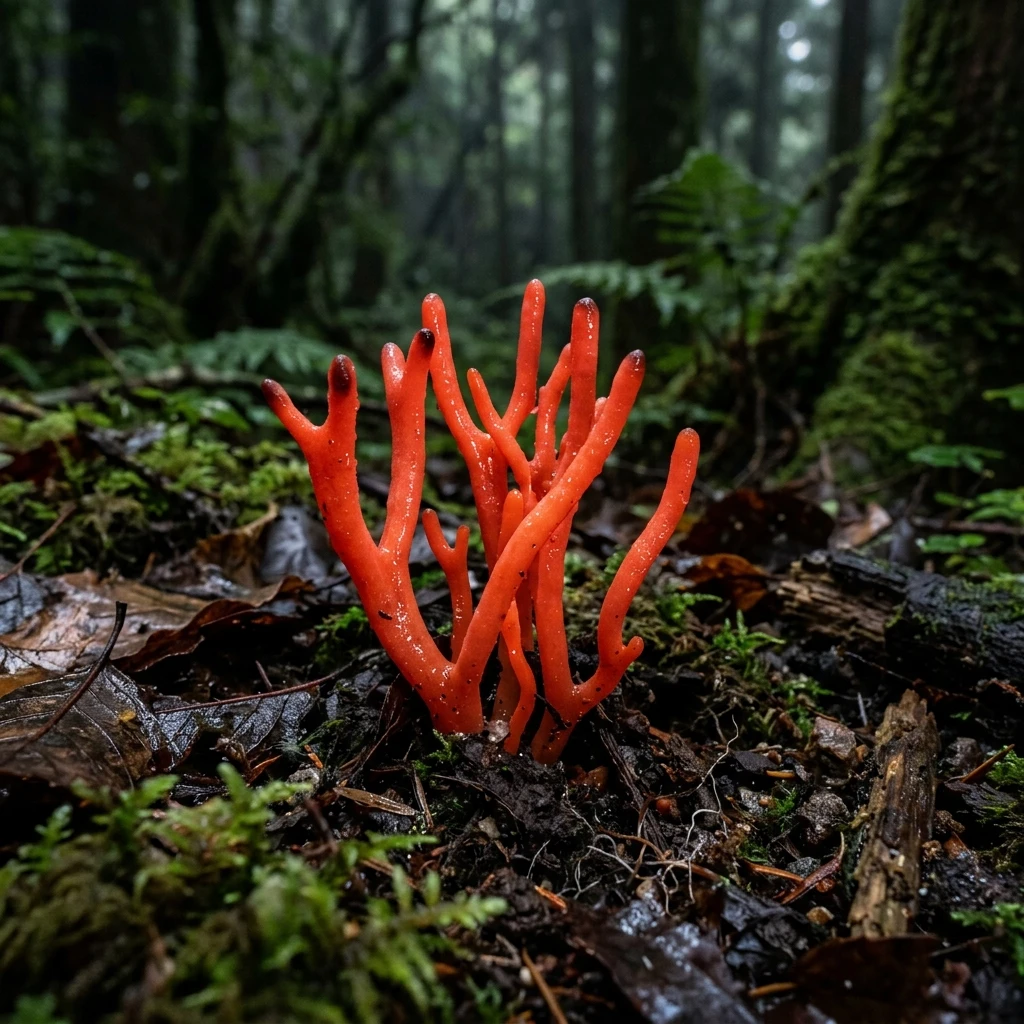
Podostroma cornu-damae

Poison Fire Coral Foraging & Identification Guide

The Poison Fire Coral is an extremely rare, bizarre, and exceptionally deadly fungus native to the humid forests of East Asia and northern Australia. Emerging vertically from damp soil near decaying oak roots, this unique orange-red fungus looks exactly like aquatic fire coral. It is the only known mushroom in the world whose powerful trichothecene toxins can be absorbed through the skin, causing severe contact dermatitis and fatal multi-organ failure if consumed.


Environment Icon
Environment Damp Forest Floors
Humidity Icon
Humidity High Humidity (85-95%)
Substrate Icon
Substrate / Host Soil near Decaying Oak roots
Size Icon
Size 3cm - 10cm
Category Icon
Category Highly Toxic 💀
Botanical macro photography of Poison Fire Coral (Podostroma cornu-damae) - Plant AI care database

How to Identify Poison Fire Coral

A bright orange-red, club-like or finger-like branched stroma emerging vertically from the soil.

  • Cap: Varies by species.
  • Spore: Critical check.
💡 Plant AI Tip: 🚫 TOUCH DANGER: Never touch this fungus. It is the only known mushroom whose toxins can be absorbed through the skin. If touched, wash hands immediately with soap and water.

Detailed Mycology Profile & Foraging Guide

Follow our detailed scientific field guide and environmental parameters to identify and study Poison Fire Coral safely.

Grows in temperate broadleaf hardwood forests, particularly on soils rich in decaying oak and beech tree roots. Native to Japan, Korea, China, and Queensland.
Requires exceptionally high relative humidity (85-95%) and warm, humid summer conditions to sprout its bright red club-like fruiting bodies.
Thrives in deep shaded forest floors, nestled under leaf litter and damp moss canopy away from direct sun.
No cap or gills. Spores are produced in microscopic flask-shaped perithecia embedded inside the rough, bumpy bright-red branched stalks.
Produces a white spore print. The fungus propagates through root association and wind-dispersed spores during wet summer months.
Flesh is firm, fibrous, white inside, covered by a bright red-to-orange warty outer skin. Lacks a stem ring, volva, or cap structure.
NEVER harvest or touch. If spotted in wild forests, report to local forestry authorities. Keep children and pets far away from the site.
Deadly and highly fatal. Consuming even a tiny piece (less than 1 gram) causes rapid, agonizing multi-organ failure, bone marrow suppression, and hair loss.
Packed with highly toxic trichothecene mycotoxins (such as satratoxin H and roridin E) which block protein synthesis, cause cellular necrosis, and dissolve tissues.
CRITICAL WARNING: Frequently mistaken by wild herbal foragers for the edible Cordyceps or the Red Cordyceps (Tolypocladium), or the young Gordius/Coral Fungi. Cordyceps has a dark brown club emerging from insect larvae, whereas Poison Fire Coral has bright orange-red branches growing directly from soil near oak tree roots.
This is the only known mushroom where touching the outer skin can cause severe chemical burns and peeling skin on human hands. Always use thick gloves or a stick if you must examine wild forest growths, and wash skin immediately.

Is your Poison Fire Coral showing signs of rot, decay or discoloration?

Ensure foraging safety and keep your specimens healthy. Take a photo with Plant AI to identify wild mushrooms and get instant toxicity warnings.

Diagnose Specimen Now

Common Look-alikes & Foraging Danger

Tip Blackening

Symptoms: The bright orange-red branched tips turn black, shriveled, and dry.

Action: This is natural decay. The mushroom has reached maturity and is releasing white spores, with the warty coral-like branches drying out and decomposing back into the soil.

Color Fading

Symptoms: The bright red stalks turn a dull yellowish-orange or pale pinkish-brown.

Action: Do not touch. Fading is caused by dry weather or over-exposure to sun. It remains exceptionally toxic and must never be handled or ingested.

Frequently Asked Questions

Why is it called the 'Poison Fire Coral'?

It is named 'Poison Fire Coral' because its bright orange-red, cylindrical, branched stalks look exactly like marine fire coral, and it carries some of the most lethal toxins in the fungal kingdom.

Can touching this mushroom really make you sick?

Yes. It is the only known mushroom whose toxins (trichothecenes) can penetrate human skin. Touching it can cause painful skin peeling, swelling, and localized contact dermatitis.

What happens if someone eats it?

Within hours, it triggers severe abdominal pain, vomiting, peeling skin on the face, hair loss, and acute bone marrow suppression. This leads to internal bleeding, liver failure, kidney failure, and death within days.

How do you distinguish it from edible Cordyceps?

Cordyceps grows as a single, slender, dark brown or bright orange shoot emerging directly from a buried insect mummy. Poison Fire Coral forms branched, bright crimson, coral-like fingers growing directly out of oak-root soil.

Understand nature safely. Identify mushrooms instantly!

Get Started for Free