Boletus edulis

Porcini Identification & Cultivation

Porcini, or King Bolete, is one of the most famous and delicious wild mushrooms in the world. Native to spruce, pine, and birch forests across Europe and North America, this large mycorrhizal fungus features a smooth, reddish-brown cap and a uniquely fat, bulbous white-netted stem, delivering an intensely savory, nutty, and woody umami flavor.


Environment Icon
Environment Spruce & Pine Forests
Humidity Icon
Humidity High Humidity (80-90%)
Substrate Icon
Substrate Acidic Forest Soil Mycorrhiza
Cap Diameter Icon
Cap Diameter 7cm - 30cm
Edibility Icon
Edibility Choice Edible
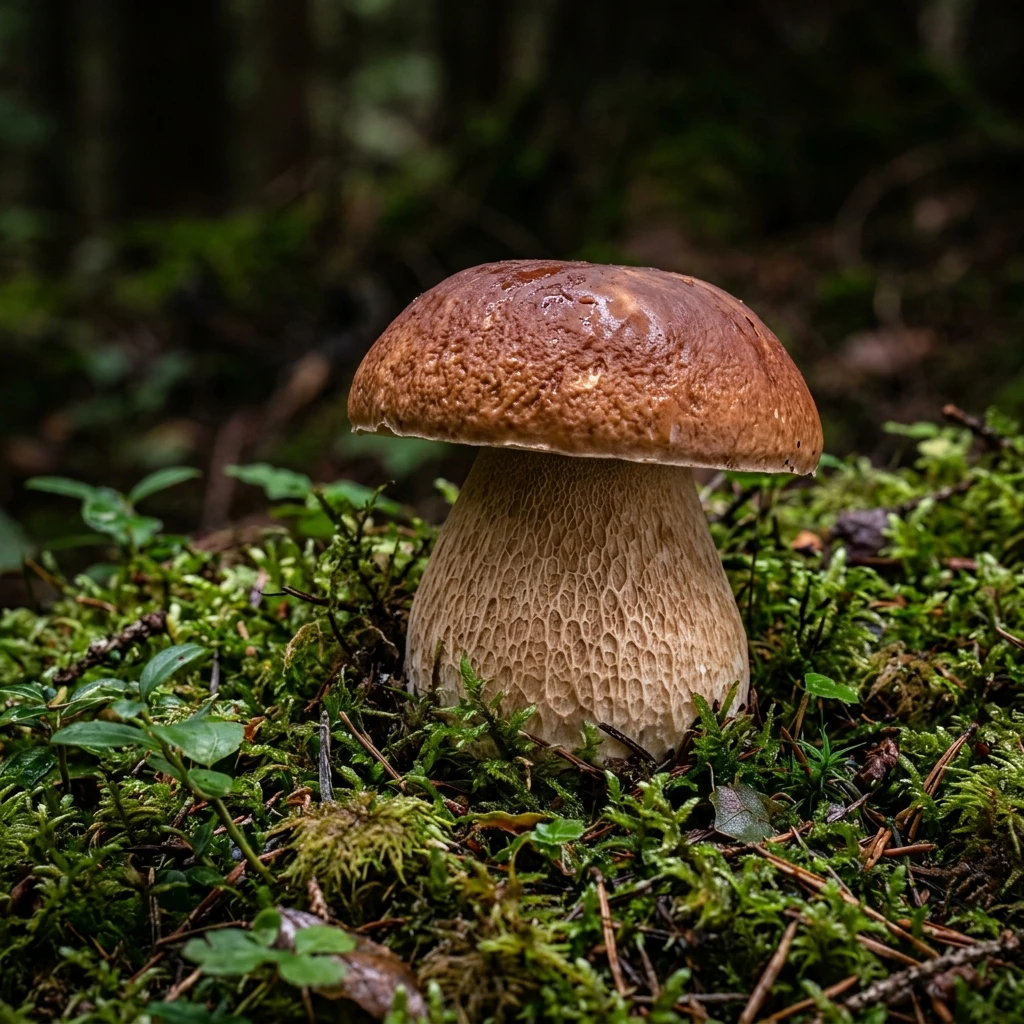
Botanical macro photography of Porcini (Boletus edulis) - Plant AI care database

How to Identify Porcini

A large, heavy mushroom with a smooth brown cap, white spongy pores underneath (no gills), and a fat netted stem.

  • Smooth Brown Cap: Large, thick, slightly sticky reddish-brown cap resembling a toasted hamburger bun.
  • Spongy Pore Surface: Gills are absent. Under the cap is a thick layer of vertical tubes with white pores that turn olive-green as it matures.
  • Fat Netted Stem: Extremely thick, bulbous white-to-light-brown stem covered in a fine white net-like pattern (reticulation) near the top.
💡 Safety Tip: True Porcini flesh never changes color when cut. If the sliced flesh instantly turns blue or red, it is NOT Boletus edulis.

Complete Scientific Cultivation & Identification

Follow our professional mycological parameters and identification guidelines for safe foraging.

Porcini grows in symbiotic mycorrhizal relationship with conifers (Spruce, Pine) and hardwoods (Oak, Birch). It prefers well-drained, acidic forest soils.
Requires abundant summer and autumn rains. Fruiting bodies emerge rapidly in forest clearings and along paths 3 to 5 days after heavy rainfall.
Grows in shaded forest floors with filtered dappled light. Sunlight helps mature the cap color, but the mycelium remains protected under deep forest litter.
The cap is 7 to 30 cm, convex, smooth, reddish-brown. It has NO gills. The underside consists of a spongy pore layer that is white when young and turns yellow-green when old.
Produces an olive-brown spore print. Porcini cannot be cultivated commercially because it relies on living tree roots for survival.
The flesh is dense, thick, white, and does not change color when cut or bruised. The stem is fat, club-shaped, reticulated, and lacks a ring or volva.
Harvest by twisting the bulbous base gently out of the soil or cutting it at the base. Brush off pine needles and dirt before placing in your foraging basket.
A world-class choice edible. Highly valued fresh or dried. Fresh porcini can be grilled, pan-seared with garlic and parsley, or dried to concentrate its intense umami flavor for risottos.
Extremely rich in selenium, zinc, vitamin B complex, and powerful dietary antioxidants like ergothioneine and glutathione.
CRITICAL WARNING: Avoid the 'Bitter Bolete' (Tylopilus felleus), which looks similar but has pinkish pores and a highly bitter taste that ruins any dish, and poisonous blue-staining boletes.
Slice young, firm porcini ('buttons') thinly and pan-fry on high heat to get a caramelized crust. Avoid washing; wipe with a damp cloth to prevent waterlogging.

Is your Porcini turning spongy, yellow or full of bugs?

Inspect the stem base for worm holes, dry immediately if wet, and consume or dehydrate quickly.

Identify My Mushroom

Common Diseases & Wild Contamination

Worm Infestation

Symptoms: Symptoms: Small holes in the stem base; flesh inside is riddled with tiny channels and white larvae.

Action: Action: Trim away the infested stem base immediately. If the cap is clean, use the cap. Dehydrating infested slices will cause larvae to drop out.

Soggy Pore Decay

Symptoms: Symptoms: Spongy pore layer turns dark olive-green, soft, and slimy.

Action: Action: Strip away the old, slimy spongy pore layer from the cap before cooking. Use only the firm white cap flesh.

Frequently Asked Questions

Why are dried Porcini so popular?

Drying porcini concentrates their amino acids and natural flavor compounds, creating an incredibly intense, savory mushroom aroma that is far more potent than fresh specimens.

What does 'reticulated stem' mean?

Reticulation refers to a fine, raised network of white-to-light-tan ridges on the stem surface that resembles a net, primarily visible near the top of a Porcini stem.

Is Boletus edulis safe to eat raw?

Young, firm, bug-free Porcini buttons can be shaved raw very thinly in salads with olive oil and parmesan. However, cooking is generally recommended to ease digestion.

How do you preserve wild Porcini for winter?

The best method is dehydration. Slice them 1/4 inch thick and place in a food dehydrator at 50°C (122°F) until cracker-dry. Store in airtight glass jars.

Understand nature safely. Identify mushrooms instantly!

Get Started for Free