Fomitopsis pinicola

Red Banded Polypore Identification & Cultivation

The Red-Banded Polypore is a highly common and sturdily built wood-decay bracket fungus native to coniferous forests across North America and Europe. Shaping like a hoof-shaped (horse-hoof) shelf, it features a unique dark gray-to-black woody crust marked by a highly distinct, vibrant red-to-orange banded margin. Prized in Native American medicine, it is highly studied today for its outstanding immune-supporting and cellular-protecting properties.


Environment Icon
Environment Conifer Forests / Pine Woods
Humidity Icon
Humidity Moderate Humidity (65-75%)
Substrate Icon
Substrate Decaying Pine / Spruce Wood Logs
Cap Diameter Icon
Cap Diameter 8cm - 30cm conk
Edibility Icon
Edibility Medicinal
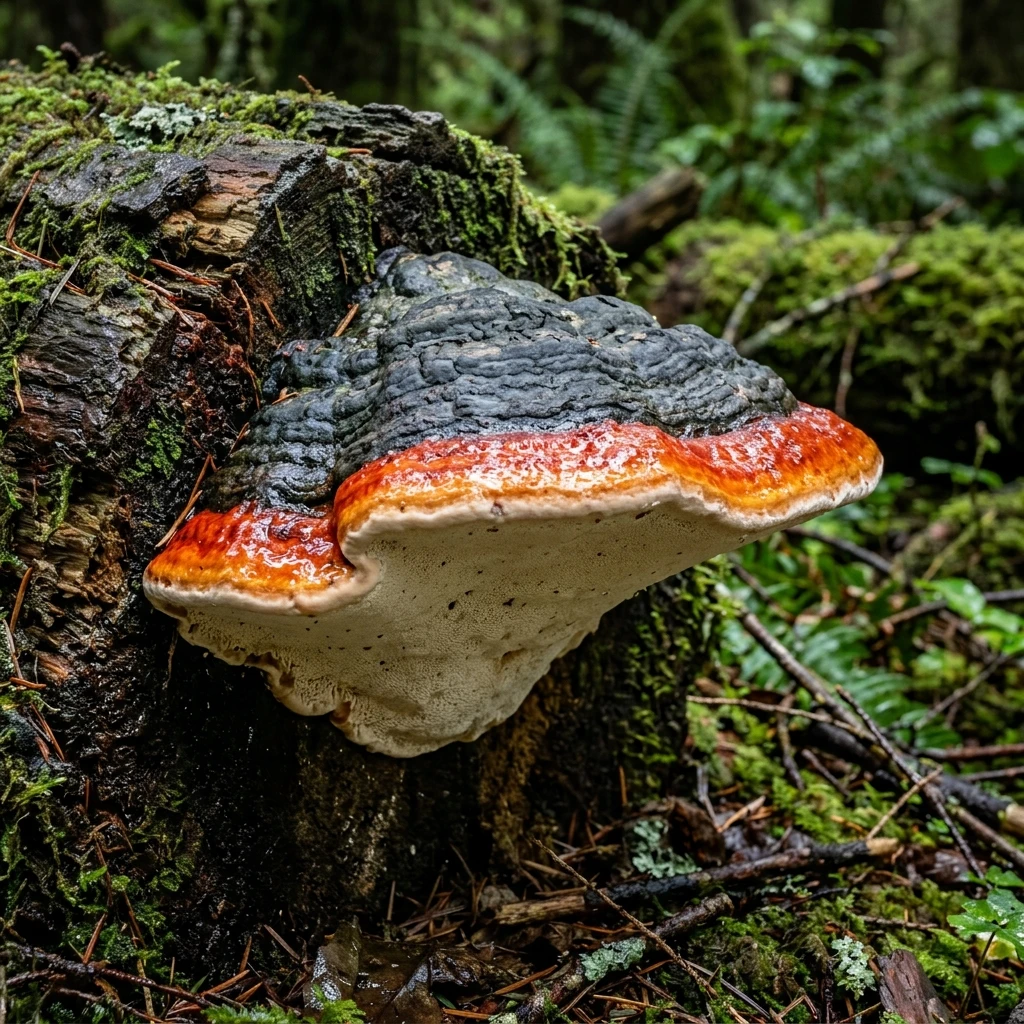
Botanical macro photography of Red Banded Polypore (Fomitopsis pinicola) - Plant AI care database

How to Identify Red Banded Polypore

A heavy, hoof-shaped conk featuring a gray-black crust with a bright red-to-orange band near the white margin.

  • Red Concentric Band: A highly distinct, bright reddish-orange banded color stripe running near the outer edge.
  • Gray-Black Crust: Hard, resinous, dark gray-to-black shell-like cap surface marked by circular growth bands.
  • Cream Pore Underside: Underside has a flat, cream-white surface covered in microscopic circular pores.
💡 Safety Tip: Red-Banded Polypore releases a resinous, sweet acid smell when young. Always check conifer logs for this highly striking orange-red band in pine forests.

Complete Scientific Cultivation & Identification

Follow our professional mycological parameters and identification guidelines for safe foraging.

Grows on dead conifer logs and stumps (Pine, Spruce, Fir, Hemlock), and rarely on hardwoods. It causes a brown cubical rot in the wood timber.
Extremely resistant to sub-zero temperatures. Humidity is drawn from rain and the damp decay environments of conifer forests.
Thrives in cool, shaded conifer forests but tolerates bright direct sun on open forest paths.
No gills. The cap is 8 to 30 cm, horse-hoof shaped, hard. Underside is ivory-white to yellow, covered in microscopic pores.
Produces a pure white spore print. Releases spores throughout summer, infecting coniferous tree wounds.
Flesh is tough, woody, suberose (corky), off-white to pale brown. Lacks stem, ring, or volva, growing directly in shelves on dead wood.
Harvest using a hatchet or large knife to cleanly slice the bracket off the conifer trunk. Only harvest fresh, young specimens showing bright red margins.
Inedible and woody. Sliced, dried, and simmered into medicinal tea, or processed into concentrated tinctures and health tonics.
Rich in unique ergostane triterpenes and immunomodulatory polysaccharides that support natural killer cell functions and reduce systemic inflammation.
CRITICAL WARNING: Highly safe with no toxic look-alikes. Avoid confusing with 'Tinder Conk' (Fomes) by checking for the bright red band and coniferous host wood.
Red-Banded Polypore tea has a very strong, bitter, woodsy-resinous flavor. Blend it with peppermint or honey to make it more palatable for daily adaptogenic wellness.

Is your Red-Banded Polypore losing its red band or turning soft?

Dry thoroughly, protect from stagnant humidity, and verify coniferous wood substrate.

Identify My Mushroom

Common Diseases & Wild Contamination

Wood Rot Crumbles

Symptoms: Symptoms: The woody bracket turns soft, spongy, crumbles easily, and cap margins turn grey.

Action: Action: Discard immediately. The bracket is old and being decomposed by forest white rot. Harvest only fresh, rock-hard brackets.

Resinous Fading

Symptoms: Symptoms: The bright orange-red color band near the margin fades to dry brown under direct sunlight.

Action: Action: Store in dry, cool, dark boxes. Direct UV rays bleach the carotenoid pigments in the red band over time.

Frequently Asked Questions

Why is it called 'Red-Banded'?

As the woody bracket grows, the outer margin remains soft and develops a striking, highly visible orange-red resinous band that contrasts beautifully with the gray-black center.

What are the medicinal properties of this mushroom?

It is heavily studied for boosting white blood cell activity, supporting gut health through prebiotic fibers, reducing joint inflammation, and exhibiting strong antiviral properties.

Does it grow on Pine trees?

Yes! It grows primarily on dead coniferous trees like Pine, Fir, and Hemlock, playing a vital role in breaking down coniferous wood in forests.

How do you store dried Red-Banded Polypores?

Slice fresh brackets into thin pieces immediately after harvesting (before they dry rock-hard). Dehydrate at 55°C (131°F) and store in airtight glass jars.

Understand nature safely. Identify mushrooms instantly!

Get Started for Free