Identify Scaly Chanterelle (Turbinellus floccosus) - Plant AI mycology guides
Home / Mushrooms / Scaly Chanterelle

Scaly Chanterelle

Scientific Name: Turbinellus floccosus

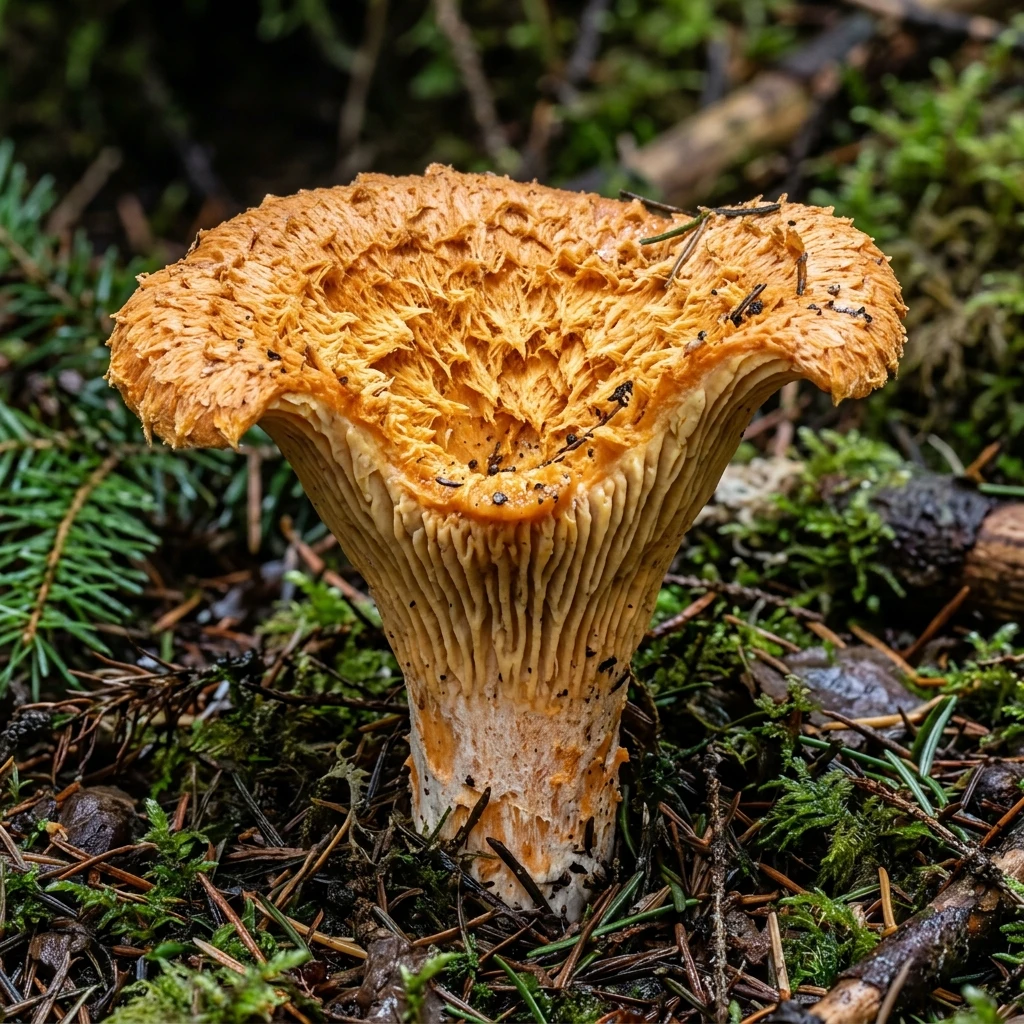
The Scaly Chanterelle, or Woolly Chanterelle, is a large, spectacular, and highly toxic wild fungus native to coniferous forests across North America and East Asia. Instantly recognizable by its striking, deep vase- or trumpet-like shape and brilliant orange-yellow color, it is a magnificent forest sight. The inside of its deep orange funnel is heavily covered in thick, shaggy scales, while the underside features blunt, yellow-green ridges. Despite its beauty, it contains severe toxic acids that cause intense gastrointestinal distress.


🌍 Environment Conifer Spruce & Fir Woods
💧 Humidity High Humidity (70-80%)
🪵 Substrate / Host Conifer Needles / Rich Humus
📏 Size 5cm - 15cm
🍄 Category Highly Toxic 💀
🔍

How to Identify

A large, bright orange trumpet-shaped mushroom with a shaggy, scaly funnel interior and blunt yellow ridges underneath.

  • Deep Shaggy Funnel: A large, trumpet-shaped cap, 5 to 15 cm wide, with a deeply hollow center packed with thick, orange-red scales.
  • Blunt Ridges: The outer underside consists of blunt, shallow, heavily wrinkled ridges (not sharp gills) that are pale yellow-to-cream.
  • Solid Rooting Base: A thick, solid, fleshy stem that tapers down, rooting deeply into coniferous needle litter.
💀 Toxicity Warning: The Scaly Chanterelle contains **norcaperatic acid**, a highly irritating compound that acts as a severe gastrointestinal toxin, causing violent vomiting, diarrhea, and stomach cramps.

Detailed Mycology Profile & Safety Guide

Click on any dimension to expand detailed field guides, substrate requirements, and safety warnings.

Forms strict mycorrhizal relationships with conifers, particularly Spruce, Fir, Hemlock, and Douglas Fir. Fruits in scattered groups on mossy, damp, acidic conifer forest soils in autumn.
Requires cool, damp autumn weather (10-18°C) and high moisture. It sprouts rapidly after early autumn rains in high-elevation coniferous zones.
Thrives in shaded, dense evergreen forests. Sunlight can bleach the outer orange cap to a dull, faded yellowish-white color.
Cap is deeply vase-shaped, 5 to 15 cm wide, 10 to 20 cm tall. Underside has blunt, wrinkled, decurrent ridges that branch repeatedly, turning cream-buff.
Produces a pale yellowish-white spore print. Spores are large, smooth, and elliptical, carried by forest wind drafts.
Flesh is thick, white, firm, fibrous, lacking a distinct odor but having a mild-to-slightly-sour taste. Stems are thick, solid, lacking a ring.
Do not harvest. Foragers leave them in the forest, as they are toxic. Never mistake them for true edible Chanterelles.
Highly toxic. It causes severe, exhausting gastrointestinal distress (vomiting and diarrhea) within 2 to 8 hours of ingestion. Hospitalization is occasionally required for dehydration.
Contains high concentrations of **norcaperatic acid**. This compound has been studied in laboratory pharmacology for its strong citric-acid cycle inhibition properties.
CRITICAL WARNING: Toxic confusion! Beginner foragers frequently mistake the Scaly Chanterelle for the choice edible **Golden Chanterelle** (Cantharellus cibarius) or **Lobster Mushroom** (Hypomyces lactifluorum). However, the edible Golden Chanterelle is **much smaller, lacks shaggy scales in the cap, is never deeply hollow like a trumpet, and smells like fresh apricots**, whereas the toxic Scaly Chanterelle is **huge, deeply vase-shaped, and has prominent shaggy orange scales in the funnel**. Always avoid large, scaly orange trumpets!
This species was long classified in the genus *Cantharellus* due to its wrinkled ridges. However, modern genetic analysis moved it to *Turbinellus* inside the Gomphaceae family, showing it is evolutionarily closer to stinkhorns and earthstars than true chanterelles.
AI Diagnoser

Is your Scaly Chanterelle growing moldy or decaying?

Take a photo with the Plant AI app to instantly diagnose fungal diseases, green mold, or wood decay, and get expert botanical recommendations in 1 second.

Scan Mushroom Now
🦠

Cap Bleaching and Fading

Symptoms: The brilliant orange scales turn a dull yellow-cream, making the mushroom look pale.

Action: Action: This is natural sun and rain bleaching. Old specimens rapidly lose their bright orange pigments. The toxins remain fully active; never forage pale specimens.

🍂

Soggy Rot

Symptoms: The deep funnel traps rainwater, causing the center to turn black, slimy, and rot.

Action: Action: Discard. The trumpet shape easily pools water. In wet autumns, the rotted center attracts mold and forest beetles. Leave them to decompose.

Frequently Asked Questions

Why is it called 'Scaly Chanterelle'?

It is named 'Scaly Chanterelle' because its large, trumpet-like orange cap has a deeply hollow center that is heavily covered in rough, shaggy, woolly scales, resembling orange shingles.

Is the Scaly Chanterelle lethal?

It is rarely fatal to healthy adults, but it is highly toxic. Ingesting it causes extremely severe, exhausting gastrointestinal illness with intense vomiting, nausea, and dehydration that can last for several days.

How do you tell it apart from the edible Golden Chanterelle?

The edible Golden Chanterelle (Cantharellus cibarius) is small (3-8 cm), solid, fleshy, smells like sweet apricots, and has a flat or slightly depressed cap with no scales. The toxic Scaly Chanterelle is huge (up to 15 cm wide), deeply hollowed like a vase, has zero apricot smell, and is packed with prominent orange scales inside the funnel.

What toxin does it contain?

It contains norcaperatic acid. This compound is chemically similar to citric acid but acts as an inhibitor of the citric acid cycle in human cells, leading to severe localized irritation and toxicity in the digestive tract.

Understand nature safely. Identify mushrooms instantly!

Get Started for Free