Identify Shaggy Parasol (Chlorophyllum rhacodes) - Plant AI mycology guides
Home / Mushrooms / Shaggy Parasol

Shaggy Parasol

Scientific Name: Chlorophyllum rhacodes

The Shaggy Parasol is a large, highly popular, and delicious wild edible mushroom native to open woodlands, pastures, and garden compost heaps across Europe, North America, and temperate Asia. Growing on rich, organic soils, it features a spectacular, massive cap covered in thick, concentric, shaggy brown scales that strongly resemble a feathered bird. It is highly valued for its thick, meaty, and savory white flesh. However, it requires extreme caution, as it has a lethal, poisonous look-alike and can cause mild stomach upset if eaten raw.


🌍 Environment Open Woodlands & Gardens
💧 Humidity Moderate Humidity (60-70%)
🪵 Substrate / Host Rich Organic Soil / Compost
📏 Size 10cm - 20cm
🍄 Category Edible
🔍

How to Identify

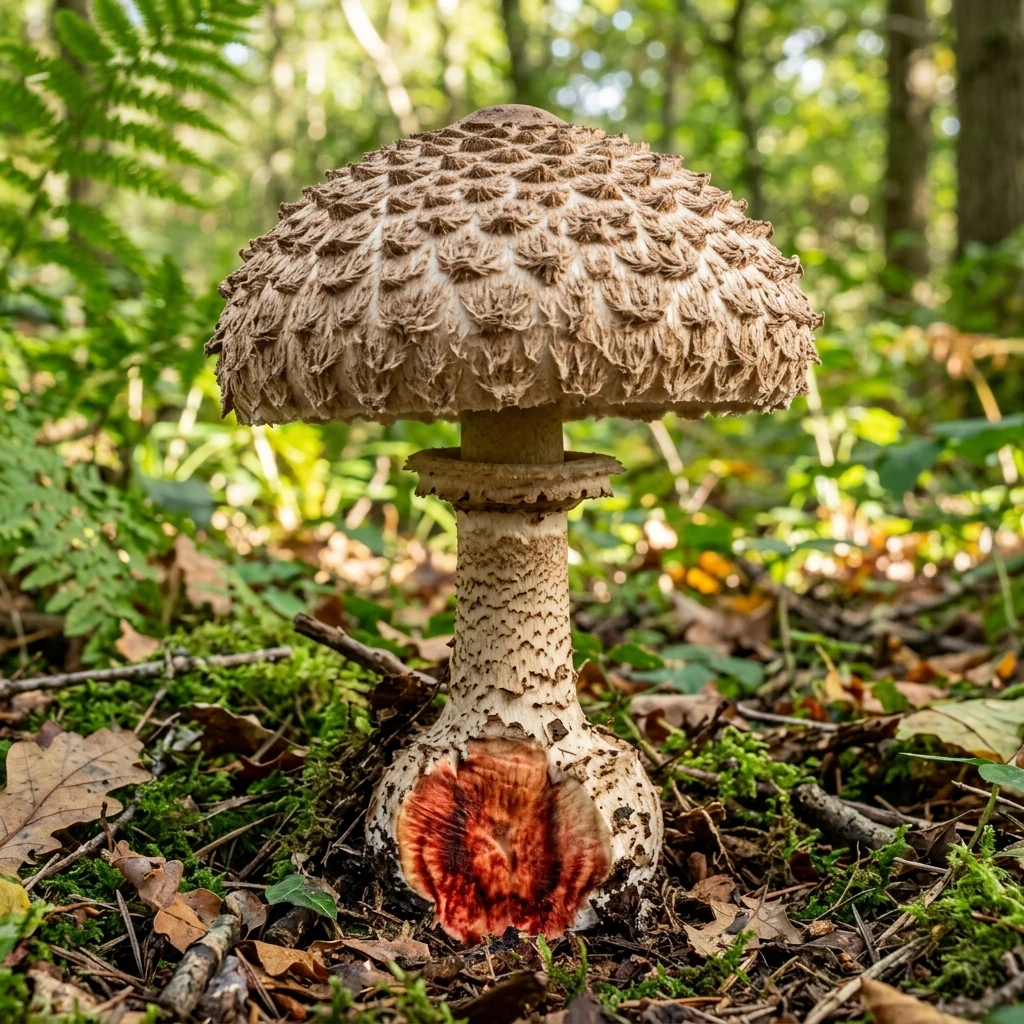
A massive, shaggy brown-scaled cap on a smooth stem with a thick double ring, showing a quick red-orange staining reaction when sliced.

  • Shaggy concentric scales: A large cap, 10 to 20 cm, covered in thick, dark-brown, concentric, shaggy, tile-like scales on a white background.
  • Red-Staining White Flesh: Slicing the thick white flesh of the cap or stem base causes it to stain a distinct, quick reddish-orange or saffron-red.
  • Smooth Stem & Double Ring: A tall, smooth, bulbous stem featuring a thick, prominent, sliding double-edged ring, lacking a volva cup.
🍳 Thorough Cooking: Highly delicious, but **Toxic Raw!** It contains heat-sensitive toxins that cause gastrointestinal irritation if raw. It must be cooked thoroughly for at least 15 minutes, which destroys the toxins and unlocks its choice, nutty flavor.

Detailed Mycology Profile & Safety Guide

Click on any dimension to expand detailed field guides, substrate requirements, and safety warnings.

Grows as a decomposer of rich organic matter. Fruits in large scattered groups, rings, or clusters in open coniferous forests, compost piles, and rich garden soils from summer to autumn.
Requires moderate moisture and warm-to-cool autumn climates (10-20°C). It sprouts abundantly a few days after heavy rains in warm soil.
Thrives in partial shade, open forest glades, and shaded garden edges. Avoids complete deep shade, requiring some light to develop cap scales.
The cap is spherical when young, expanding to flat, 10 to 20 cm, shaggy brown-scaled. Underneath is a dense layer of free, white-to-cream gills, turning yellowish in age.
Produces a pure white-to-pale-cream spore print. Spores are smooth and large, carried by autumn drafts.
Flesh is thick, white, turning saffron-red instantly when cut, with a pleasant nutty smell. Stem is smooth, tall, bulbous at base, with a thick double-edged ring.
Harvest young, firm button caps. The stems are very fibrous, tough, and woody, so foragers usually discard the stems in the forest and cook only the massive, meaty caps.
Edible and choice when thoroughly cooked. Famous for its deep, rich, nutty, and savory flavor. The thick caps are excellent breaded and fried like cutlets, grilled, or sautéed.
Contains high natural dietary fiber, essential vitamins, and polysaccharides showing moderate antioxidant properties in laboratory tests.
CRITICAL WARNING: Dangerous look-alike warning! **Never forage Shaggy Parasol without verifying the spore print.** It looks virtually identical to the highly toxic **Green-Spored False Parasol** (Chlorophyllum molybdites). The poisonous False Parasol features a **distinct green spore print and its flesh never stains red when sliced**, whereas the edible Shaggy Parasol **has a pure white spore print and stains saffron-red instantly when sliced**. Always check the spores and slicing reaction!
This species is highly prized by advanced foragers. The rapid red-staining reaction is an enzymatic defense mechanism. Beginner foragers must always perform a spore print test to guarantee 100% safety before consuming any parasol mushroom.
AI Diagnoser

Is your Shaggy Parasol growing moldy or decaying?

Take a photo with the Plant AI app to instantly diagnose fungal diseases, green mold, or wood decay, and get expert botanical recommendations in 1 second.

Scan Mushroom Now
🦠

Green Spore Dust (False Parasol)

Symptoms: The white gills underneath develop a pale green or olive-gray tint, and the spore print is green.

Action: Action: DISCARD IMMEDIATELY. This is the highly toxic *Chlorophyllum molybdites* (False Parasol). Eating this will cause severe gastrointestinal poisoning. Never consume any parasol with green spores.

🍂

Stem Toughening (Woodiness)

Symptoms: Slicing the tall stem feels extremely fibrous, and the stem remains tough and stringy after cooking.

Action: Action: This is natural. The stem is highly fibrous to support the massive cap. Always discard the stems and only cook the thick, tender caps.

Frequently Asked Questions

How do you tell it apart from the toxic False Parasol?

The edible Shaggy Parasol has a pure white spore print and its white flesh stains a distinct reddish-orange immediately when cut. The toxic False Parasol (Chlorophyllum molybdites) has a green spore print, and its flesh does not turn red when cut.

Why does it stain red when sliced?

It is a rapid chemical oxidation. Slicing the white flesh exposes compounds to oxygen, triggering an enzymatic reaction that converts colorless precursors into a bright saffron-red pigment within seconds.

Can I eat Shaggy Parasol raw?

Can I eat Shaggy Parasol raw?

No. Eating Shaggy Parasol raw or undercooked will cause severe stomach pain, cramps, and vomiting due to heat-sensitive toxins. You must cook it thoroughly for at least 15 minutes to make it safe and delicious.

Is the stem edible?

Technically yes, but the stem is extremely fibrous, stringy, and tough, making it unpleasant to chew and difficult to digest. Most foragers discard the stems in the field and only cook the massive meaty caps.

Understand nature safely. Identify mushrooms instantly!

Get Started for Free