Identify Spring Amanita (Amanita verna) - Plant AI mycology guides
Home / Mushrooms / Spring Amanita

Spring Amanita

Scientific Name: Amanita verna

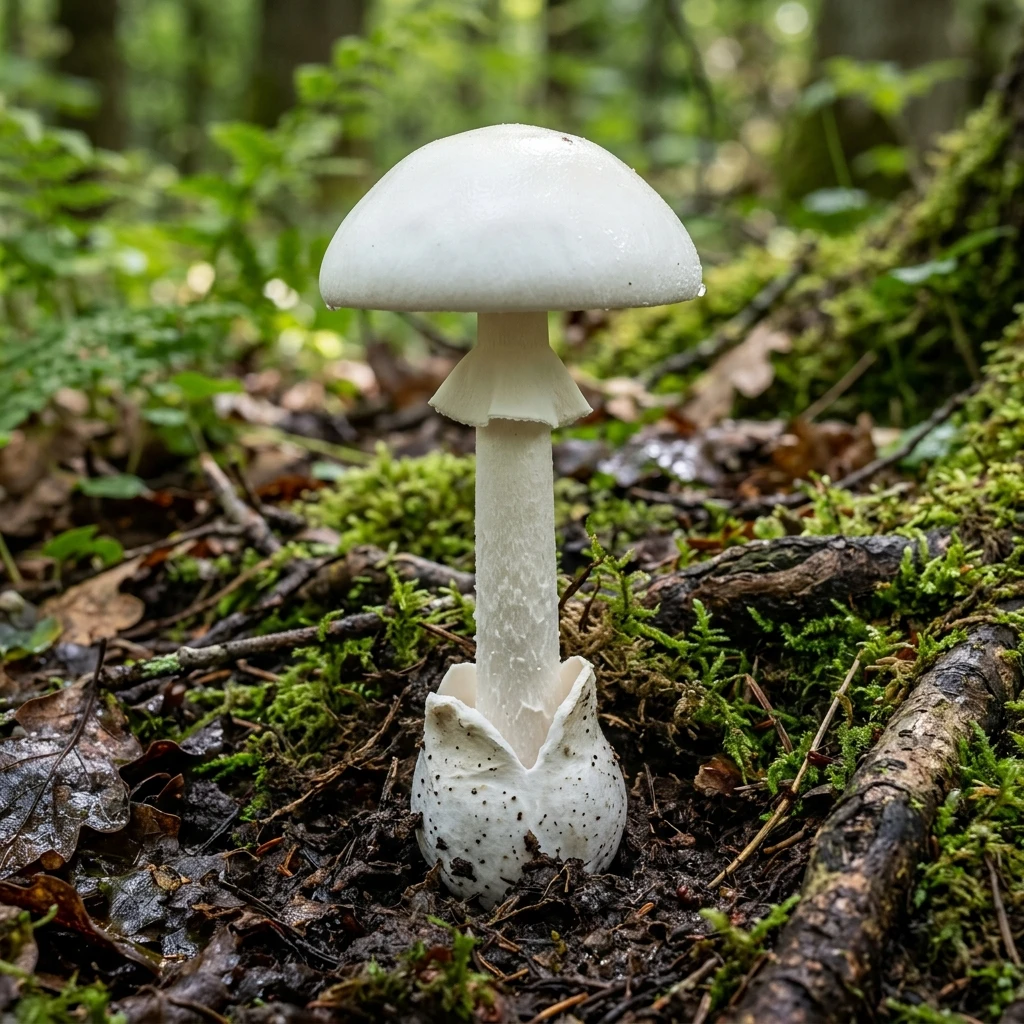
The Spring Amanita, or Fool's Mushroom, is a lethally poisonous, highly toxic wild fungus native to deciduous broadleaf forests across Europe and North America. Emerging in the warm moisture of spring and early summer (unlike most other Amanitas that fruit in autumn), it represents a deadly trap for early-season foragers. Flawlessly smooth and pure white, it features a delicate ring, white gills, and a deep sac-like volva cup at the base, containing the same deadly amatoxins as the Death Cap.


🌍 Environment Broadleaf Oak & Beech Woods
💧 Humidity Moderate Humidity (60-70%)
🪵 Substrate / Host Damp Clay Soil / Oak Roots
📏 Size 4cm - 10cm
🍄 Category Highly Toxic 💀
🔍

How to Identify

A smooth, pure white spring-fruiting mushroom with a delicate white ring, white gills, and a distinct sac-like volva at the base.

  • Smooth White Cap: A completely smooth, pure white cap, 4 to 10 cm, that becomes slightly yellow only in the center when old.
  • Delicate Hanging Ring: A thin, fragile, white skirt-like ring hanging from the upper part of the smooth white stem.
  • Loose Sac-like Volva: A bulbous stem base that is fully enclosed in a tight, white, bag-like cup (volva) sitting in the soil.
💀 SPRING LETHAL WARNING: Highly deadly! Contains lethal **amatoxins** that stop cellular protein synthesis. It fruits in spring, catching mushroom hunters off guard when they expect only edible morels.

Detailed Mycology Profile & Safety Guide

Click on any dimension to expand detailed field guides, substrate requirements, and safety warnings.

Forms mycorrhizal relationships with deciduous trees, especially Oak and Chestnut. Fruits on clay-rich, damp forest soils in deciduous woodlands exclusively in spring and early summer.
Requires warm spring temperatures (15-22°C) and early spring rains. It sprouts rapidly during late May and June forest flushes.
Thrives in shaded broadleaf forests. Its pure white color makes it stand out brightly against the dark green forest floor.
Cap is 4 to 10 cm, smooth, silky-dry. Gills are pure white, crowded, free from the stem, producing white spores. Never changing color.
Produces a pure white spore print. The spores are smooth, round, and are wind-dispersed from the white gills.
Flesh is white, firm, with a mild, pleasant smell when young, turning sickly-sweet with age. Stems are solid, smooth-to-slightly-hairy, with a delicate ring.
NEVER harvest. Avoid foraging any white spring mushrooms unless you are an expert botanist. Clean your hands thoroughly if you handle one.
Lethally poisonous. Ingestion causes the classic three-stage Amanita poisoning: severe gastrointestinal distress after a long delay, a false recovery phase, and terminal liver-renal failure.
Contains high concentrations of **alpha-amanitin**. This molecule is completely heat-stable and resistant to stomach acids, traveling directly to the liver to halt RNA translation.
CRITICAL WARNING: Fatal look-alike confusion! The Spring Amanita is frequently confused by novice foragers with the edible **Spring Agaricus** (Agaricus campestris) or **White Paddy Straw Mushroom** (Volvariella volvacea). However, the edible Spring Agaricus **has pink-to-brown gills and lacks a volva cup**, whereas the poisonous Spring Amanita **has strictly white gills and a prominent bag-like volva cup**. The Volvariella **has pink spores and lacks a ring**, whereas Spring Amanita **has white spores and a clear stem ring**. Always check for the ring and the volva!
A key field test to distinguish Amanita verna from Amanita virosa is the KOH chemical test: dropping potassium hydroxide on the cap of Amanita verna produces **zero color change (negative reaction)**, whereas Amanita virosa **instantly turns bright yellow**. Both are equally lethal!
AI Diagnoser

Is your Spring Amanita growing moldy or decaying?

Take a photo with the Plant AI app to instantly diagnose fungal diseases, green mold, or wood decay, and get expert botanical recommendations in 1 second.

Scan Mushroom Now
🦠

Central Yellowing

Symptoms: The center of the pure white cap develops a soft, pale yellow-ochre coloration as it matures.

Action: Action: This is natural aging. The cap surface is highly sensitive to spring heat. It remains lethally toxic; do not handle.

🍂

Ring Shriveling

Symptoms: The delicate white ring on the upper stem shrivels, falls off, or clings tightly to the stem, appearing invisible.

Action: Action: This is caused by hot spring winds. Always dig up the soil carefully to check for the bulbous stem base and loose volva cup to confirm identification.

Frequently Asked Questions

Why is it called 'Spring Amanita'?

It is named 'Spring Amanita' because it fruits during the spring and early summer (May to June), which is highly unusual for Amanitas, which normally fruit in the autumn.

How poisonous is the Spring Amanita?

It is extremely deadly. A single bite of the cap contains enough amatoxins to cause severe liver necrosis, kidney failure, and death in an adult if medical treatment is not received immediately.

How do you distinguish it from a white Morel?

They look completely different. Morels are hollow, brown-to-cream, and have a honeycomb-like pitted cap with no gills. The Spring Amanita has a smooth white cap, white gills, a ring on the stem, and a cup at the base.

What is the difference between Amanita verna and Amanita virosa?

Both are pure white and lethal, but Amanita verna (Spring Amanita) fruits in spring, has a completely smooth stem, and does not change color when touched with KOH. Amanita virosa (European Destroying Angel) fruits in autumn, has a shaggy stem, and turns bright yellow under KOH.

Understand nature safely. Identify mushrooms instantly!

Get Started for Free