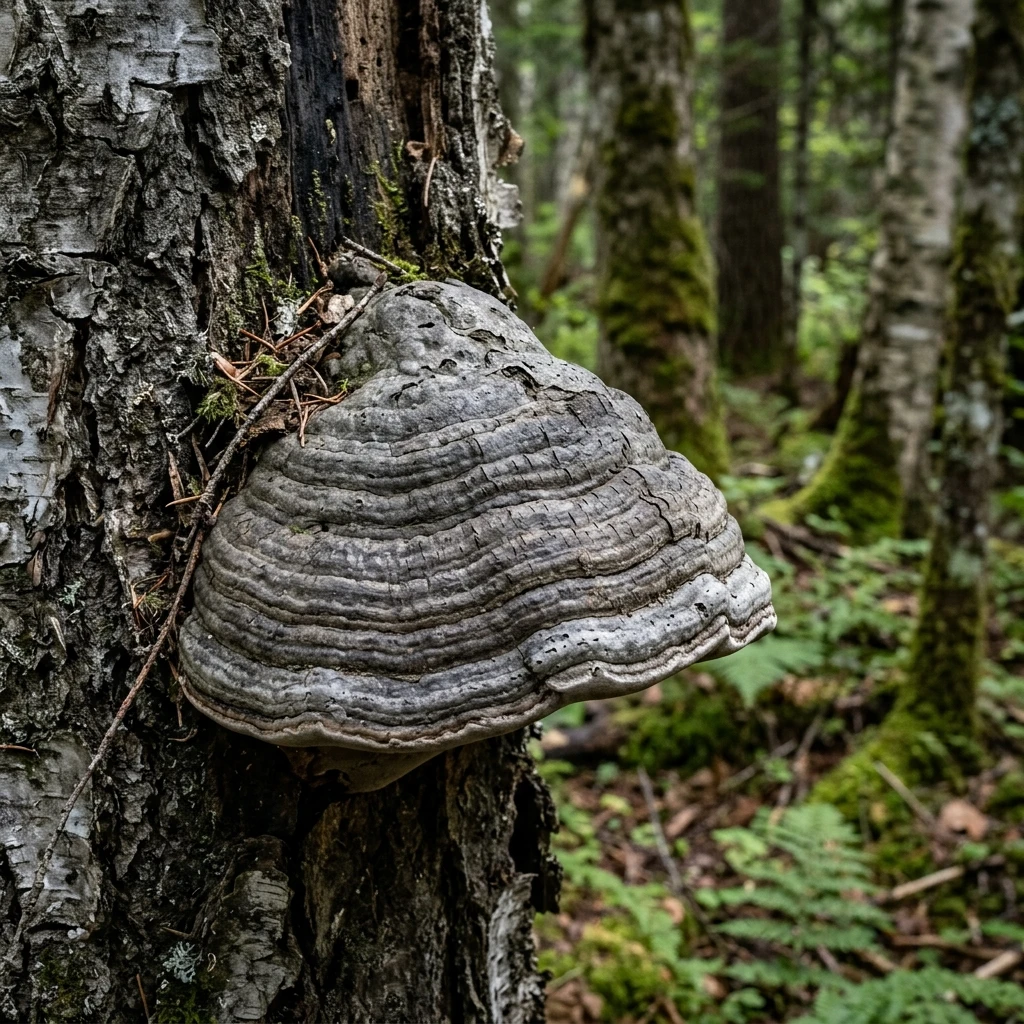
Fomes fomentarius

Tinder Conk Identification & Cultivation

Tinder Conk, or Hoof Fungus, is a massive, woody bracket parasite widely distributed in cold northern hardwood forests. Shaping like a large horse's hoof, this gray, multi-layered conk grows on birch and beech trunks, acting as a slow heartwood decay parasite. Famously carried by the 5,000-year-old alpine mummy 'Ötzi the Iceman' to transport fire, this durable wood conk is prized for immune support and traditional Amadou leathercraft.


Environment Icon
Environment Boreal Hardwood Forests / Beech Woods
Humidity Icon
Humidity Moderate Humidity (60-70%)
Substrate Icon
Substrate Decaying Beech / Birch Tree Wood
Cap Diameter Icon
Cap Diameter 10cm - 45cm conk
Edibility Icon
Edibility Medicinal
Botanical macro photography of Tinder Conk (Fomes fomentarius) - Plant AI care database

How to Identify Tinder Conk

A heavy, gray, hoof-shaped woody bracket with concentric ridges growing on birch or beech wood trunks.

  • Horse Hoof Shape: Massive, thick woody conk that resembles a horse's hoof, growing in sturdy shelves.
  • Hard Gray Crust: Shell-like gray-to-black exterior marked by deep concentric rings representing annual growth layers.
  • Tinder Pore Surface: Underside has a smooth, light brown pore surface with micro-pores that bruise slightly darker.
💡 History Fact: The inner spongy layer of Tinder Conk (Amadou) was highly prized in antiquity for capturing sparks from flint and steel, allowing pre-historic humans to carry fire safely across mountains.

Complete Scientific Cultivation & Identification

Follow our professional mycological parameters and identification guidelines for safe foraging.

Grows primarily as a parasite on living Birch, Beech, and Alder tree trunks, and as a saprophyte on decaying fallen hardwood logs, causing white rot.
Extremely resistant to sub-zero temperatures. Humidity is drawn from the host tree's moisture levels.
No light requirement. Grows slowly over several decades on tree trunks in shaded northern hardwood forests.
No gills. The cap is massive, horse-hoof shaped, grey-brown, 10 to 45 cm. Underside is flat, light brown, with tiny circular pores.
Produces a white to light cream spore print. Releases millions of spores primarily in spring, infecting tree wounds.
Flesh is tough, woody, fibrous, dark brown. Lacks a stem, ring, or volva, growing directly out of the bark of the host tree.
Harvest using a hammer and a chisel to carefully pry the woody bracket off the tree base. Handle with care, as the hard woody bracket is extremely heavy.
Completely inedible and woody. Traditionally sliced, dried, and simmered into medicinal tea, or processed to make Amadou 'fungus leather' for hats and fly-fishing drying pads.
Contains high levels of fomentariol, beta-glucan complexes, and anti-inflammatory triterpenes that support cardiovascular and immune systems.
CRITICAL WARNING: Highly safe. Watch out for 'Artists Conk' (Ganoderma applanatum) which is flatter, brown-crusted, and has white underside pores that instantly turn black when scratched.
Amadou leather is made by boiling the inner spongy brown flesh of Tinder Conk in washing soda (sodium carbonate), then stretching and pounding the fibers until they turn soft, velvety, and highly absorbent.

Is your Tinder Conk growing dusty, moldy or cracking?

Dry thoroughly, protect from humid indoor storage, and keep in dry, well-ventilated boxes.

Identify My Mushroom

Common Diseases & Wild Contamination

Humidity Mold Decay

Symptoms: Symptoms: Fuzzy white mold appearing on the light brown pore underside during damp storage.

Action: Action: Brush off the mold. Bake the woody conk in an oven at 60°C (140°F) for 2 hours to dry completely. Store in a ventilated area.

Crust Cracking

Symptoms: Symptoms: Deep cracks appearing on the gray hoof-like crust during rapid indoor dehydration.

Action: Action: This is normal drying. Avoid placing freshly harvested conks near direct heaters. Allow them to dry slowly in a cool, dry room.

Frequently Asked Questions

Why is it called 'Tinder Conk'?

The inner velvety brown flesh of the hoof mushroom can easily catch and hold a tiny spark from flint and steel without bursting into flames, burning slowly like tinder for hours to carry fire.

What are the health benefits of Tinder Conk?

It is traditional medicine for boosting immune response, regulating blood sugar levels, reducing chronic inflammation, and exhibiting strong antibacterial properties.

How do you make Amadou leather?

Cut off the hard outer gray shell. Slice the inner spongy brown layer into thin strips. Soak the strips in water with sodium carbonate for 24 hours, then pound them with a wooden mallet to flatten and soften the fibers.

Can Tinder Conk be found in winter?

Yes! Tinder Conk is a perennial woody bracket fungus that remains attached to host trees for decades. It can be easily harvested at any time of year, including mid-winter.

Understand nature safely. Identify mushrooms instantly!

Get Started for Free