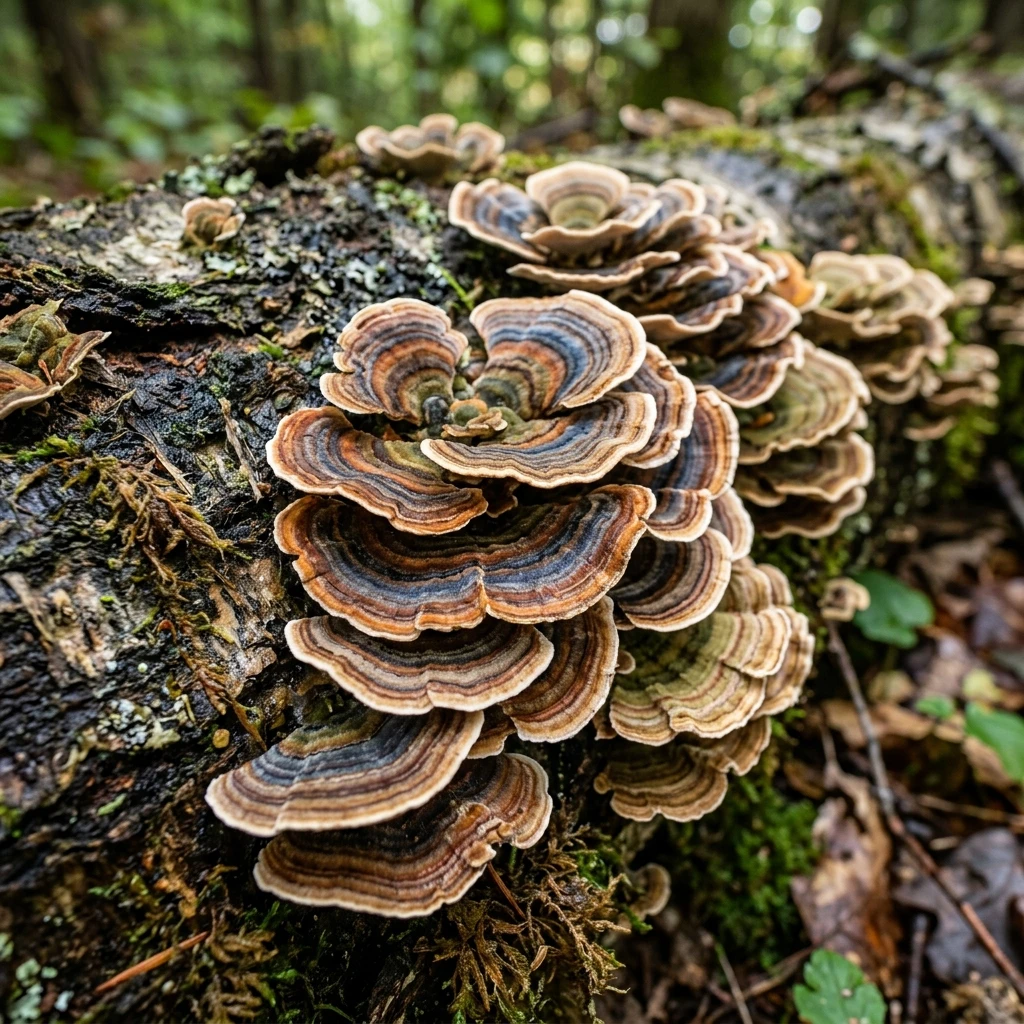
Trametes versicolor

Turkey Tail Identification & Cultivation

Turkey Tail is an exceptionally common and visually stunning wood-decaying bracket fungus distributed globally. Famous for its overlapping, fan-shaped brackets marked by striking concentric bands of brown, grey, blue, and cream, it resembles the colorful tail of a wild turkey. Widely revered in both Eastern and Western medicine, it is a powerhouse of active immunotherapeutic polysaccharides.


Environment Icon
Environment Hardwood Forests / Decaying Logs
Humidity Icon
Humidity Moderate Humidity (70-80%)
Substrate Icon
Substrate Decaying Birch/Oak Wood Logs
Cap Diameter Icon
Cap Diameter 2cm - 8cm bracket
Edibility Icon
Edibility Medicinal
Botanical macro photography of Turkey Tail (Trametes versicolor) - Plant AI care database

How to Identify Turkey Tail

A thin, leathery, fan-shaped bracket marked by colorful concentric stripes and a white pore underside.

  • Concentric Stripes: Thin cap covered in highly colorful, velvet concentric bands of brown, blue, black, and cream.
  • White Pore Underside: Under cap is a pure white-to-cream surface covered in tiny, distinct microscopic pores.
  • Velvety Hair: Cap surface is densely covered in fine, velvety hairs, giving it a soft, fabric-like texture.
💡 Foraging Tip: Always check the underside. True Turkey Tail has a porous white underside. If the underside is completely smooth, gills-like, or purple, it is NOT true Turkey Tail.

Complete Scientific Cultivation & Identification

Follow our professional mycological parameters and identification guidelines for safe foraging.

A highly common wood decay fungus that grows on fallen logs, dead stumps, and decaying branches of hardwood trees (Birch, Oak, Beech).
Thrives in autumn and winter wet seasons. It resists dry summer heat by shrinking into dry, leathery sheets and revives fully during damp autumn rains.
Thrives in shaded woodland floors but tolerates partial sun. Light helps develop the beautiful blue and grey pigments in the concentric stripes.
No gills. The cap is thin, fan-shaped, 2 to 8 cm. Underside is pure white, covered in micro-pores (3 to 5 pores per millimeter).
Produces a white to light cream spore print. Turkey Tail propagates rapidly via wind-dispersed spores and is easily found in most temperate forests.
Flesh is thin, tough, leathery, and white. Lacks a stem, ring, or volva, growing directly in bracket shelves from decaying hardwood logs.
Harvest by cutting the leathery brackets cleanly at the wood base. Wash thoroughly under cold water to remove forest dirt, insects, and moss before processing.
Too tough and leathery to eat. It is traditionally sliced and simmered into a mild, slightly woodsy-tasting medicinal tea, or dried and powdered into capsules.
Extremely famous for containing **Polysaccharide K (PSK)** and **Polysaccharide Peptide (PSP)**, two clinically approved cancer immunotherapeutic agents.
CRITICAL WARNING: Beware of the 'False Turkey Tail' (Stereum ostrea). The False Turkey Tail has a completely smooth, poreless, orange-brown underside and is highly paper-thin.
True Turkey Tail has tiny pores on a white underside that do not stain yellow when bruised. Always dry harvested turkey tails completely in a dehydrator before storing to prevent molding.

Are your Turkey Tails turning green, molding or hard to identify?

Clean the pores surface, dry completely, and inspect concentric stripes velvety hair.

Identify My Mushroom

Common Diseases & Wild Contamination

Green Algae Growth

Symptoms: Symptoms: Bright green film covering the velvety top concentric stripes in damp forests.

Action: Action: Do not harvest. The green color is algae colonizing the wet velvety hair of old specimens. Harvest clean, young brackets.

Insect boring

Symptoms: Symptoms: Small holes in the leathery brackets; fine white powder dropping out during storage.

Action: Action: Heat-treat harvested mushrooms. Place dried turkey tails in the freezer at -20°C for 48 hours to kill hidden forest boring insect eggs.

Frequently Asked Questions

What is the difference between True and False Turkey Tail?

True Turkey Tail (Trametes versicolor) has a velvety top and a pure white underside covered in microscopic pores. False Turkey Tail (Stereum ostrea) has a smooth, completely pore-less, parchment-like orange-brown underside.

What are PSK and PSP?

They are active proteoglycans extracted from Turkey Tail mycelium. PSK is a clinically approved drug in Japan (Krestin) used alongside chemotherapy to boost patient survival rates by stimulating immune cells.

How do you prepare Turkey Tail tea?

Simmer 20 grams of dried Turkey Tail in 1 liter of boiling water for 1 hour. Strain the tough leathery mushrooms. The tea has a mild, earthy, and pleasant flavor and can be sweetened with honey.

Can Turkey Tail be found in winter?

Yes! Turkey Tail is a highly durable bracket fungus that persists year-round. It can be easily found and harvested throughout the winter months, even in snowy conditions.

Understand nature safely. Identify mushrooms instantly!

Get Started for Free