Dyer's Polypore Foraging & Identification Guide
The Dyer's Polypore, also known as the Velvet-Top Fungus, is a highly common, large, and completely inedible wild bracket polypore mushroom native to coniferous forests across the Northern Hemisphere. Growing on the ground at the base of mature Pine, Spruce, and Larch trees, it is a famous hazard for forestry but a legendary treasure for textile artists. Eerily beautiful when young, its thick, soft, velvety ochre-brown cap features a striking, bright sulfur-yellow margin. While completely woody and inedible, it is highly celebrated globally for its ability to produce rich, beautiful natural dyes for wool and silk.





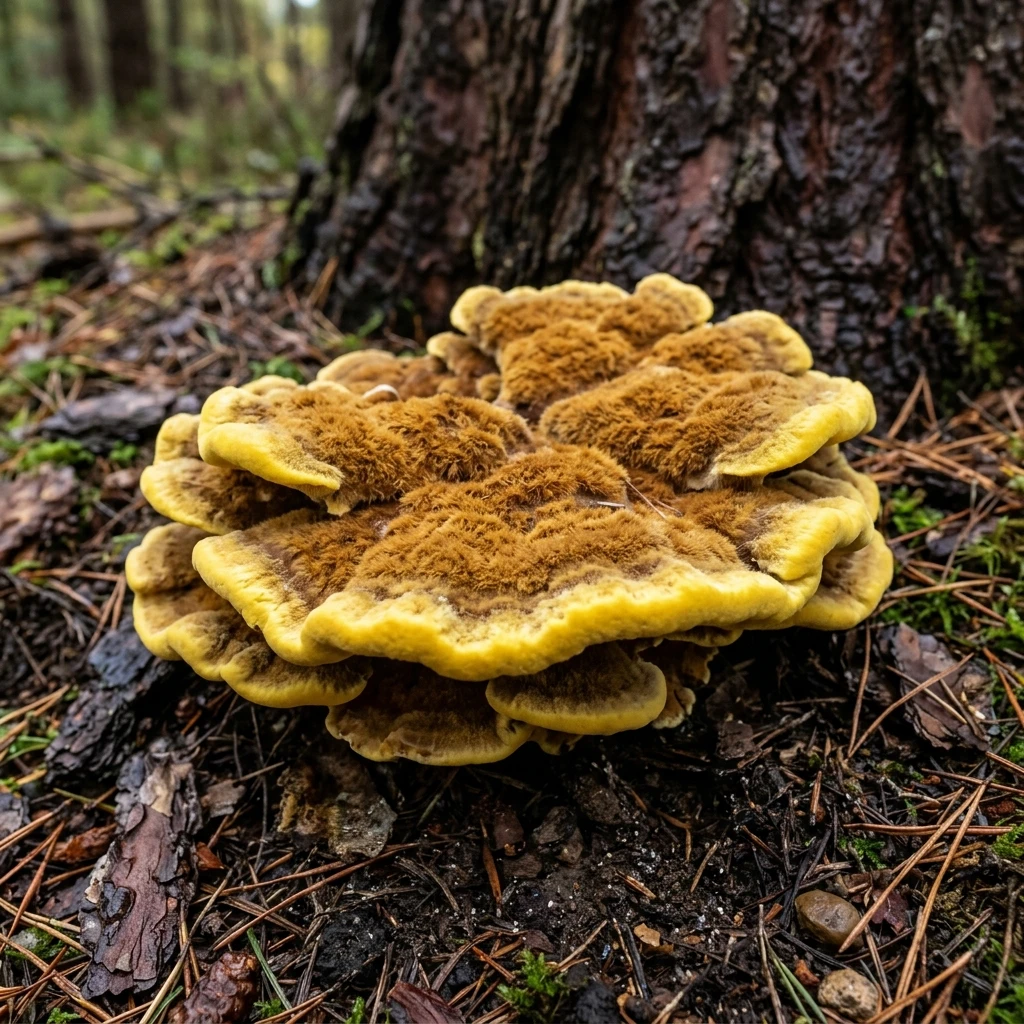
How to Identify Dyer's Polypore
A large, fan-shaped ochre-brown bracket covered in thick velvety felt-like hair, with a striking bright sulfur-yellow margin, growing near conifers.
-
✔
Cap: Varies by species.
-
✔
Spore: Critical check.
Detailed Mycology Profile & Foraging Guide
Follow our detailed scientific field guide and environmental parameters to identify and study Dyer's Polypore safely.
Common Look-alikes & Foraging Danger
Margin Loss & Browning (Aging)
Symptoms: The bright sulfur-yellow margin disappears, and the entire bracket turns a dark, dingy rusty-brown.
Soggy Rot
Symptoms: The woody bracket becomes black, soggy, mushy, and covered in white mold after heavy rains.
Frequently Asked Questions
Why is it called 'Dyer's Polypore'?
It is named 'Dyer's Polypore' because it contains exceptionally high concentrations of natural yellow-brown pigments (like hispidin). For centuries, it has been harvested and boiled by textile artists to dye wool, silk, and cotton.
What colors can you get from this mushroom?
You can get a spectacular spectrum! Young, yellow-ringed brackets produce beautiful golden-yellow and bright orange dyes. Older, rusty-brown brackets produce deep bronze-green, olive, and rich dark forest-brown dyes.
Does it kill the pine tree it grows on?
Yes. It is a highly destructive root-rot parasite. It infects the root system of living conifer trees, hollowing the roots and causing a brittle 'brown rot.' Stressed conifers can host the fungus for years before collapsing.
Is the Dyer's Polypore toxic?
It is not known to be chemically toxic, but it is considered completely inedible because it is as hard as wood or cork, making it impossible to chew, swallow, or digest.