Lithops Care & Identification Guide
Lithops is an extraordinary, highly structural mimicry succulent native to extreme rocky gravel plains. Composed of fleshy, plump leaves, it has adapted a fascinating survival strategy: mimicking surrounding pebbles (often celebrated as 'Living Stones') and undergoing a highly critical annual splitting cycle to grow fresh foliage.





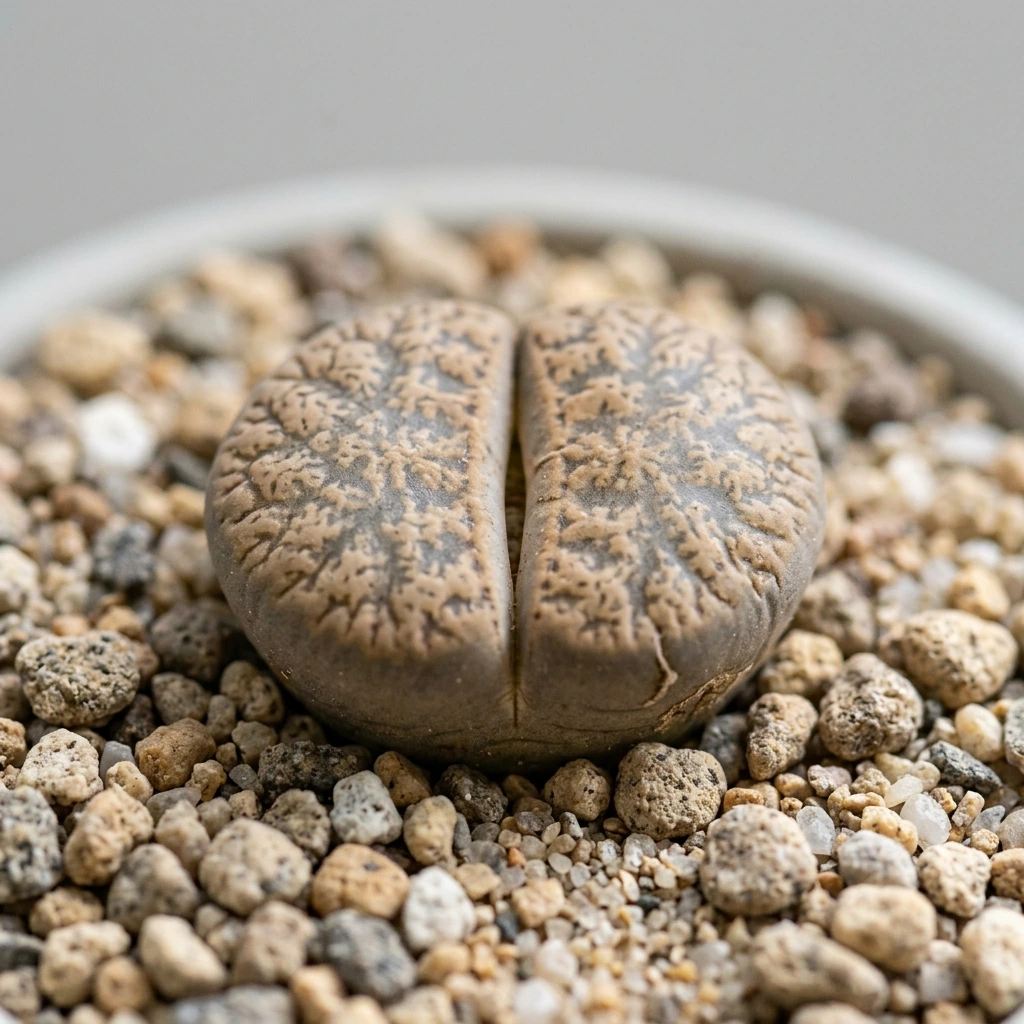
How to Identify Lithops
-
✓
Distinctive Features: Plump vertical rosettes of fleshy leaves.
-
✓
Typical Coloration: Pastel green, blue-gray, turning pink or red under sun stress.
-
✓
Potential Confusions: Confused with other similar looking rosettes, but distinguished by leaf thickness.
11-Step Professional Care Guide
Lithops demands a strictly regulated watering schedule tied directly to its annual growth cycle. During the splitting phase in late winter and early spring, the new inner leaves will emerge and absorb all the moisture and nutrients from the old outer leaves. Do not water them at all! Watering during this splitting phase is the absolute number one killer, causing leaf rupture (splitting burst) and sudden fungal rot (liquefaction).
Lithops requires Bright Direct Sun (Requires 4-5 hours of direct morning sun to prevent stretch/etiolation). Place on a south-facing windowsill. Insufficient light causes the 'stones' to stretch.
The optimal substrate is a highly gritty, mineral potting mix with minimal organic matter. A standard recipe consists of 80% mineral grit (pumice, fine lava rock, coarse sand, perlite) and 20% organic sandy loam (pH 6.5-7.5).
Thrives in standard warm conditions: 18°C - 30°C (64°F - 86°F); protect from freezing temperatures below 10°C. Keep safe from cold drafts and high humidity.
Lithops requires absolutely no pruning. Never peel off the old, outer shriveled leaves during the splitting phase; the new inner leaf pair absorbs moisture and nutrients from them naturally.
Apply a highly diluted, low-nitrogen liquid organic cactus fertilizer once in early autumn just before the blooming period. Never fertilize during the winter splitting phase.
Propagate Lithops primarily by seeds in spring. Older multi-headed clumps can be carefully divided during repotting in spring, ensuring each leaf head has a portion of the taproot.
Choose a deep terracotta container (at least 4 to 5 inches deep) with large bottom drainage holes to accommodate its long taproot. Terracotta allows excess soil moisture to breathe and evaporate safely.
Inspect crevices between the two leaves for mealybugs or spider mites. Treat immediately by dabbing with a cotton swab dipped in rubbing alcohol. Avoid heavy chemical sprays.
Fungal root rot due to overwatering is the absolute number one killer. The plant turns translucent, soft, and liquefies. Ensure the soil is gritty and dry.
The golden rule of Lithops care is: when the plant is 'splitting' (producing a new leaf pair from its center crack that slowly consumes the old outer leaves), do not water it at all! It requires zero water during this splitting phase. Additionally, ensure the potting soil is 85% coarse mineral grit to accommodate its sensitive root system and prevent damp moisture trap.
Frequently Asked Questions
Q: How do I care for Lithops?
A: Lithops requires sandy soil and very sparse watering to thrive.
Q: How often should I water Lithops?
A: Water deeply only when the potting soil is 100% dry throughout the container.
Q: What is the ideal soil for Lithops?
A: Use a grit-rich, porous cactus and succulent potting mix containing perlite and pumice.
Q: Can Lithops survive freezing winter?
A: No. They are highly frost-sensitive. Bring them indoors if temperature drops below 10°C.