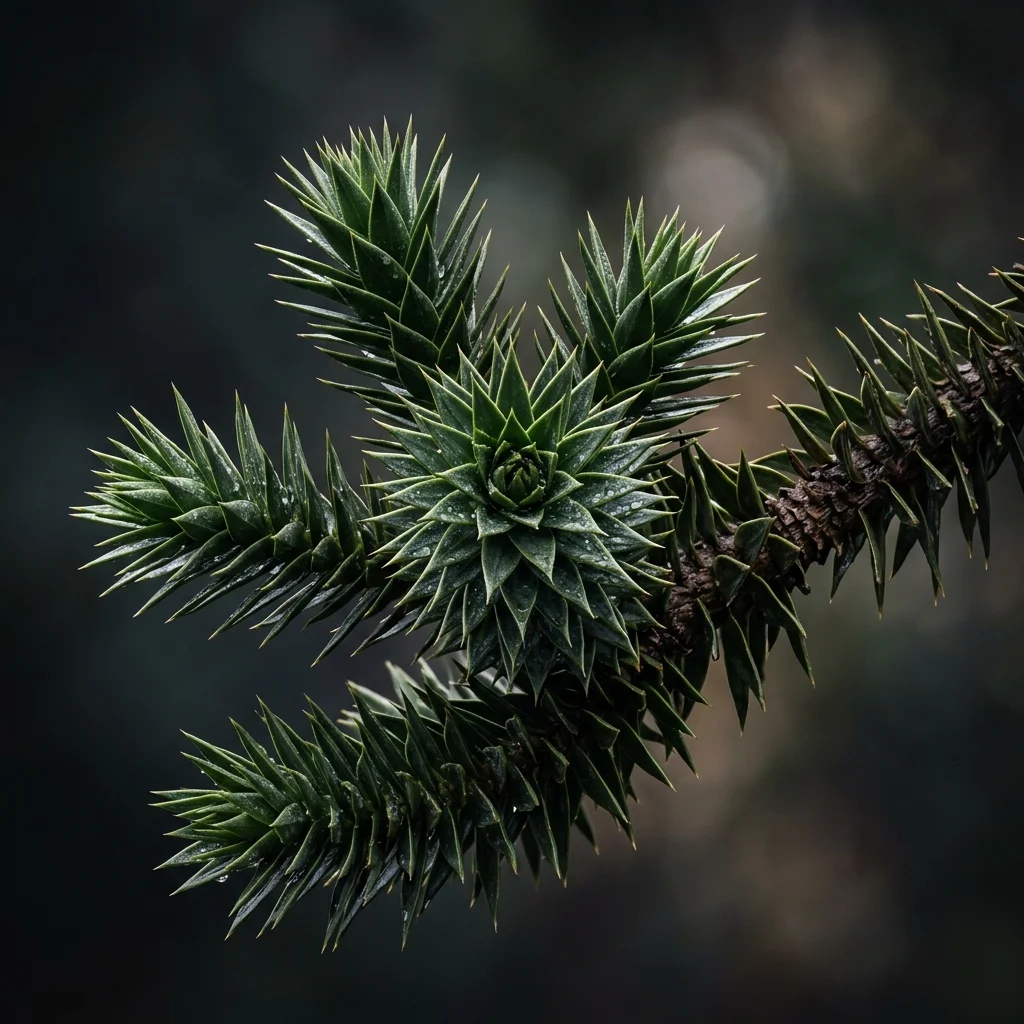
Araucaria araucana

Monkey Puzzle Tree Care & Identification Guide

The magnificent Chilean Monkey Puzzle Tree (Araucaria araucana) is a spectacular and bizarre evergreen conifer native to the slopes of the Andes mountains in Chile and Argentina, celebrated globally as a Jurassic-era living fossil. Its heavy branches are densely covered in exceptionally stiff, sharp-pointed triangular scale-like leaves arranged in a tight spiral. This formidable foliage evolved as a physical defense to prevent ancient herbivorous dinosaurs from climbing and eating the crown. It requires cool summer climates, rich volcanic soils, and moderate watering.


Sunlight Icon
Sunlight Full Sun
Watering Icon
Watering Moderate
Soil Mix Icon
Soil Mix Volcanic Acidic Loam
Temperature Icon
Temperature -15°C to 25°C
Toxicity Warning Icon
Toxicity Non-toxic (but sharp needles pose physical hazard)
Botanical photography of Monkey Puzzle Tree (Araucaria araucana) - Plant AI care database

How to Identify Monkey Puzzle Tree

Identify Monkey Puzzle Tree immediately by its highly distinct biological features. Native to its specific ecosystem, it showcases spectacular foliage and structural habits optimized for its environment.

  • Distinctive Features: Highly symmetric pyramidal crown, heavy geometric branches covered entirely in sharp, spirally-arranged triangular woody scales, and large globe-shaped cones.
  • Typical Coloration: Glossy dark green rigid scale foliage, and dark grey wrinkly bark resembling an elephant's foot.
  • Potential Confusions: Similar to Norfolk Island Pine, but easily distinguished by its significantly stiffer, wider, extremely sharp triangular scale-like leaves (Norfolk Pine leaves are soft and needle-like).

11-Step Professional Care & Planting Guide

💧 【Watering & Moisture】 Water moderately. Prefers consistently moist, cool, well-draining volcanic soil. Young trees are highly sensitive to drought; irrigate weekly.

☀️ 【Sunlight & Exposure】 Requires full direct sun. Young specimens tolerate light partial shade, but mature trees must have open, bright skies to maintain their rigid geometric branches.

🪴 【Ideal Soil Mix】 Thrives in deep, rich, organic, acidic volcanic soils. Blend 40% organic leaf mold, 30% sandy loam, and 30% volcanic grit or perlite (pH 5.5-6.5).

🌡️ 【Temperature & Winter Care】 Cold-hardy conifer (USDA Zone 7-10). Tolerates winter freezes down to -15°C. Dislikes sultry, tropical heat and hot humid summers.

✂ 【Pruning & Grooming】 Do not prune healthy branches! Every limb defines its perfect prehistoric symmetry. Dead lower limbs will naturally drop cleanly over time.

🧪 【Fertilization】 Apply a slow-release organic acidic balanced fertilizer once in early spring. Mulch with composted pine bark to preserve cool root runs.

🏺 【Potting & Garden Planting】 Plant in highly visible, open garden spaces where its ancient silhouette can stand out. Ensure soil drainage is outstanding.

🌱 【Propagation】 Propagated by sowing the large, edible seeds in spring, or by taking vertical tip cuttings (horizontal lateral branch cuttings will grow sideways!).

🐛 【Common Pests】 Generally pest-resistant due to tough armored foliage. Watch for rare mealybugs or spider mites.

🦠 【Common Diseases】 Susceptible to Phytophthora root rot in heavy, waterlogged clay soils. Outstanding drainage is mandatory.

🎓 【Botanist Advice】 **Physical Hazard:** The triangular leaves are incredibly stiff and razor-sharp! Always plant this majestic tree away from pedestrian pathways and children's play areas, as contact will cause painful physical scratches.

Frequently Asked Questions

Q: Why is it called 'Monkey Puzzle'?

A: It has an amusing origin! In the 19th century, a British observer remarked that the tree's intricate, razor-sharp, closely-packed scale armor would puzzle even a monkey attempting to climb it, leading to its popular common name.

Q: Are the seeds edible?

A: Yes! The massive globose female cones contain large, highly nutritious, starch-rich edible seeds (called piñones), which have been a vital traditional staple food for the indigenous Mapuche people of Chile for centuries.

Q: How old is this tree species?

A: It is a prehistoric survivor! The Araucariaceae family dates back over **200 million years** to the Jurassic and Cretaceous periods, making this species a true living dinosaur.

Q: Can I grow it as a potted indoor plant?

A: Only as a juvenile conifer in a highly ventilated, exceptionally bright, cool sunroom. It grows very slowly but eventually requires spacious outdoor conditions to thrive.

Is your Monkey Puzzle Tree showing yellow or dry leaves?

Don't let rot or scale pests kill your trees. Upload a photo now to get an instant AI botanical diagnosis and save your forest today!

Diagnose Monkey Puzzle Tree Now