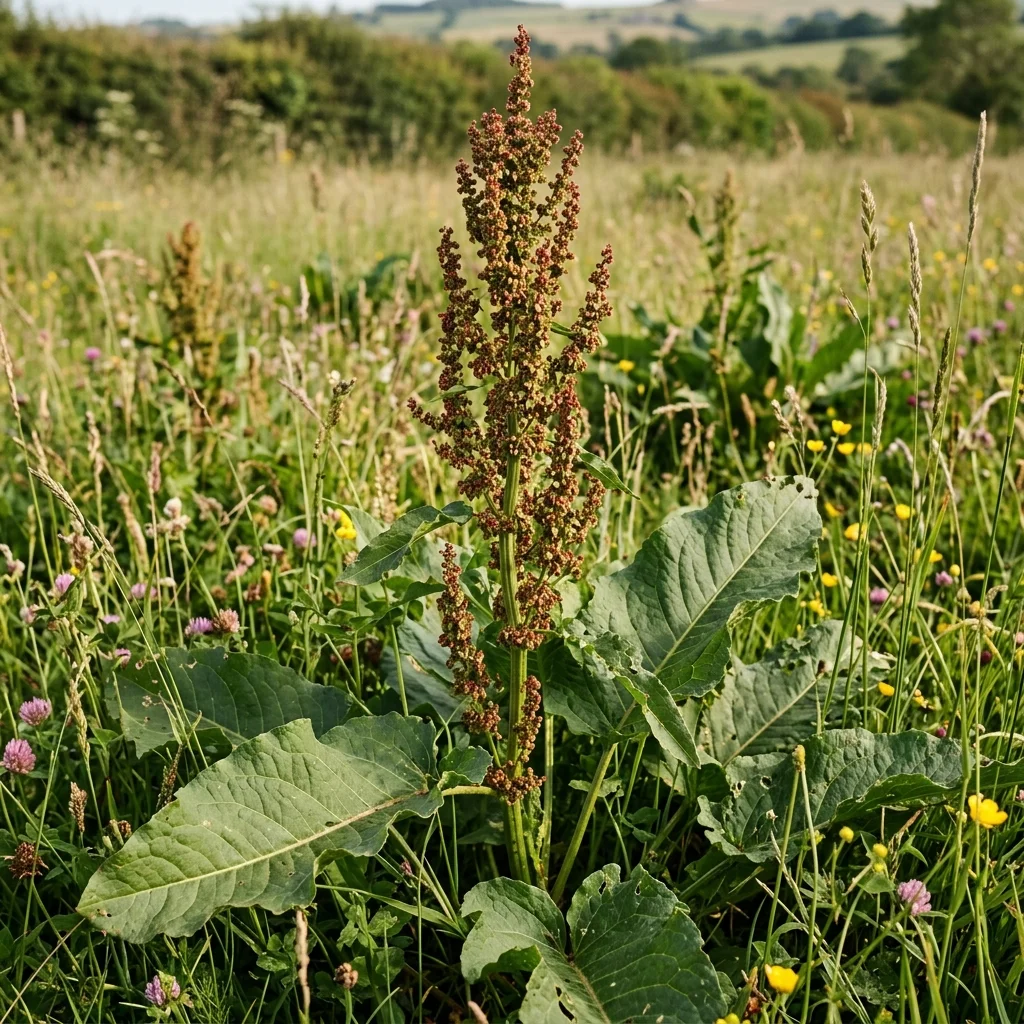
Rumex obtusifolius

Broadleaf Dock Identification & Control

Broadleaf Dock, also known as Bitter Dock or Broad-Leaved Dock, is an exceptionally robust, tough perennial broadleaf weed in the buckwheat family. Native to Europe but thoroughly naturalized globally, it is a highly persistent pest in moist pastures, home gardens, and orchards. It features massive, broad, egg-shaped green leaves with distinctive reddish veins and leaf stalks, growing from a massive, woody, yellow taproot that anchors stubbornly into compacted clay soils.


Sunlight Icon
Sunlight Full Sun to Partial Shade
Watering Icon
Watering Tolerance Moderate
Soil Mix Icon
Soil Adaptability Moist Clay / Compacted / Rich Soil
Temperature Icon
Growth Temp 5°C - 36°C
Toxicity Danger Icon
Danger / Toxicity Pet Toxic / Massive Taproot
Botanical macro photography of Broadleaf Dock (Rumex obtusifolius) - Plant AI care and control database

How to Identify Broadleaf Dock

A robust, upright perennial with exceptionally large, broad, egg-shaped green leaves showing flat margins and heart-shaped bases, and reddish veins.

  • Massive Broad Leaves: The lower leaves are exceptionally wide, egg-shaped (up to 40 cm long), with heart-shaped bases and relatively flat (non-curly) margins.
  • Reddish Veins & Petioles: Leaf stalks (petioles) and central veins often display a highly distinct, deep reddish-purple coloration.
  • Upright Green-Brown Spikes: Stems bear dense whorls of green-red flowers that mature into brown winged seeds, lacking the bright rusty-red phase of curly dock.
💡 Plant AI Tip: Broadleaf Dock has a massive seed bank! A single plant can release up to 60,000 seeds, which can survive dormant in wet clay for over 80 years. Turning the soil stimulates them to germinate.

Complete Care & Management Guide

Access highly technical, scientific management directives to control or cultivate Broadleaf Dock effectively.

Highly adapted to wet, damp, and poorly drained compacted soils. It thrives in overwatered lawns and damp pasture margins, but survives summer dry spells by tapping deep sub-soil moisture.
Resistant to mowing. Mowing clips the tall seed heads, but the massive broad leaves adapt by growing flatter to the ground, and the deep yellow taproot remains completely unharmed.
Highly aggressive. It absorbs high levels of nitrogen and potassium, outcompeting pasture grasses and garden flowers. Shifting soil fertility helps grass compete.
Prefers Full Sun but exhibits high shade tolerance, allowing it to colonize orchard floors, shaded garden borders, and lawn edges beneath tree canopies.
Prefers moist clay, rich organic loam, and poorly drained high-nitrogen soils. It easily survives in hard-packed turf ground.
Spreads entirely by seeds. The winged seeds are easily dispersed by wind, water, agricultural machinery, and by sticking to animal fur.
Extremely cold-hardy perennial. Leaves die back under freezing winter temperatures, but the thick yellow taproot crown survives easily, sprouting massive rosettes in early spring.
Features an exceptionally deep, thick, branched woody yellow taproot that drills 4-5 feet deep. Manual removal requires deep excavation with a garden spade.
Occasionally targeted by dock leaf beetles and green dock beetles, which chew numerous holes in the massive leaves, weakening the root crown.
Subject to **Fungal Leaf Spots** and **Dock Rust Fungus**, though diseases rarely kill the extensive yellow taproot system.
To control Broadleaf Dock organically, you must dig up the taproot crown using a sharp spade. You must dig out at least the top 4 inches of the yellow taproot to prevent regeneration. Do not compost seeded plants.

Is your garden showing massive broad leaves with red veins or tall seed spikes?

Dig out the woody yellow taproot crown 4 inches deep, improve clay drainage, and mow before seedheads mature.

Diagnose Weed Instantly

Common Diseases & Treatment

Dock Leaf Spot

Symptoms: Symptoms: Circular brown spots with distinct purple borders covering the massive broad leaves.

Action: Action: Clip and dispose of infected leaves. Ensure proper air circulation, and apply organic copper fungicide to prevent fungal spread.

Root Regeneration

Symptoms: Symptoms: The massive broad leaves sprout back rapidly from a snapped taproot left in the clay soil.

Action: Action: Deep excavation. Snapped roots will grow back. Use a spade to dig a hole 8 inches wide and deep around the root core to lift it completely.

Frequently Asked Questions

How do you distinguish Broadleaf Dock from Curly Dock?

Broadleaf Dock (Rumex obtusifolius) has exceptionally wide, broad, egg-shaped leaves with heart-shaped bases and flat edges. Curly Dock (Rumex crispus) has very narrow, lance-shaped leaves with highly wavy, crinkled margins.

Is Broadleaf Dock toxic to pets?

Yes. Like Curly Dock, it contains high concentrations of soluble calcium oxalates. If consumed in large quantities by dogs, cats, or sheep, it can cause salivation, gastrointestinal irritation, and potential kidney damage.

Why does it grow so well in compacted pastures?

Its branched yellow taproot is exceptionally strong, capable of drilling through dense, oxygen-poor clay soils. Compaction kills off sensitive grass species, leaving open ground that Broadleaf Dock aggressively colonizes.

What is the best way to get rid of it organically?

Use a sharp garden spade to slice a circle around the base of the rosette. Dig deep and lift the woody yellow root crown out intact. Mow the area regularly to prevent seed production.

No more dying plants. Grow healthy greens today!

Get Started for Free