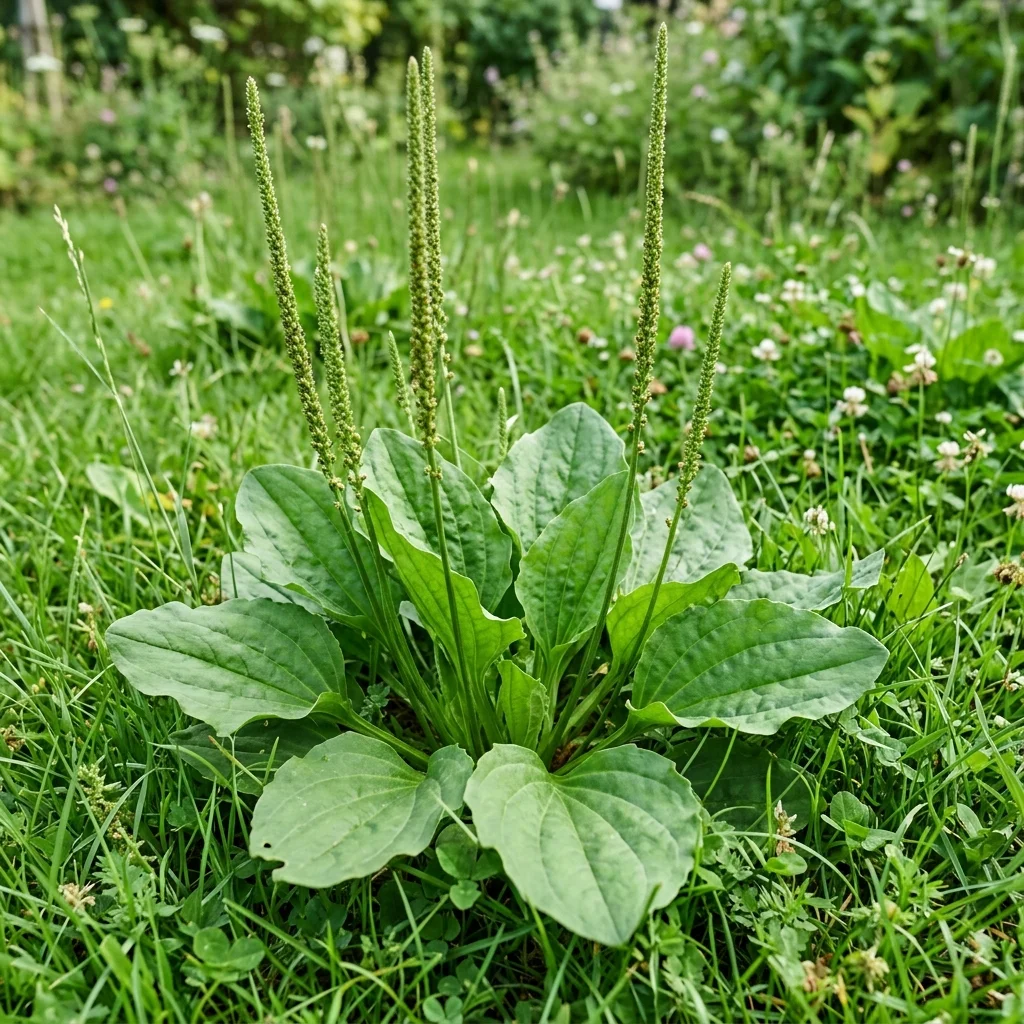
Plantago major

Broadleaf Plantain Identification & Control

Broadleaf Plantain is a highly common, tough, and stubborn broadleaf perennial weed native to Eurasia but fully naturalized across temperate regions worldwide. Celebrated for its outstanding ability to survive severe soil compaction and foot traffic, it thrives abundantly in walkways, compacted park lawns, and driveway margins. It features massive, thick, oval green leaves arranged in a flat rosette, sprouting upright, rod-like seed heads that release thousands of sticky, durable seeds.


Sunlight Icon
Sunlight Full Sun to Shade
Watering Icon
Watering Tolerance Moderate
Soil Mix Icon
Soil Adaptability Compacted Clay / Poor Soil
Temperature Icon
Growth Temp 8°C - 38°C
Toxicity Danger Icon
Danger / Toxicity Pet Safe / Edible
Botanical macro photography of Broadleaf Plantain (Plantago major) - Plant AI care and control database

How to Identify Broadleaf Plantain

A flat basal rosette of broad, oval green leaves with 3 to 7 prominent parallel veins, and tall, narrow, green spike-like flower stalks.

  • Broad Parallel Veins: Large, thick, egg-shaped green leaves (5 to 15 cm) with 3 to 7 highly distinct parallel veins running from base to tip.
  • Flat Basal Rosette: Leaves lie extremely flat against the soil, allowing the plant to survive heavy foot trampling and lawn mowers.
  • Narrow Seed Spikes: Upright, rod-like green-brown spikes densely covered in tiny, inconspicuous flowers that mature into seed capsules.
💡 Management Tip: Broadleaf Plantain is the ultimate indicator of compacted soil! It thrives where grass cannot grow because of tight soil structure. Core aerate your lawn to alleviate compaction and weaken this weed.

Complete Care & Management Guide

Access highly technical, scientific management directives to control or cultivate Broadleaf Plantain effectively.

Extremely resilient to waterlogging and drought. Thrives in damp, poorly drained compacted soils, but survives hot summer dry spells by entering a semi-dormant state, reviving quickly after rain.
Virtually immune to standard lawn mowing. Because the large leaves lie flat in a tight rosette right at the soil surface, mower blades pass completely over them. Hand-digging is required.
Thrives in nutrient-poor soils. It accumulates minerals and acts as a soil binder. Regular fertilization helps lawn grasses grow densely, shading out emerging plantain seedlings.
Highly versatile. Thrives in Full Sun but exhibits high shade tolerance, allowing it to colonize dense orchard floors and shaded home lawns. Shading alone will not easily eradicate it.
Prefers heavy, compacted clay, gravelly driveways, and high-traffic pathways where other plants collapse due to lack of soil aeration. It does not require loose soil.
Reproduces strictly by seeds. A single plantain spike can produce up to 14,000 seeds. The seeds develop a sticky mucilage coating when wet, adhering to animal fur, shoes, and tires.
Extremely cold-hardy perennial. Foliage dies back in harsh winters, but the thick, fibrous root crown survives underground, sprouting new leaves in early spring.
Features a short, thick root crown with a dense network of tough, fibrous roots that anchor tightly into compacted clay. Digging requires a hand trowel or weeding fork.
Occasionally host to leafhoppers and flea beetles, but pests rarely cause significant damage. The plant is highly resilient to natural insect pressure.
Subject to **Bacterial Leaf Spot** and **Powdery Mildew**. *Action*: Prune off spotted leaves. Spray with organic neem oil or copper fungicide to prevent spread.
To control broadleaf plantain organically, perform lawn core aeration to loosen the soil, raise mowing heights to shade the soil surface, and manually dig out rosettes in early spring.

Is your Plantain leaves showing dark spots or resisting mowing?

Aerate compacted lawn soil, dig out the fibrous root crown, and inspect for upright green seed spikes.

Diagnose Weed Instantly

Common Diseases & Treatment

Bacterial Leaf Spot

Symptoms: Symptoms: Water-soaked dark brown or black circular spots appearing on the broad green leaves.

Action: Action: Clip and dispose of infected leaves. Avoid overhead watering to keep leaf surfaces dry, and apply organic copper fungicide.

Mower Escape

Symptoms: Symptoms: Plantain continues to sprout large leaves and seed spikes despite weekly low lawn mowing.

Action: Action: Use a hand-weeder tool. Mowing high (3+ inches) helps grass compete, but plantains lying flat must be physically dug out from the root crown.

Frequently Asked Questions

Why does Broadleaf Plantain grow in compacted pathways?

Plantain roots are exceptionally tough and fibrous, capable of extracting oxygen and water from dense, compacted clay soils. Compaction kills off sensitive turf grasses, leaving open, bare soil that plantains colonize.

Are Plantain leaves edible or medicinal?

Yes. The young, tender leaves are edible raw or cooked, rich in vitamins A, C, and K. Medicinally, the leaves contain allantois and have been used for centuries as a soothing poultice to relieve insect bites and bee stings.

How do the seeds spread?

The seeds produce a sticky, gelatinous coating when wet. This allows them to stick to shoes, pet paws, lawn mower wheels, and car tires, spreading efficiently along park trails and driveways.

What is the best way to eradicate Broadleaf Plantain?

Physically dig them out using a weeding tool, ensuring you remove the central root crown. Follow up with core aeration of your lawn to alleviate soil compaction, and sow dense grass seed to cover bare spots.

No more dying plants. Grow healthy greens today!

Get Started for Free