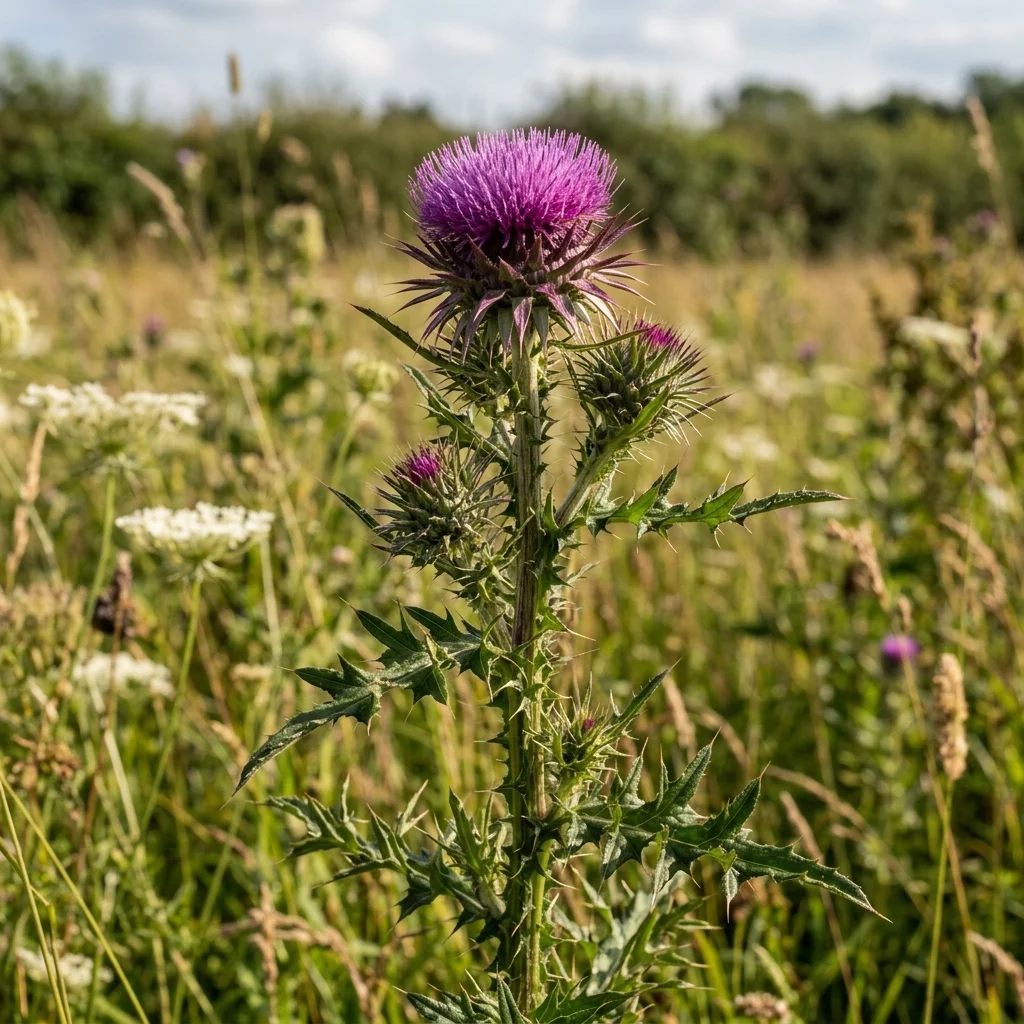
Cirsium vulgare

Bull Thistle Identification & Control

Bull Thistle, classically celebrated as the Common Thistle or Spear Thistle, is an exceptionally aggressive, heavily armed biennial broadleaf weed in the Asteraceae family. Native to Europe but thoroughly naturalized globally, it is a severe threat to pastures, forest margins, and home gardens. During its second year of growth, it sprouts thick, heavily-winged stems covered in long yellow spines, large jagged leaves terminating in needle-sharp points, and showy purple globe flower heads that are highly painful to touch.


Sunlight Icon
Sunlight Full Sun
Watering Icon
Watering Tolerance Low to Moderate
Soil Mix Icon
Soil Adaptability Any Soil / Loam / Dry Clay / Sandy
Temperature Icon
Growth Temp 5°C - 35°C
Toxicity Danger Icon
Danger / Toxicity Danger / Severe Spines / Biennial
Botanical macro photography of Bull Thistle (Cirsium vulgare) - Plant AI care and control database

How to Identify Bull Thistle

An upright biennial with spiny-winged stems, deeply lobed leaves tipped with sharp yellow needles, and showy purple flower heads.

  • Needle-Sharp Yellow Spines: The tips of all leaf lobes and the prominent vertical wings along the stems are armed with stiff, needle-sharp yellow spines.
  • Showy Purple Globe Heads: Large, rounded, purple-to-pink flower heads (3 to 5 cm wide) sitting in highly spiny, green cup-like bracts.
  • Deeply Lobed Prickly Leaves: Massive, dark-green leaves deeply divided into tooth-like lobes, covered in stiff prickles on top and fuzzy white hairs below.
💡 Biennial Lifecycle: Bull Thistle is a biennial! In its first year, it grows flat to the ground as a spiny basal rosette. In the second year, it shoots up massive, heavily-armed flowering stalks up to 5 feet tall.

Complete Care & Management Guide

Access highly technical, scientific management directives to control or cultivate Bull Thistle effectively.

Highly adapted to dry and damp conditions. It grows vigorously in early spring moisture but survives dry spells by accelerating its seeding cycle, producing seeds and dying in summer.
Controlled effectively by mowing. Mowing the weed close to the ground in mid-summer before the purple flower heads open completely stops seed release.
Thrives in nutrient-poor and sterile sandy soils. Regular lawn fertilization helps turf grass grow densely, shading out emerging thistle seedlings in spring.
Requires Full Sun. It cannot tolerate shade and will fail to grow under trees or beneath competitive garden grass shading.
Adapts to dry sandy loam, compacted poor clay, roadsides, and disturbed fields. It struggles in wet, saturated organic bogs.
Reproduces strictly by seeds. A single plant can produce up to 10,000 seeds that are carried by the wind using a fluffy white pappus.
Extremely cold-hardy biennial. The first-year rosette survives freezing winter temperatures easily, sprouting massive flowering stalks in early spring.
Features an exceptionally deep, thick, branched woody yellow taproot that drills 4-5 feet deep. Manual removal requires deep excavation with a garden spade.
Occasionally targeted by thistle seed head weevils, which feed heavily on the seed heads, acting as a helpful natural biological control.
Rarely suffers from diseases, though damp autumns can bring mild leaf spot spots that fail to kill the plant before it drops seeds.
To control Bull Thistle organically, wear thick leather gloves, use a spade to slice the central taproot 2 inches below the soil surface, and mow rosettes flat.

Are your pasture margins showing spiny-winged stems or showy purple globe heads?

Wear leather gloves, dig out the deep yellow taproot crown, cut off yellow berries, and keep horses away.

Diagnose Weed Instantly

Common Diseases & Treatment

Thistle Spine Puncture

Symptoms: Symptoms: Handling the plant bare-handed causes immediate stinging pain, localized skin swelling, and small needle wounds.

Action: Action: Always wear heavy-duty leather gloves and long sleeves when clearing thistle. Disinfect any scratch scratches.

Seed Head Shattering

Symptoms: Symptoms: Purple globe heads turn dry, brown, and explode into clouds of white fluffy seeds carried by wind.

Action: Action: Cut off the flower heads using shears and discard them in a trash bag before the seeds can shatter and fly away.

Frequently Asked Questions

Why is Bull Thistle so painful?

Every single part of the mature Bull Thistle—including the leaf margins, the stem surfaces (which have vertical wings), and the bracts wrapping the flower—is covered in exceptionally stiff, needle-sharp yellow spines that easily puncture skin and thin gloves.

Is Bull Thistle toxic to grazing pets?

No, it is chemically non-toxic. However, the sharp spines cause severe physical trauma to the mouths and tongues of cattle and horses if they try to graze near it, leading to painful sores and preventing proper feeding.

How does it spread?

Like dandelions, each seed of Bull Thistle is attached to a delicate, fluffy white parachute of fine hairs called a 'pappus'. This structure allows the seeds to float on wind drafts for miles, colonizing fresh pasture soils.

What is the best way to get rid of it?

Wear thick leather gloves. Slice the central taproot 3 inches below the soil surface using a sharp spade while the plant is still in its flat rosette stage in late spring. Bag the plant to prevent seed spread.

No more dying plants. Grow healthy greens today!

Get Started for Free