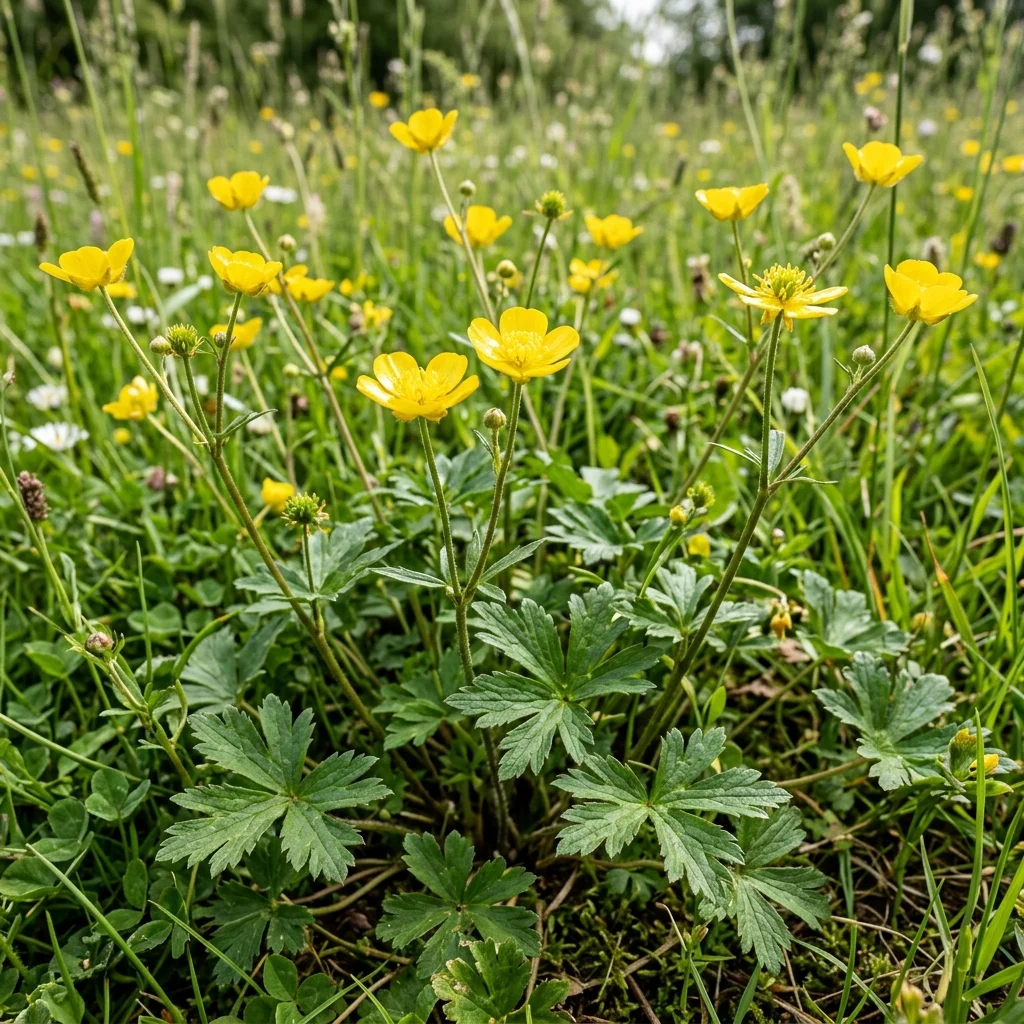
Ranunculus acris

Buttercup Identification & Control

Tall Buttercup, botanically known as Ranunculus acris, is an exceptionally common, highly toxic perennial broadleaf weed in the buttercup family. Native to Europe but thoroughly naturalized globally, it is a major nuisance in cattle pastures, hayfields, and home lawns. Famous for its bright, waxy golden-yellow 5-petaled flowers, every part of the fresh plant is packed with ranunculin, which converts to the highly toxic, blister-causing chemical compound protoanemonin when crushed or chewed, posing a severe hazard to grazing livestock and curious pets.


Sunlight Icon
Sunlight Full Sun to Partial Shade
Watering Icon
Watering Tolerance Moderate to High
Soil Mix Icon
Soil Adaptability Moist Clay / Wet Loam / Wet Poor Soil
Temperature Icon
Growth Temp 8°C - 32°C
Toxicity Danger Icon
Danger / Toxicity Toxic / Blistering Sap / Pet Toxic
Botanical macro photography of Buttercup (Ranunculus acris) - Plant AI care and control database

How to Identify Buttercup

An upright, branched perennial with deeply divided hairy leaves, tall stalks, and brilliant, waxy-golden 5-petaled flowers.

  • Waxy Golden-Yellow Flowers: Bright, glossy, cup-like golden-yellow flowers (2 cm wide) with exactly 5 petals that show a highly distinct waxy sheen.
  • Deeply Divided Hairy Leaves: Palmate green leaves are deeply divided into 3 to 5 narrow, deeply-toothed lobes, covered in rough white hairs.
  • Upright Hollow Stems: Stems are erect, branched, hollow (growing up to 3 feet tall), and covered in stiff, spreading hairs.
💡 Toxic Chemistry: Buttercup sap contains **ranunculin**, which converts to **protoanemonin** when chewed! This caustic compound causes painful mouth ulcers, drooling, and blistering in animals. Fortunately, once dried in hay, the toxin completely breaks down and becomes harmless.

Complete Care & Management Guide

Access highly technical, scientific management directives to control or cultivate Buttercup effectively.

Highly adapted to wet, damp, and poorly drained compacted soils. It thrives in overwatered lawns and damp pasture margins, but survives summer dry spells by tapping deep sub-soil moisture.
Controlled moderately by early cutting. Mowing the weed close to the ground in late spring before the waxy yellow flowers open completely stops seed release.
Thrives in nutrient-poor, highly acidic, and low-oxygen soils. Adding lime to raise soil pH (making it more alkaline) and fertilizing helps turf outcompete it.
Highly versatile. Thrives in Full Sun but exhibits high shade tolerance, allowing it to colonize orchard floors, shaded garden borders, and lawn edges beneath tree canopies.
Prefers moist clay, rich organic loam, and poorly drained high-nitrogen soils. It easily survives in hard-packed wet ground.
Reproduces strictly by seeds. A single plant can produce up to 200 seeds. Seeds have a tough outer coat and can survive dormant in soil for over 40 years.
Extremely cold-hardy perennial. Foliage dies back in harsh winters, but the thick, fibrous root crown survives underground, sprouting new leaves in early spring.
Features a short, branched taproot with a dense network of fibrous lateral roots. It is exceptionally easy to hand-pull due to its shallow root anchor.
Occasionally targeted by aphids, but pests rarely cause significant damage to this highly robust annual grass.
Subject to **Fungal Leaf Spots** and **Downy Mildew** under humid autumn weather, though diseases rarely kill the extensive root crown system.
To control Buttercup organically, slice the fibrous root crown using a sharp hoe 1 inch below the soil surface to kill the plant permanently.

Are your damp pasture margins showing waxy golden flowers or divided hairy leaves?

Slice the fibrous root crown using a sharp hoe, improve clay drainage, and keep grazing pets away.

Diagnose Weed Instantly

Common Diseases & Treatment

Protoanemonin Blistering

Symptoms: Symptoms: Grazing pets chew fresh buttercup, leading to severe drooling, mouth blisters, swelling, and colic.

Action: Action: Emergency veterinary care. Flush the mouth with clean water. The toxin is highly caustic; avoid letting pets consume raw patches.

Saturated Clay Spread

Symptoms: Symptoms: Wet pasture corners are completely overtaken by bright yellow buttercup flowers, choking out grass.

Action: Action: Alleviate waterlogging. Install drainage channels, apply agricultural lime to raise soil pH, and sow competitive grass.

Frequently Asked Questions

Why do Buttercup flowers look so waxy?

The petals of Buttercups have a highly unique, mirror-like waxy layer of flat cells on the surface, backed by a starch layer. This structure reflects yellow light exceptionally strongly, creating the famous glossy, brilliant waxy sheen that attracts bees.

Is Buttercup toxic to horses?

Yes. Fresh Buttercups are highly toxic to horses, sheep, and cattle due to protoanemonin. However, animals usually avoid eating them because they have a highly bitter, burning taste. The main danger is when pastures are overgrazed and no grass is left.

Can I feed dried buttercups to my rabbit?

Yes! Once buttercups are dried (such as in field hay), the toxic protoanemonin compound dimerizes into anemonin, which is completely non-toxic and harmless. Dried hay containing buttercups is safe for livestock and small pets.

What is the best way to get rid of it?

Because it has a shallow fibrous root system, it is very easy to pull out by hand. Manual weeding or close mowing in late spring before the yellow flowers open is the most effective organic control method.

No more dying plants. Grow healthy greens today!

Get Started for Free