Carpetweed Identification & Control
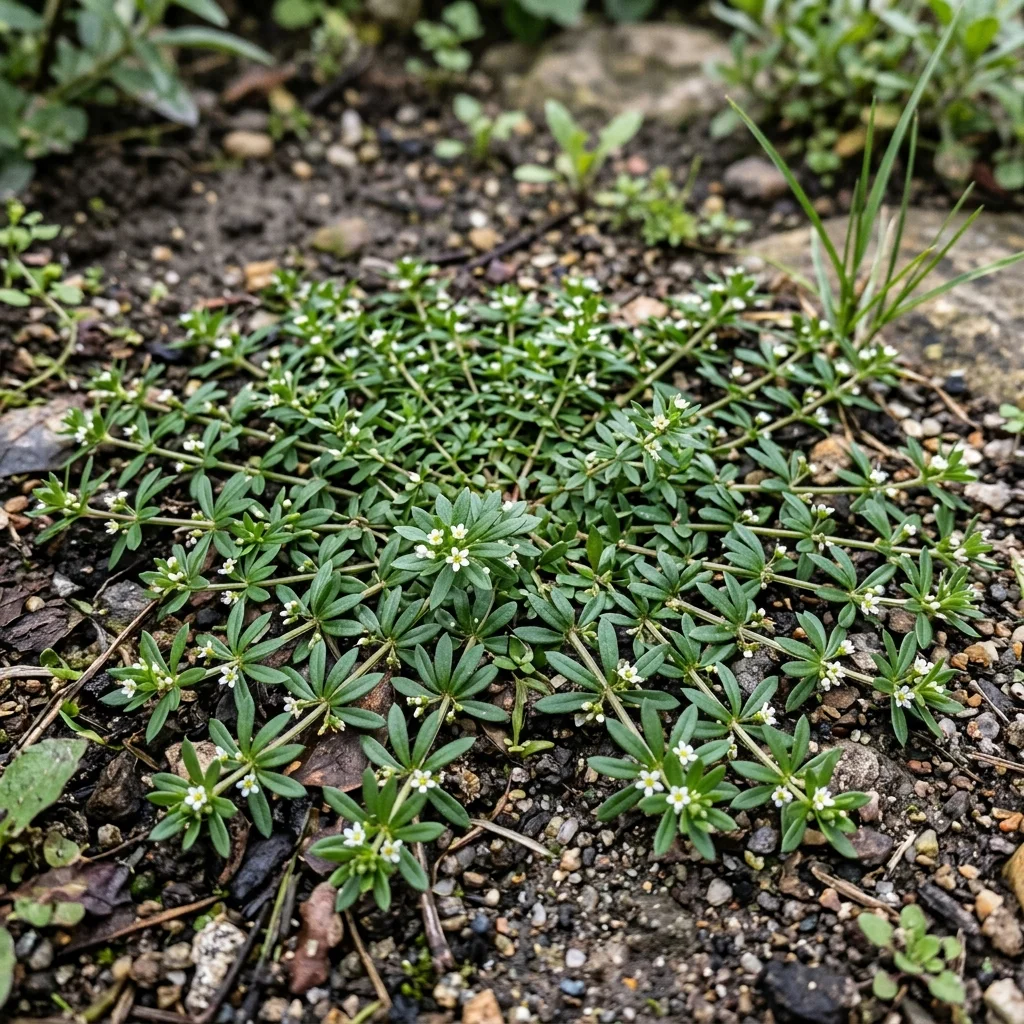
Carpetweed, also known as Indian Chickweed, is a highly common, rapid-growing annual broadleaf weed in the Molluginaceae family. Native to tropical America but thoroughly naturalized across North America, it thrives in sandy soils, dry garden beds, and gravel driveways. It features a unique, highly symmetrical wheel-like growth habit, with narrow leaves arranged in beautiful whorled rosettes flat to the ground, forming dense, carpet-like green mats that cover bare soil.





How to Identify Carpetweed
A flat, prostrate annual with smooth, light-green leaves arranged in symmetrical whorls of 3 to 8 leaves at stem joints, forming circular mats.
-
✔
Symmetrical Leaf Whorls: Smooth, tongue-shaped leaves (1.5 to 3 cm long) are arranged in perfect whorls of 3 to 8 leaves, looking like a green wheel.
-
✔
Smooth Multi-Branched Stems: Light-green or pinkish stems are completely hairless, smooth, and branched, creeping flat along the soil.
-
✔
Tiny White Flowers: Small, star-like white flowers (3 mm wide) sprout in clusters of 2 to 5 from the leaf whorl joints.
Complete Care & Management Guide
Access highly technical, scientific management directives to control or cultivate Carpetweed effectively.
Common Diseases & Treatment
Whorled Node Rooting
Symptoms: Stems form dense circular carpets, choking out turf grass seed germinations in late summer.
Late-Season Seeding
Symptoms: Symmetrical mats dry up in late autumn, dropping thousands of orange-brown seeds into sandbox margins.
Frequently Asked Questions
Why is it called 'Carpetweed'?
It is named Carpetweed because its stems branch out horizontally flat in all directions from a central root, creating a dense, flat, light-green circular mat that literally blankets bare soil like a carpet.
Is Carpetweed toxic to dogs?
No, Carpetweed is completely non-toxic and safe for dogs, cats, and horses. However, it grows very fast and will quickly choke out weak lawn grass if left unchecked.
How can I identify Carpetweed from Chickweed?
Carpetweed is easily identified by its leaves, which grow in unique, flat symmetrical 'whorls' (circles of 3 to 8 leaves) around the stem joints. Chickweed leaves are strictly opposite (pairs of 2) along the stems.
What is the best way to get rid of it?
Because it has a very shallow central taproot and no rooting stolons, it pulls up effortlessly. Grip the center of the rosette and pull; the entire carpet mat will lift out intact. Hoeing or heavy mulching also works perfectly.