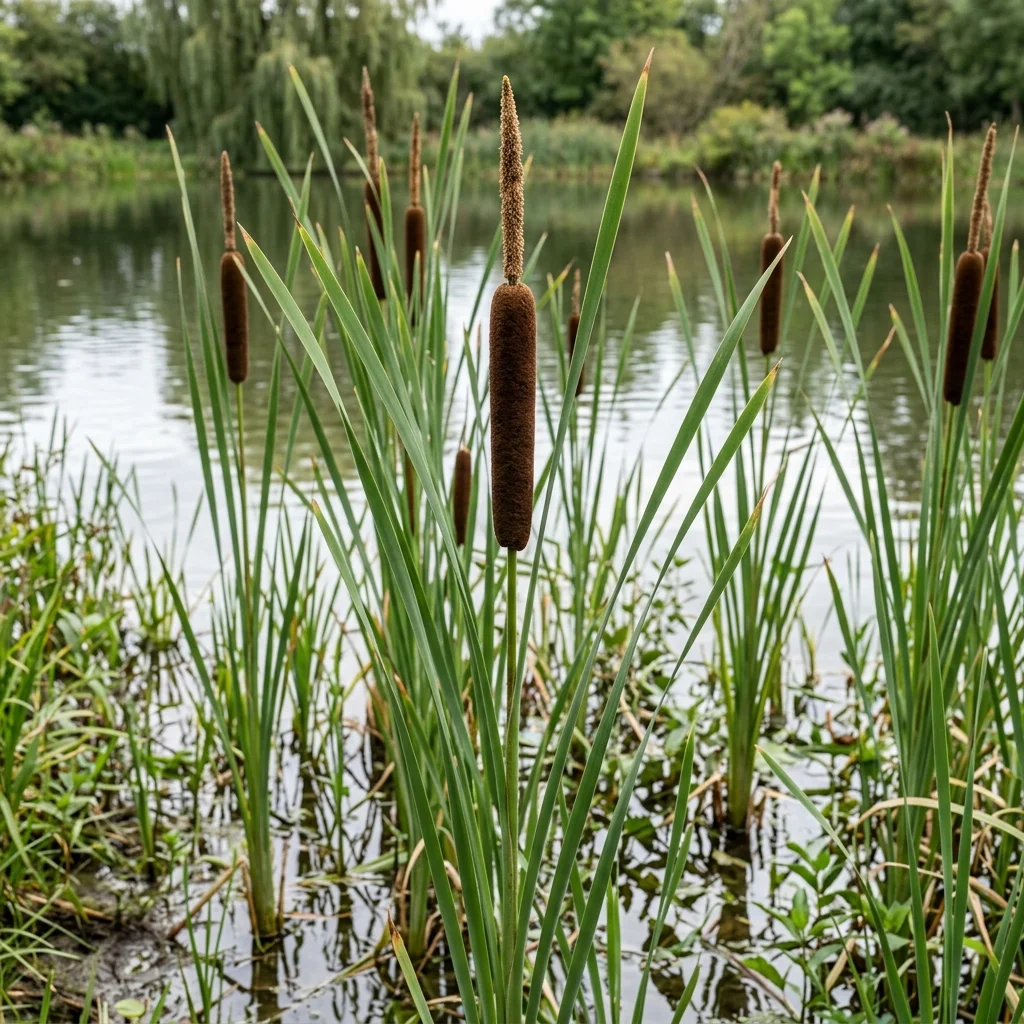
Typha latifolia

Cattail Identification & Control

Cattail, botanically known as Typha latifolia and commonly known as Broadleaf Cattail, is an exceptionally common, highly aggressive perennial aquatic weed in the Typhaceae family. Native to North America and Eurasia, it dominates shorelines, wetlands, and roadside ditches globally. Growing up to 8 feet tall, it features long, flat, sword-like gray-green leaves, and a highly iconic, velvety, dark-brown cylindrical flower spike resembling a 'hot dog'. It spreads relentlessly via a massive network of creeping underground rhizomes, forming dense, exclusive monocultures that choke out native wetland plants.


Sunlight Icon
Sunlight Full Sun
Watering Icon
Watering Tolerance High to Wet
Soil Mix Icon
Soil Adaptability Wet Mud / Saturated Clay / Aquatic
Temperature Icon
Growth Temp 5°C - 38°C
Toxicity Danger Icon
Danger / Toxicity Aggressive Wetland Spreader / Creeping Rhizomes
Botanical macro photography of Cattail (Typha latifolia) - Plant AI care and control database

How to Identify Cattail

A tall, erect wetland perennial up to 8 feet tall with sword-like gray-green leaves and a velvety, dark-brown cylindrical seed spike.

  • Velvet Cylindrical Spike: The iconic, velvety, sausage-like dark-brown spike (up to 20 cm long) composed of thousands of tightly packed female flowers.
  • Sword-Like Gray-Green Leaves: Long, flat, smooth, sword-like leaves (up to 2 cm wide) that grow upright in neat fan-like clusters.
  • Thick Creeping Rhizomes: Features a massive, sprawling network of creeping white starch-rich underground rhizomes.
💡 Wetland Survival: Cattails are the ultimate survival plant! Virtually every part of the plant is edible or useful. The white inner core of the young stems is delicious raw, and the creeping rhizomes can be dried and ground into rich starch flour.

Complete Care & Management Guide

Access highly technical, scientific management directives to control or cultivate Cattail effectively.

Requires consistently saturated, wet, or flooded soils. It is highly adapted to standing water up to 2 feet deep, but its rhizomes survive seasonal dry spells.
Controlled effectively by underwater cutting. Cutting the stalks 3 inches below the water surface in late summer drowns the roots, starving the rhizomes.
An extreme nitrogen and phosphorus accumulator. It actively absorbs fertilizer runoff from agricultural fields, preventing lake eutrophication.
Requires Full Sun. It cannot tolerate shade and will fail to grow under trees, beneath thick garden shrubs, or in dense, shaded lawns.
Prefers organic marsh peat, wet silt, and heavy clay. It does not require loose, highly aerated soils.
Spreads aggressively by creeping stolons and seeds. Stems root at every node touching the soil, while mature seed heads produce thousands of durable seeds.
Extremely cold-hardy perennial. Stems die back and turn completely straw-brown in winter, but the deep black rhizomes sprout fresh shoots in spring.
Features an exceptionally deep, sprawling network of creeping horizontal white rhizomes. Excavation requires slicing the root crown deep below the soil.
Occasionally targeted by aphids, but pests rarely slow its aggressive colonization.
Subject to **Bacterial Wilt** and **Tobacco Mosaic Virus**, serving as a dangerous disease reservoir for garden tomatoes and peppers.
To control Cattail organically in small ponds, manually dig up young rosettes in spring before they flower, use a hoe to scrape seedlings, and mulch garden beds heavily to block seed light.

Are your pond shorelines showing dense green sword leaves or brown hot-dog spikes?

Cut stalks deep below the water surface to drown roots, harvest starch rhizomes, and clear dry winter leaves.

Diagnose Weed Instantly

Common Diseases & Treatment

Wetland Choke Monoculture

Symptoms: Symptoms: Shallow pond edges are completely overtaken by a solid, impenetrable wall of green cattails, blocking water access.

Action: Action: Underwater cutting. Cut the stalks 3 inches below the water surface in late summer. This cuts off oxygen, drowning and killing the rhizomes.

Rhizome Expansion

Symptoms: Symptoms: Cattails aggressively creep into farm ponds and garden margins, cracking thin pond liner membranes with rhizome tips.

Action: Action: Install deep heavy-duty root barrier sheets (at least 24 inches deep) along the pond margin to block creeping rhizome expansion.

Frequently Asked Questions

Why is Cattail so aggressive in wetlands?

It possesses a massive, creeping underground starch-rich rhizome network. Once established, it spreads horizontally, forming dense monocultures that outcompete all native plants.

Are Cattails edible?

Yes! Cattails are famous survival plants. The creeping white rhizomes are rich in starch and can be ground into flour, while the young spring shoot cores taste like cucumber.

How do Cattail seeds disperse?

In autumn, the velvety brown sausage spike dries, splits, and expands into a fluffy white cloud of millions of parachute-like seeds carried miles by wind.

What is the best organic way to control them?

Cut the stalks completely below the water level in late summer before seedheads dry. This deprives the creeping rhizomes of oxygen, effectively drowning the plant.

No more dying plants. Grow healthy greens today!

Get Started for Free