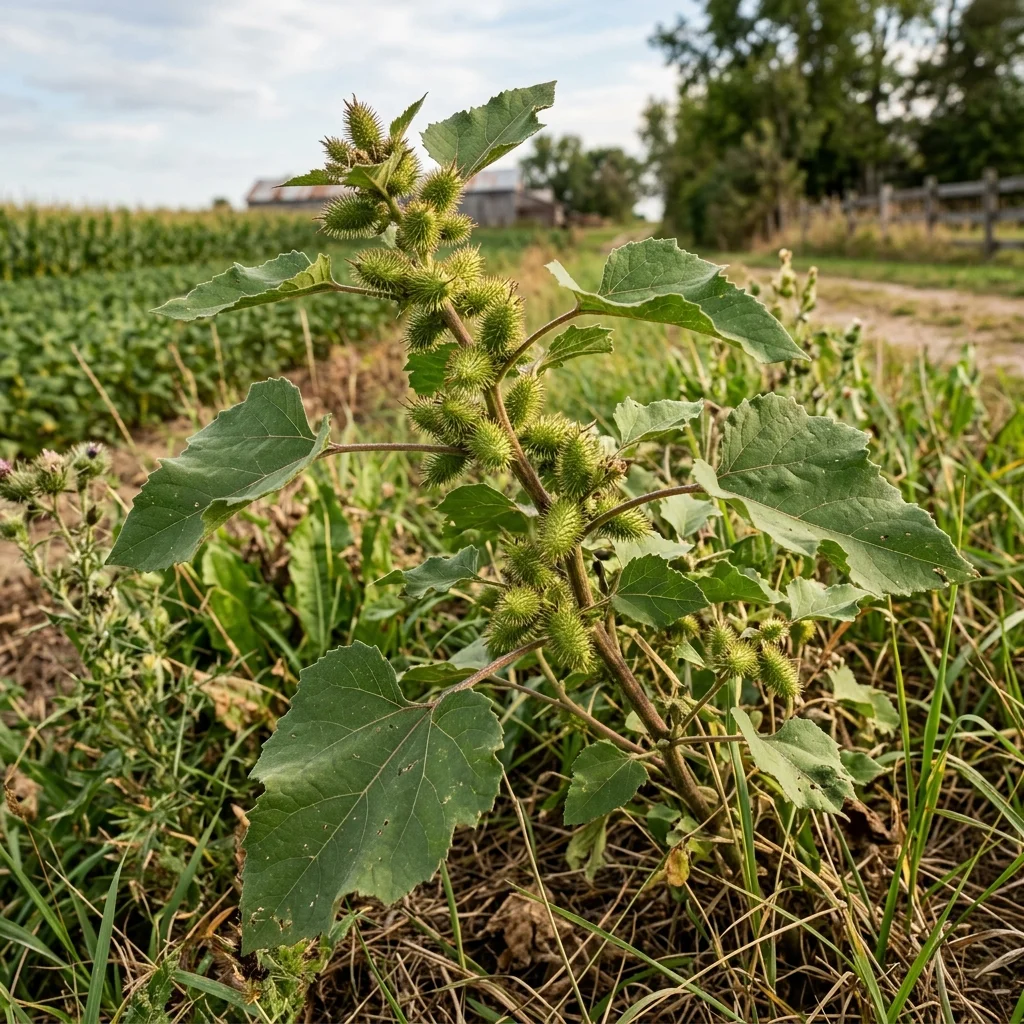
Xanthium strumarium

Cocklebur Identification & Control

Cocklebur (specifically Common Cocklebur) is an exceptionally aggressive, highly toxic summer annual broadleaf weed in the aster family. Native to North America but globally naturalized, it is a major agricultural weed and a severe threat to livestock and domestic pets. It features coarse, branched stems and triangular green leaves, producing exceptionally unique, egg-shaped woody seed burs densely armed with hooked spines that cling stubbornly to animal fur and clothing.


Sunlight Icon
Sunlight Full Sun
Watering Icon
Watering Tolerance Low to Moderate
Soil Mix Icon
Soil Adaptability Any Soil / Loam / Clay / Wet Margins
Temperature Icon
Growth Temp 15°C - 40°C
Toxicity Danger Icon
Danger / Toxicity Highly Toxic / Deadly to Livestock
Botanical macro photography of Cocklebur (Xanthium strumarium) - Plant AI care and control database

How to Identify Cocklebur

An upright annual with rough, purple-spotted stems, coarse triangular leaves, and clusters of woody, spiny seed burs with hooked tips.

  • Spiny Hooked Seed Burs: Oval, woody seed capsules (1.5 to 2.5 cm long) covered in exceptionally stiff, hooked spines, terminating in two distinct, sharp beaks.
  • Rough Triangular Leaves: Large, alternate, coarse green leaves resembling maple or grape leaves, with a highly rough, sandpaper-like texture on both sides.
  • Purple-Speckled Stems: Stout, highly branched stems that are rough to the touch and covered in dark purple-black spots and speckles.
⚠️ FATAL TOXIC WARNING: Cocklebur seedlings and two-leaf sprouts are DEADLY toxic! They contain high concentrations of **carboxyatractyloside**—a highly potent toxin that causes fatal liver failure, seizures, and death in pigs, sheep, cattle, and dogs within 24 hours of ingestion.

Complete Care & Management Guide

Access highly technical, scientific management directives to control or cultivate Cocklebur effectively.

Highly adapted to dry and damp conditions. It grows vigorously in early spring moisture but survives dry spells by accelerating its seeding cycle, producing seeds and dying in summer.
Controlled effectively by mowing. Mowing cuts off the tall, upright seedheads before the heart-shaped pods open, preventing seed dispersal and disrupting its annual lifecycle.
Thrives in nutrient-poor and highly disturbed soils. Regular fertilization helps garden plants grow densely, shading out emerging cocklebur seedlings.
Prefers Full Sun to partial shade. It struggles under dense forest canopies and dense, thick lawn turf shading. Shading lawns suppresses it.
Thrives in newly tilled soils, gardens, crop fields, and roadsides. It easily grows in dry, compacted, or poor soils where other plants struggle.
Reproduces strictly by seeds. A single plant can produce up to 10,000 seeds that can remain viable in the soil for over 50 years.
A summer annual. Germinates in spring, grows rapidly to flower in late summer, and is completely killed by the first winter frost, leaving seeds behind.
Features an exceptionally deep, thick vertical taproot anchored to a massive woody root crown. Complete manual extraction requires a sturdy spade.
Occasionally targeted by cocklebur seed beetles, which feed heavily on the seed heads, acting as a helpful natural biological control.
Highly disease-resistant. It suffers virtually zero structural damage from natural plant diseases, maintaining highly aggressive growth.
To control Cocklebur organically, manually dig up young rosettes in early summer before they develop their tough, woody taproot and bristly seed spikes, and mulch heavily.

Are your yard margins showing coarse triangular leaves or spiny hooked seed burs?

Mow early to cut off seed heads, pull the shallow fibrous roots, and keep dogs away from dry patches.

Diagnose Weed Instantly

Common Diseases & Treatment

Carboxyatractyloside Poisoning

Symptoms: Symptoms: Animals consume young two-leaf seedlings, leading to severe weakness, vomiting, convulsions, and liver failure.

Action: Action: Emergency veterinary care! Immediate administration of activated charcoal and supportive therapy is required.

Bur Clinging Spread

Symptoms: Symptoms: Oval, woody seed capsules cover your pet's fur, causing severe matting and skin irritation.

Action: Action: Cut and remove the seed burs immediately using shears. Avoid walking dogs through dry grassy margins during late summer.

Frequently Asked Questions

Why is Cocklebur so toxic to livestock?

The young seedlings and cotyledons contain carboxyatractyloside, which is a highly potent toxin that blocks mitochondrial energy production. Eating even a small amount of young cocklebur seedlings is fatal to pigs, cattle, and sheep, causing liver necrosis within hours.

How do the seed burs disperse?

The burs are covered in stiff, backward-curved hooks. When an animal or human brushes past the dry plant in autumn, the hooks snag tightly onto fur, wool, or clothing, carrying the seeds long distances before dropping.

Does Cocklebur have any uses?

Despite its high toxicity, Cocklebur (known as Cang Er Zi in Chinese medicine) has been used for centuries in traditional herbalism to treat nasal congestion, sinusitis, and skin itch. *WARNING*: Never ingest wild cocklebur due to severe toxicity risks.

What is the best way to eradicate Cocklebur organically?

Wear thick leather gloves. Hand-pull young plants in early summer before the spiny burs develop. Because it is a summer annual, cutting the plants down before they flower completely breaks the annual seed cycle.

No more dying plants. Grow healthy greens today!

Get Started for Free