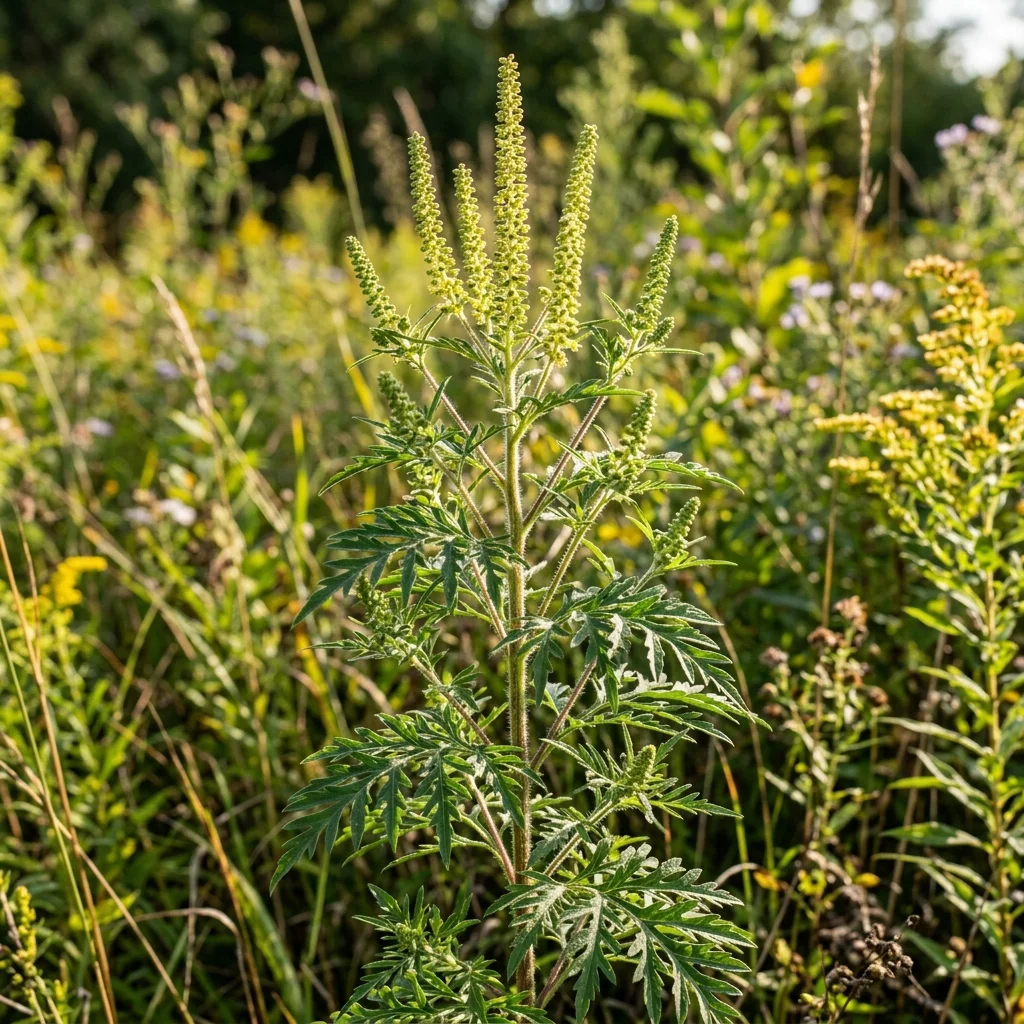
Ambrosia artemisiifolia

Common Ragweed Identification & Control

Common Ragweed is an exceptionally notorious, highly aggressive summer annual broadleaf weed in the aster family. Native to North America, it has successfully colonized agricultural fields, thin lawns, and roadsides globally. Famed as the primary culprit behind seasonal allergies, a single mature plant can produce up to 1 billion grains of wind-dispersed pollen, triggering severe hay fever and asthma attacks in millions of allergy sufferers every autumn.


Sunlight Icon
Sunlight Full Sun
Watering Icon
Watering Tolerance Low to Moderate
Soil Mix Icon
Soil Adaptability Any Soil / Compacted Clay / Sandy / Poor Soil
Temperature Icon
Growth Temp 12°C - 38°C
Toxicity Danger Icon
Danger / Toxicity Severe Allergy / Airborne Pollen
Botanical macro photography of Common Ragweed (Ambrosia artemisiifolia) - Plant AI care and control database

How to Identify Common Ragweed

An upright annual grass-like broadleaf weed with fern-like, deeply divided green leaves, hairy stems, and spikes of green male flowers releasing yellow pollen.

  • Fern-Like Divided Leaves: Leaves are opposite, deeply divided, lacy, and fern-like (5 to 10 cm long), covered in fine hairs and completely hairless on top.
  • Hairy Branched Stems: Stems are upright, highly branched, and covered in dense, stiff, white hairs, growing up to 3 to 5 feet tall.
  • Green-Yellow Pollen Spikes: Male flowers are small, cup-shaped, and clustered in long upright spikes at the top of stems, releasing bright yellow pollen dust.
⚠️ Allergy Alert: Common Ragweed pollen is a severe allergen! A single plant can release **1 billion pollen grains** per season. The pollen is so light it can travel up to 400 miles out to sea, causing seasonal hay fever (allergic rhinitis).

Complete Care & Management Guide

Access highly technical, scientific management directives to control or cultivate Common Ragweed effectively.

Extremely drought-tolerant. It thrives in bone-dry gravel roadsides and parched pasture hills, surviving dry summers easily due to its deep fibrous root system.
Controlled effectively by mowing. Mowing the weed close to the ground in mid-summer before the green-yellow flower spikes open completely stops pollen and seed release.
Highly aggressive. It actively steals high levels of soil nutrients, outcompeting pasture grasses and garden flowers. Improving lawn density is key.
Requires Full Sun. It cannot tolerate shade and will fail to grow under a dense forest canopy or beneath competitive garden shrub shading.
Adapts to sandy, clay, sterile rocky slopes, compacted gravel roadsides, and disturbed soils. It does not require rich soil.
Spreads aggressively strictly by seeds. A single plant can produce up to 60,000 seeds that can remain viable in the soil for over 40 years.
A summer annual. Germinates in spring, grows rapidly to flower in late summer, and is completely killed by the first winter frost, leaving seeds behind.
Features a shallow, tough, fibrous root system anchored to a short central crown, making manual hand-pulling very easy when young.
Occasionally targeted by ragweed leaf beetles (*Zygogramma suturalis*), which feed heavily on the leaves, acting as a helpful natural biological control.
Subject to **Powdery Mildew** and **Downy Mildew** under humid autumn weather, though diseases rarely kill the plant before it successfully seeds.
To protect yourself and your family from autumn allergies, hand-pull or mow down ragweed plants in mid-summer (July) *before* the yellow-green flower spikes can bloom and release pollen.

Are your yard margins showing fern-like leaves or releasing yellow pollen dust?

Mow early to cut off pollen spikes, hand-pull the shallow fibrous roots in early summer, and wear a mask.

Diagnose Weed Instantly

Common Diseases & Treatment

Pollen Explosion

Symptoms: Symptoms: Tall, green-yellow flower spikes release massive clouds of fine yellow dust under wind in late August.

Action: Action: Hand-pull immediately wearing a dust mask. Dispose of the weed in trash bags to prevent pollen and seed spread near homes.

Hay Fever Trigger

Symptoms: Symptoms: Severe sneezing, itchy watery eyes, runny nose, and asthma flare-ups appearing in family members during autumn.

Action: Action: Eradicate all ragweed plants within a 100-foot radius of the home in early summer before they have a chance to flower.

Frequently Asked Questions

Is Ragweed the same as Goldenrod?

No! This is a highly common mistake. Goldenrod (Solidago) has showy, bright golden-yellow flowers that attract insects, and its heavy pollen is not airborne. Ragweed has inconspicuous green flowers, light wind-blown pollen, and is the true cause of hay fever.

Why does my nose itch in autumn?

It is highly likely caused by airborne Ragweed pollen. Because ragweed pollen grains are exceptionally light, dry, and produced in billions, they float on the wind for miles, easily entering your nasal passages and triggering allergic rhinitis.

Can I get a skin rash from touching Ragweed?

Yes. Some sensitive individuals develop mild contact dermatitis (redness, itching, small bumps) from physically handling the hairy leaves and stems of Ragweed. It is best to wear gloves.

What is the best way to get rid of it?

Because it has a shallow fibrous root system, it is very easy to pull out by hand. Manual weeding or close mowing in mid-summer before the flower stalks open is the most effective organic control method.

No more dying plants. Grow healthy greens today!

Get Started for Free